


ASUS Gallop Humanoid Targets 99.5% Packing in 20 Seconds

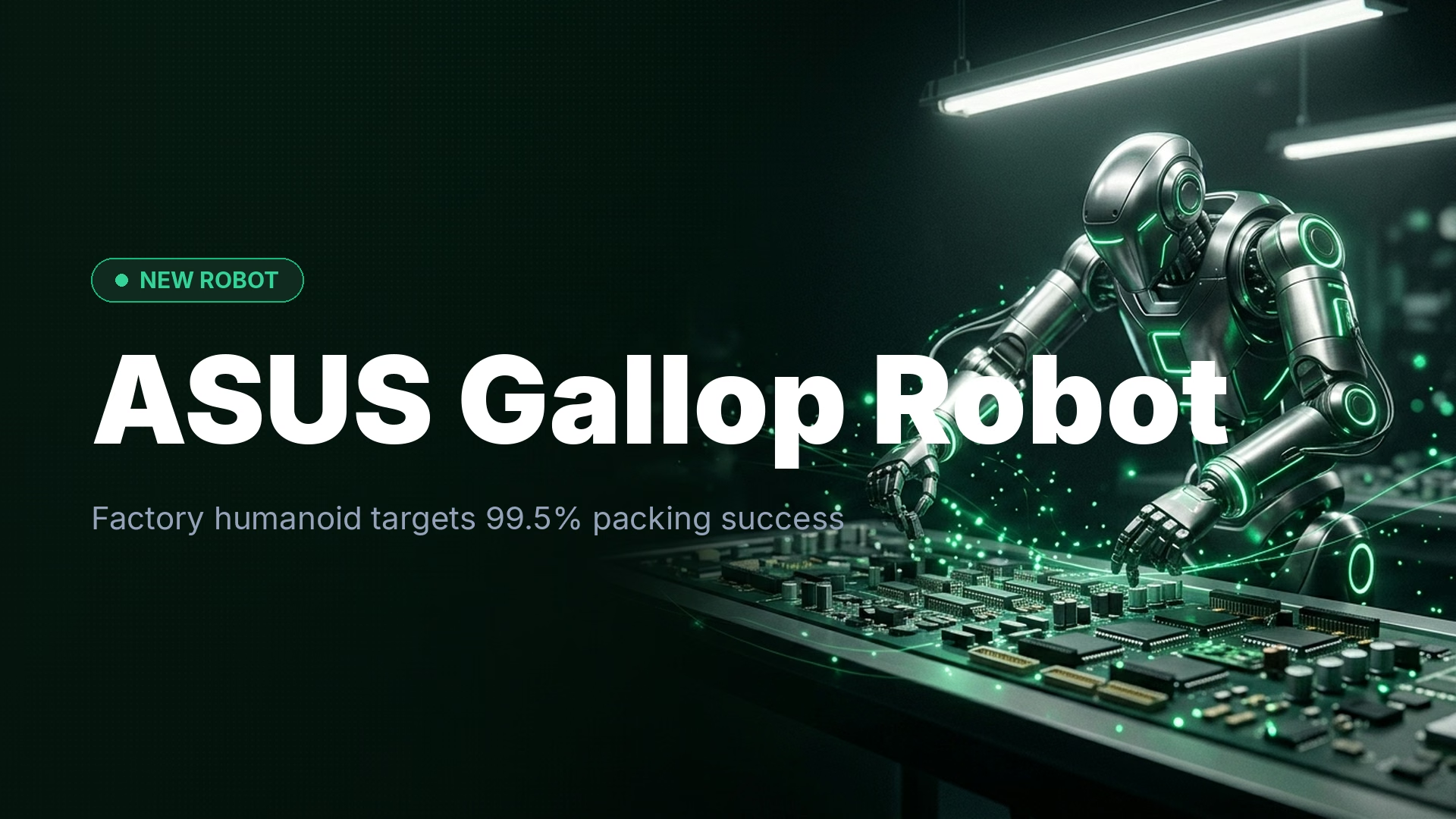
ASUS on November 13, 2026 detailed Gallop, its first humanoid robot designed to perform pick-and-place tasks on electronics production lines. The two-armed, fixed-base system is currently learning to pack 15 motherboard accessories per unit, with ASUS setting a performance target of 99.5% success within 20 seconds per board. The robot represents the company's entry into physical AI, leveraging its existing manufacturing infrastructure to develop a platform that can operate at human-equivalent speed and accuracy on factory floors designed for people.
Four-Layer Software Architecture for Factory Tasks
Gallop runs on a single NVIDIA Jetson AGX Thor computer and uses a four-layer software stack designed for modularity and real-world adaptability. The top planner layer interprets the scene and breaks jobs into discrete steps. A second AI supervisor layer monitors each step and triggers replanning when problems occur. The skills layer handles fundamental robotic operations like reaching, grasping, and placing objects, while the control layer manages precise arm and hand movements with built-in safety stops. ASUS designed fixed interfaces between these layers to allow individual AI model upgrades without requiring full system redesigns.
Worker-Guided Training with VR and Camera Demos
ASUS trains Gallop using demonstrations from experienced factory workers who wear head-mounted cameras with their consent. These recordings capture how tasks are actually performed in production environments, providing ground-truth data that simulation systems then use to generate training variations. Operators wearing VR headsets and gloves guide the robot through practice sessions using the same parts, cameras, and workstation configurations deployed on the real line. Once the robot moves to production testing, its operational recordings feed back into the training pipeline, creating a continuous learning loop grounded in actual station requirements and quality standards.
Hardware Design and In-House Component Development
The current Gallop configuration uses a fixed base and two arms optimized for stationary pick-and-place work. ASUS designs the robot's body and a touch-sensing dexterous hand internally, sourcing motors and standard components from established robotics partners. The in-house hand has not yet been integrated into the production test units. ASUS plans to integrate that hand and add wheels to create a mobile version for demonstration at Computex 2027. The company's rationale for the humanoid form centers on compatibility with existing factory infrastructure: arms and hands can use workstations, tools, and trays designed for human workers without requiring facility redesigns.
Planned Timeline and Customer Pilots
ASUS will show Gallop to customers at Computex 2027, where customer pilot programs are also scheduled to begin. Officially launched on November 13, 2026, the robot is currently undergoing factory line testing at ASUS's own electronics manufacturing facilities. Market availability is targeted for the second half of 2028, contingent on successful pilot validation. The company positions electronics manufacturing as the initial market, with potential later applications in hospitals and service environments once pick-and-place skills demonstrate transferability across different job types.
What This Means for Factory Automation
ASUS's approach emphasizes data from real production environments over proprietary foundation models, using its manufacturing footprint as a test lab that most robotics startups must rent externally. The 99.5% success rate within 20 seconds mirrors the performance standard ASUS applies to human workers on the same stations, framing the robot as a solution for repetitive, physically demanding roles that are difficult to staff rather than a wholesale worker replacement. The pilot phase will determine whether learning from skilled workers and station-specific operational data can sustain factory quality and pace through daily operation, which ASUS has set as the threshold for broader deployment. Employees who demonstrate tasks are expected to transition into roles setting up, supervising, and improving robotic systems.


on Emergent today


