


BotPsy: Sub-Billion-Parameter On-Device Assistant Launches

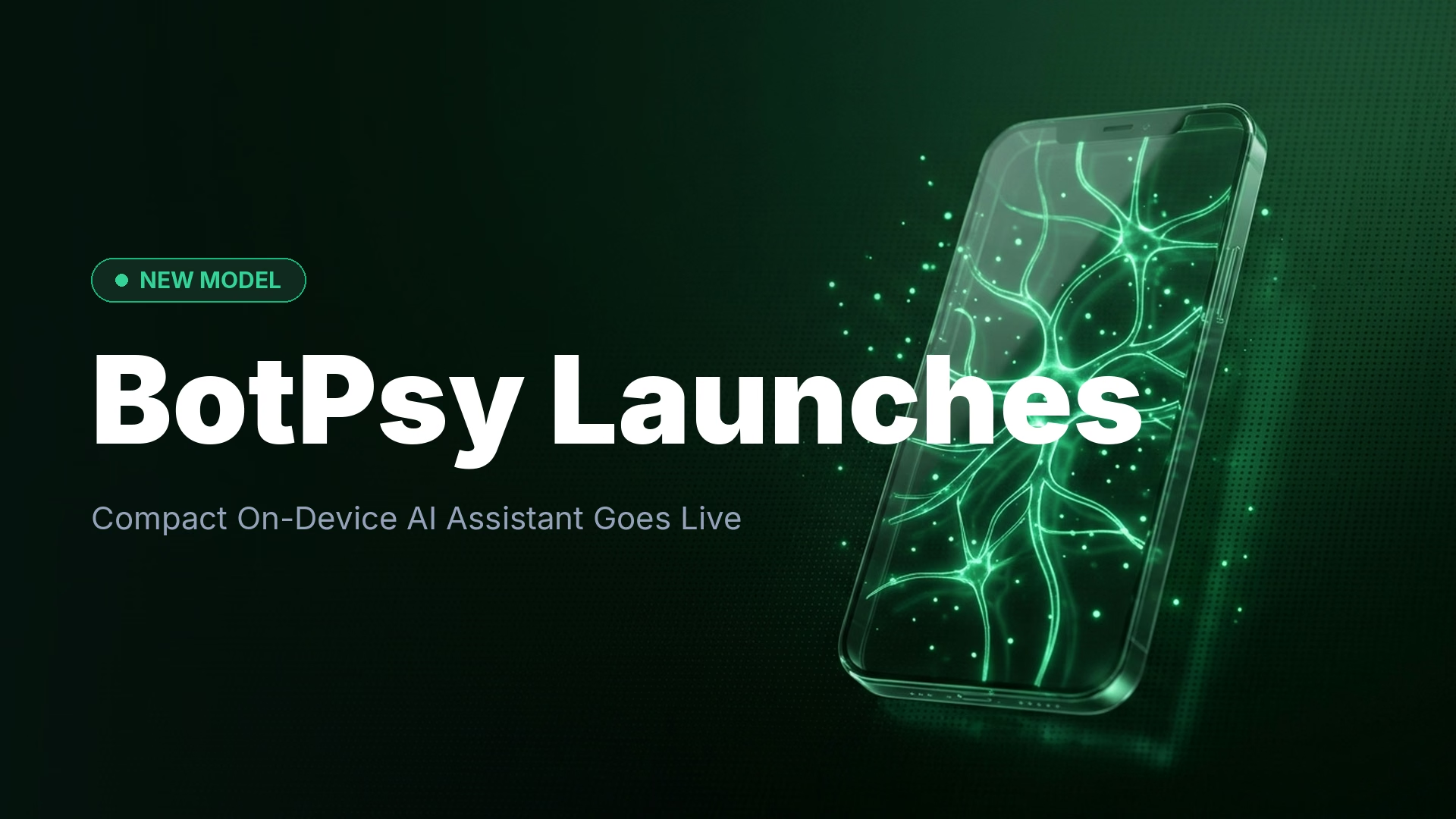
BotPsy has officially launched as an on-device personal assistant powered by a sub-billion-parameter agentic language model, marking a significant shift toward privacy-first AI deployments. Released today on Hugging Face by the QVAC research team, the model delivers conversational assistance entirely on-device without requiring cloud connectivity or external servers.
Compact Architecture for Edge Deployment
The sub-billion-parameter design enables BotPsy to run on consumer smartphones and tablets with limited computational resources. Unlike cloud-dependent assistants that transmit user queries to remote servers, BotPsy processes all interactions locally, eliminating network latency and reducing privacy risks. The model's compact footprint represents a practical breakthrough for edge AI applications where bandwidth constraints or data sovereignty requirements make cloud deployment impractical.
The agentic architecture allows BotPsy to handle multi-turn conversations, task planning, and context retention across sessions. Developers can integrate the model into mobile applications, IoT devices, or offline environments where continuous internet access is unavailable or undesirable.
Privacy-First Design Philosophy
By processing all data on the user's device, BotPsy ensures that sensitive personal information never leaves the local environment. This architecture addresses growing regulatory pressures around data localization and user consent, particularly in healthcare, finance, and enterprise contexts where confidentiality is paramount. The model's open weights on Hugging Face enable security audits and custom fine-tuning for domain-specific deployments.
Organizations concerned with GDPR, HIPAA, or CCPA compliance gain a deployment option that minimizes data exposure while maintaining functional assistant capabilities. The local-first approach also eliminates subscription dependencies and usage metering common in cloud AI services.
Release Date and Availability
BotPsy was officially launched on November 11, 2026, with full model weights and inference code available through the Hugging Face Model Hub. The release includes documentation for iOS, Android, and embedded Linux deployments, along with benchmark comparisons against cloud-based alternatives. Developers can download the model immediately for research, commercial integration, or custom training on proprietary datasets.
The QVAC team has published reference implementations demonstrating real-time inference on mid-range mobile hardware, with latency measurements below 200 milliseconds for typical assistant queries. Community contributions for optimization and additional language support are already underway in the project repository.
What This Means
BotPsy's launch validates the viability of sophisticated AI assistance without cloud infrastructure, offering a roadmap for privacy-conscious deployments across consumer and enterprise markets. As regulatory scrutiny of data handling intensifies and edge hardware capabilities improve, compact agentic models like BotPsy may accelerate the shift toward decentralized AI architectures. The open release empowers developers to build next-generation personal assistants that respect user autonomy while delivering practical utility in offline or bandwidth-constrained environments.
on Emergent today


