


Can Elon Musk Really Put AI Datacenters in Space?

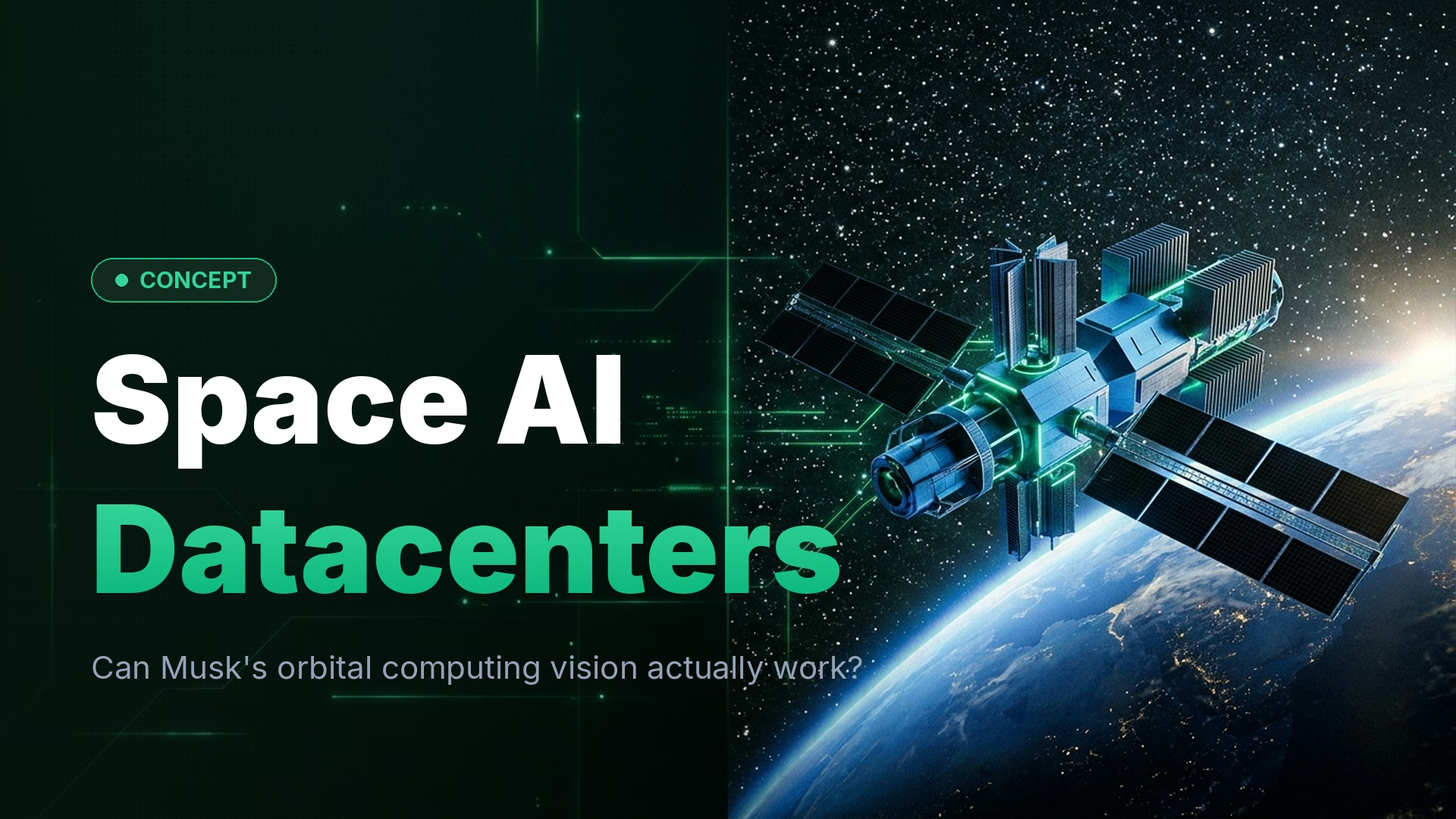
Elon Musk has reportedly floated the idea of deploying AI datacenters in orbit, leveraging SpaceX's launch capabilities to bypass terrestrial power grid limitations and thermal management challenges. While the concept sounds like science fiction, industry observers are debating whether the technical and economic hurdles make this a viable path for scaling compute infrastructure in the AI era.
The Orbital Datacenter Concept
According to sources familiar with discussions inside xAI and SpaceX, Musk has explored using modified Starship cargo modules to house GPU clusters in low Earth orbit. The rationale centers on three advantages: unlimited solar power availability, radiative cooling in the vacuum of space, and potential reduction in real estate and regulatory constraints tied to ground-based facilities. Proponents argue that as AI training runs demand exponential compute growth, space offers a frontier unconstrained by Earth's power grid capacity or water scarcity for cooling systems.
However, thermal engineers point out that radiative cooling in space is far less efficient than convection-based systems on Earth. Without air or liquid to carry heat away, dissipating megawatts of GPU waste heat requires massive radiator arrays, adding significant mass and complexity to any orbital design.
Technical Barriers and Feasibility
The primary obstacles include latency, power generation, and launch economics. AI inference workloads serving real-time applications require sub-100 millisecond response times, but even low Earth orbit introduces 20 to 40 milliseconds of round-trip signal delay. Training workloads are less latency-sensitive, but synchronizing multi-node distributed training across orbital and ground infrastructure presents novel engineering challenges.
- Power generation: Solar arrays can provide continuous energy in sun-synchronous orbits, but energy storage for eclipse periods adds weight and cost.
- Cooling: Radiators must be sized to dissipate heat loads, with surface area requirements potentially exceeding the datacenter footprint itself.
- Launch costs: Even with reusable Starship rockets, lifting thousands of GPUs and supporting infrastructure remains capital-intensive compared to building terrestrial facilities.
SpaceX's vertical integration and launch cadence could reduce per-kilogram costs below $1,000 by late 2026, making experimental deployments plausible for research purposes if not yet economically competitive with hyperscale ground datacenters.
Rumored Timeline and Strategic Intent
Industry watchers expect Musk to test a proof-of-concept module with limited compute capacity. Rumored to release on an unspecified 2026 timeline, such a demonstration would likely focus on validating thermal management and long-duration operation rather than achieving cost parity with Earth-based facilities. xAI's growing compute demands for Grok model training could justify experimental infrastructure if regulatory or energy constraints tighten in key markets.
Some analysts view the space datacenter narrative as strategic positioning, signaling to investors and regulators that AI labs have alternatives if terrestrial expansion faces bottlenecks. Whether Musk pursues full-scale deployment or uses the concept as leverage in energy policy discussions remains unclear.
What This Means
While orbital AI datacenters face formidable technical and economic challenges, Musk's track record of turning ambitious concepts into operational systems keeps the idea within the realm of possibility. For now, the proposal underscores the escalating appetite for compute resources in AI development and the creative lengths labs may explore to secure future capacity. Whether space-based infrastructure becomes reality or remains a thought experiment, the discussion highlights how rapidly AI's resource demands are outpacing conventional infrastructure planning.



on Emergent today


