


Claude Cloud Agents GitHub Limitations Explained

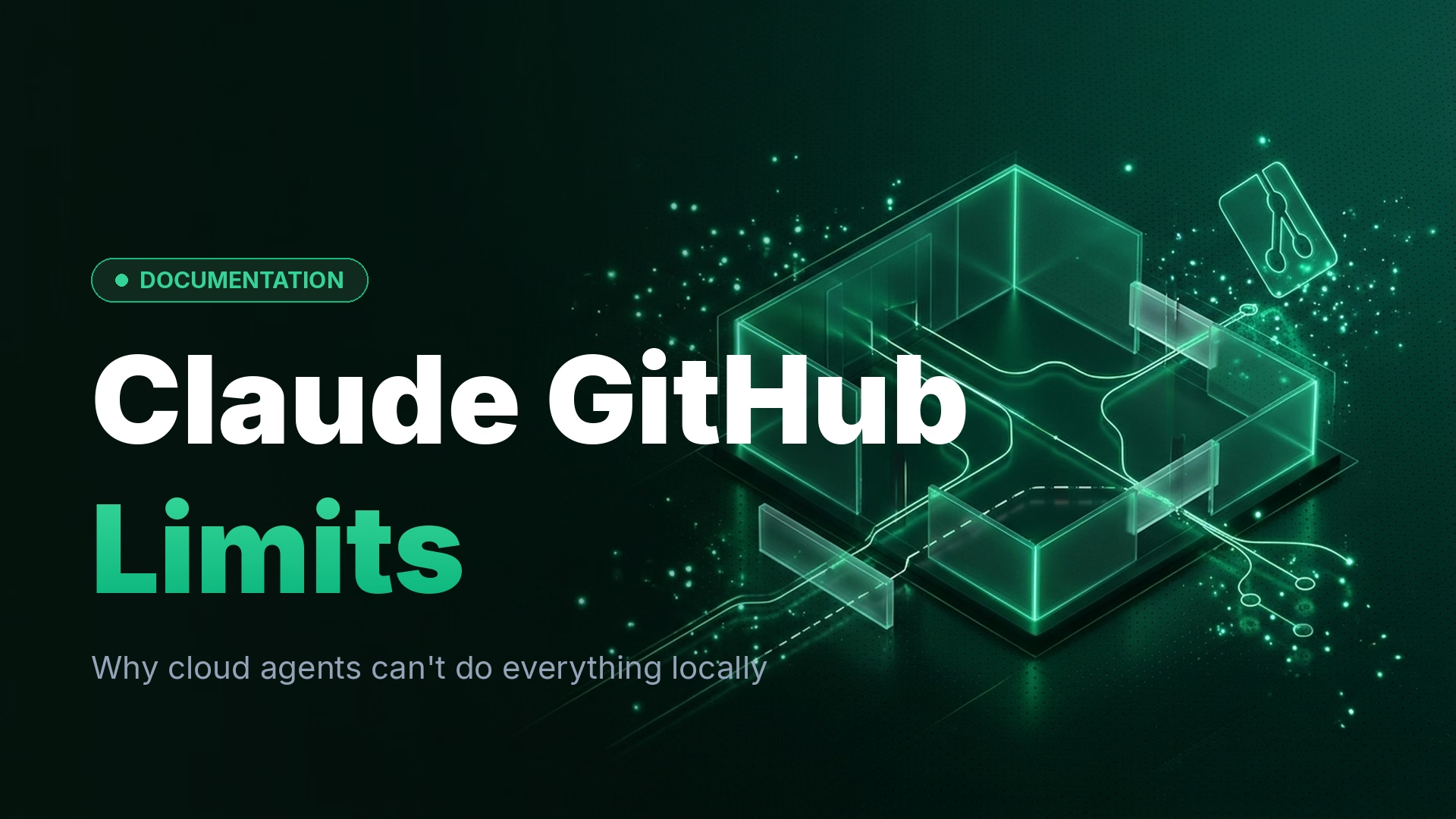
Anthropic's Claude cloud agent environments impose deliberate constraints on GitHub operations, a security-by-design decision that prevents arbitrary network access from hosted execution contexts. The official documentation now details which repository interactions work in cloud sandboxes and which require local execution modes, clarifying a common friction point for developers building automated workflows.
Network Isolation in Cloud Agent Environments
Claude's hosted agent infrastructure runs code in isolated containers with restricted outbound network access. This architecture blocks direct connections to GitHub's API endpoints, preventing operations like repository cloning over HTTPS, webhook registration, and authenticated API calls. The sandbox model prioritizes security over convenience, ensuring user code cannot exfiltrate credentials or access unauthorized external services.
Local execution modes bypass these restrictions entirely. When Claude agents run on a developer's machine rather than Anthropic's infrastructure, they inherit the host system's network stack and credential stores, enabling full GitHub integration through standard Git protocols and SSH keys.
What Works and What Doesn't
Operations that function in cloud environments include read-only actions on public repositories accessible without authentication, basic Git diff parsing from uploaded file content, and code analysis tasks that don't require live repository access. Agents can process GitHub webhook payloads forwarded through approved channels and generate pull request templates or issue responses as structured text output.
- Cloning private repositories fails due to credential isolation policies
- GitHub API calls requiring OAuth tokens are blocked by network filters
- Webhook endpoints cannot be dynamically registered from cloud contexts
- Git push operations to remote repositories are prohibited in sandboxed environments
The documentation recommends pre-fetching repository snapshots or using GitHub Actions integration patterns for workflows requiring write access to version control systems.
Officially Launched on November 3, 2026
Anthropic released the cloud environments documentation update today, addressing developer questions that surfaced in community forums over the past quarter. The guidance formalizes architectural decisions made during the initial cloud agent rollout and provides migration paths for teams hitting GitHub integration walls.
Workarounds and Configuration Options
Developers can configure explicit allowlists for trusted domains in enterprise Claude deployments, though this requires coordination with Anthropic's infrastructure team. A hybrid approach runs Git operations locally while delegating code generation and review tasks to cloud agents, splitting the workflow across execution contexts.
Third-party bridge services now offer GitHub proxy APIs that sanitize requests and responses, functioning as a controlled intermediary between cloud agents and version control platforms. These services handle credential management and audit logging while exposing a restricted subset of GitHub functionality to sandboxed environments.
What This Means
The documentation update clarifies that Claude's cloud agent model trades full GitHub integration for stronger security guarantees in multi-tenant execution environments. Teams requiring unrestricted version control access must either adopt local execution modes or architect workflows around the documented constraints. As cloud agents mature, expect Anthropic to introduce more granular permission models that balance automation capabilities with isolation requirements, potentially including scoped credential delegation and audited network policies for enterprise customers.

on Emergent today


