


Claude Code Projects Now Run Parallel AI Workers Hands-Free

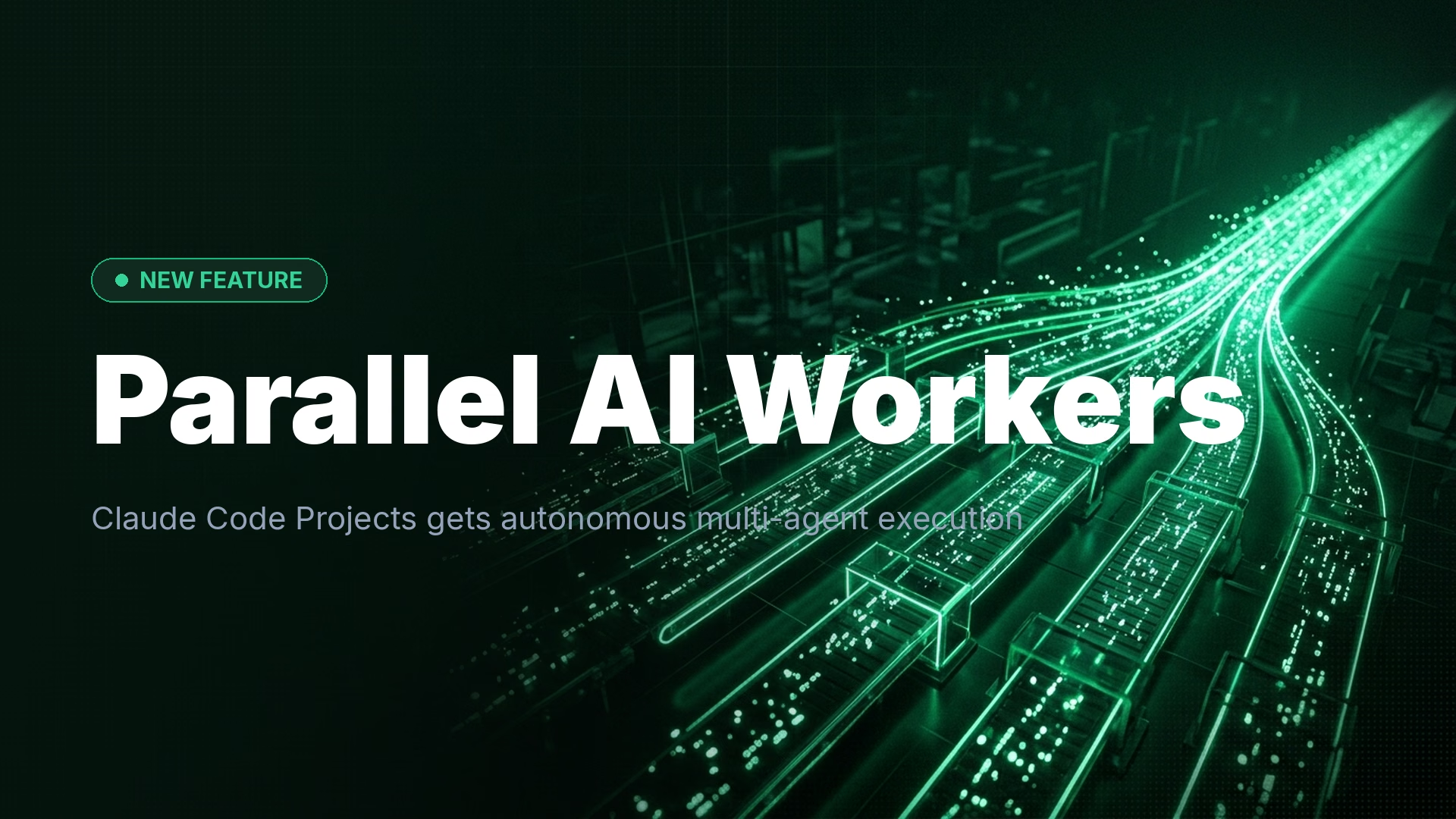
Anthropic has upgraded Claude Code Projects with parallel AI worker execution, enabling multiple autonomous agents to collaborate on development tasks without manual coordination. The feature, officially launched on November 14, 2026, represents a significant shift from sequential agent workflows to true parallel multi-agent systems that can divide work, execute simultaneously, and merge results independently.
How Parallel Workers Change Development Workflows
The new parallel execution model allows Claude Code Projects to spawn multiple workers that operate concurrently on different aspects of a codebase. Unlike previous sequential approaches where developers manually queued tasks, the system now automatically distributes work across agents based on dependency analysis and task complexity. Each worker maintains its own context window while sharing project state through a coordination layer that prevents conflicts and ensures consistency.
Developers can define high-level objectives and watch as parallel workers split implementation into logical units, execute in parallel across frontend components, backend services, and testing suites, then integrate changes through automated merge strategies. The system handles race conditions, resource contention, and inter-agent communication without requiring explicit orchestration code.
Technical Architecture and Coordination
The parallel worker infrastructure uses a distributed task scheduler that analyzes project structure and dependencies to generate execution plans. Workers communicate through a shared event bus that tracks state changes, file modifications, and completion signals. When conflicts arise, the coordination layer pauses affected workers, resolves differences through contextual analysis, and resumes execution with updated state.
- Workers operate in isolated sandboxes with read-write access to designated project areas
- Real-time synchronization prevents merge conflicts through predictive locking
- Automatic rollback mechanisms handle failures without corrupting shared state
- Context sharing allows workers to reference each other's outputs mid-execution
Release Date and Availability
The parallel worker feature was officially released on November 14, 2026, as part of the Claude Code Projects platform upgrade. Anthropic rolled out the capability to all existing Projects users through automatic backend updates, requiring no client-side changes or opt-in configuration. The feature works across all supported project types, including web applications, API services, data pipelines, and infrastructure-as-code repositories.
Impact on Agent-Driven Development
The shift to parallel execution addresses a core bottleneck in AI-assisted development: the sequential nature of single-agent workflows. By enabling true parallelism, Claude Code Projects can now tackle larger codebases and more complex refactoring tasks that previously required human intervention to partition work. Early testing shows parallel workers reduce development time for multi-component features by 40 to 60 percent compared to sequential agent execution.
The coordination layer also learns from execution patterns over time, improving task distribution and conflict prediction as developers use the system. Workers can now handle interdependent changes across microservices, simultaneously update frontend and backend code for API contract changes, and parallelize test suite execution while maintaining logical consistency.
What This Means
Anthropic's parallel worker upgrade positions Claude Code Projects as a true multi-agent development platform rather than an enhanced code assistant. The hands-free coordination model removes a major friction point in agent-driven workflows, where developers previously spent significant time managing task queues and resolving conflicts between sequential agent runs. As AI coding tools evolve toward autonomous systems, parallel execution infrastructure becomes table stakes for handling production-scale complexity without constant human oversight.


on Emergent today


