


Factory Droid 1.0: Model-Independent Coding Agent Harness

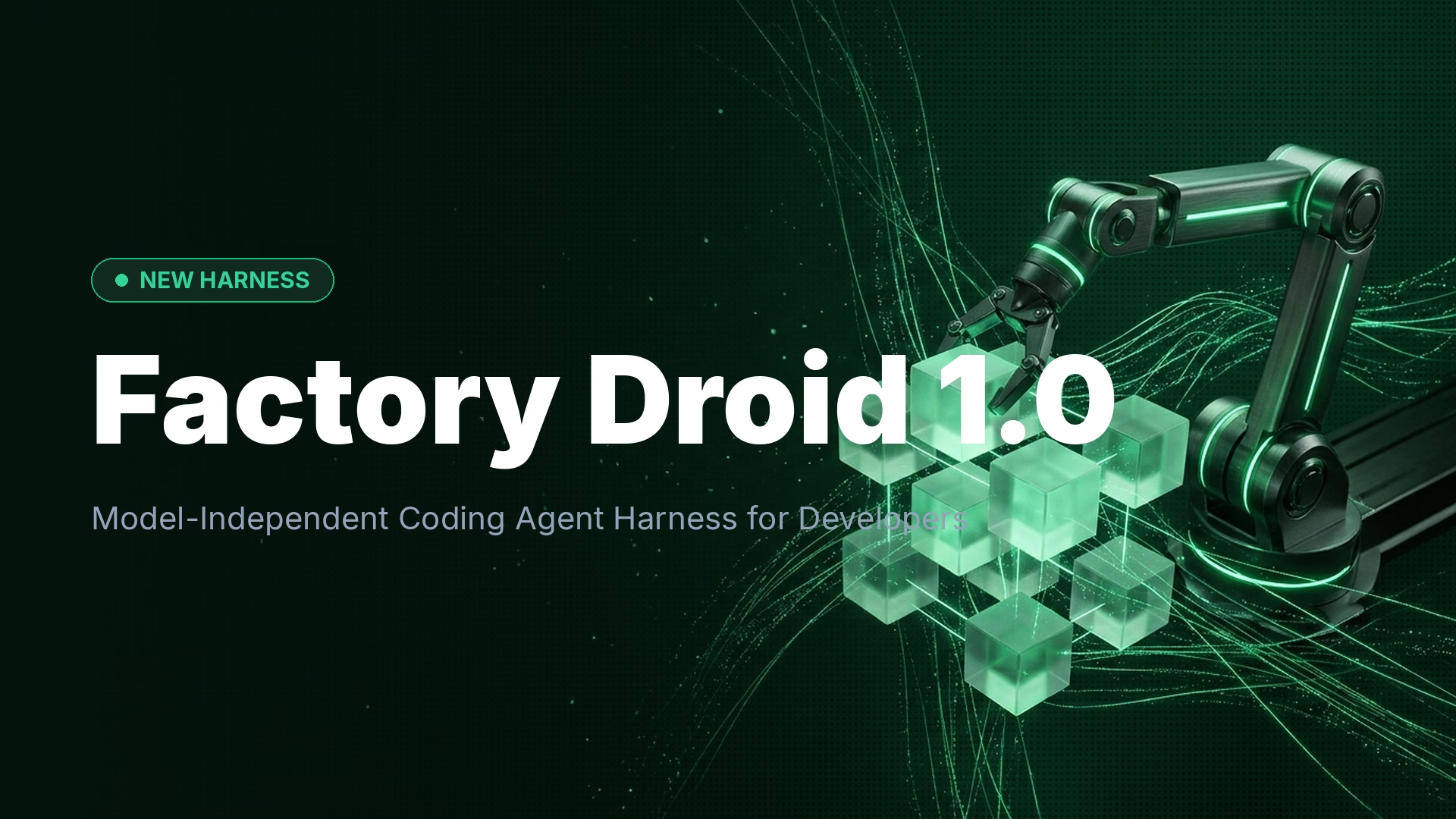
Factory has officially launched Droid 1.0, a model-independent coding agent harness designed to replace traditional text-based agentic loops with programmatic script-mode tool calling. The new harness prioritizes deterministic execution and cost efficiency, offering developers a drop-in framework that works with any foundation model. Internal benchmarks show Droid 1.0 achieving 65.2 percent on Terminal-Bench 4 when paired with Claude Opus 5.5, at a per-task cost of $4.73.
Release Date and Availability
Factory Droid 1.0 was officially released on October 31, 2026. The harness is available now for integration into production workflows, distributed as an open framework that supports multiple language models. Developers can plug in their preferred foundation model without modifying the core harness logic, making it a flexible choice for teams already committed to specific LLM vendors.
What Makes Droid 1.0 Different
Most coding agents rely on iterative text-based loops where the model generates natural language commands, the system parses them, and the cycle repeats. Droid 1.0 inverts this pattern by treating programmatic tool calls as the default mode. The harness exposes a structured API for file operations, shell commands, and environment inspection, letting the model invoke these tools directly through function signatures rather than through free-text instructions.
This script-mode architecture reduces token overhead, eliminates parsing ambiguity, and shortens the feedback loop between the model and the execution environment. Factory reports that the deterministic tool interface cuts latency by reducing the number of round trips required to complete multi-step coding tasks.
Terminal-Bench 4 Performance
Factory evaluated Droid 1.0 using Terminal-Bench 4, a benchmark suite that tests coding agents on real-world terminal tasks including file manipulation, dependency installation, test execution, and debugging workflows. When paired with Claude Opus 5.5, Droid 1.0 achieved a 65.2 percent pass rate across the benchmark's task set.
The cost per passed task came in at $4.73, a metric that includes all token usage, retry attempts, and tool invocations required to reach a successful outcome. Factory has not yet published comparative results for other model backends, but the harness is designed to support any API-compatible LLM, including open-source alternatives and fine-tuned variants.
Model-Independent Architecture
Droid 1.0's model-independent design means organizations can swap foundation models without rewriting agent logic. The harness defines a common tool interface, and the underlying LLM only needs to generate function calls in a standardized format. This approach decouples the orchestration layer from the reasoning layer, letting teams experiment with new models as they become available or optimize for cost by downgrading to smaller models on simpler tasks.
- Works with Claude, GPT, Gemini, and open-source models via unified API
- Supports custom tool definitions for domain-specific workflows
- Tracks token usage and task costs per model backend for cost analysis
- Exposes deterministic execution logs for debugging and auditing
What This Means
Factory Droid 1.0 signals a shift toward structured, programmatic control in coding agent design. By making script-mode tool calling the default, the harness addresses two persistent pain points in production agentic systems: unpredictable latency and runaway token costs. Teams building automation around code generation, testing, and deployment now have a framework that prioritizes repeatable execution over conversational flexibility. As more organizations deploy coding agents in CI/CD pipelines and internal tooling, the model-independent architecture offers a practical path to vendor diversification without sacrificing tooling stability.


on Emergent today


