


Google Gemini 3.6 Flash: Faster, Cheaper AI for Builders


Two months after launching Gemini 3.5 Flash at Google I/O, Google is already shipping its replacement. Gemini 3.6 Flash arrived on July 21 alongside two companion models, 3.5 Flash-Lite and 3.5 Flash Cyber, in what amounts to a quiet but significant upgrade to the AI tools that power millions of apps and workflows.
The key takeaway for builders: the new model uses fewer tokens, costs less per output, and handles coding and multimodal tasks more reliably than its predecessor. If you use any tool or platform that runs on Google's AI models, this update affects what you can build and how much it costs to run.
What Is Gemini 3.6 Flash?
Gemini 3.6 Flash is the latest entry in Google's "Flash" line of AI models, which prioritize speed and cost-efficiency over raw intelligence. Think of Flash models as the workhorses of Google's AI stack. They're not the most powerful models Google makes (that title belongs to the still-unreleased Gemini 3.5 Pro), but they're the ones most apps and services actually run on day-to-day.
According to Google's official announcement, the model was built directly on developer feedback from 3.5 Flash. The focus was on making the model more efficient, not just smarter.
Here's what changed, based on Google's published data:
Token efficiency: Gemini 3.6 Flash consumes 17% fewer output tokens than 3.5 Flash, according to the Artificial Analysis Index.
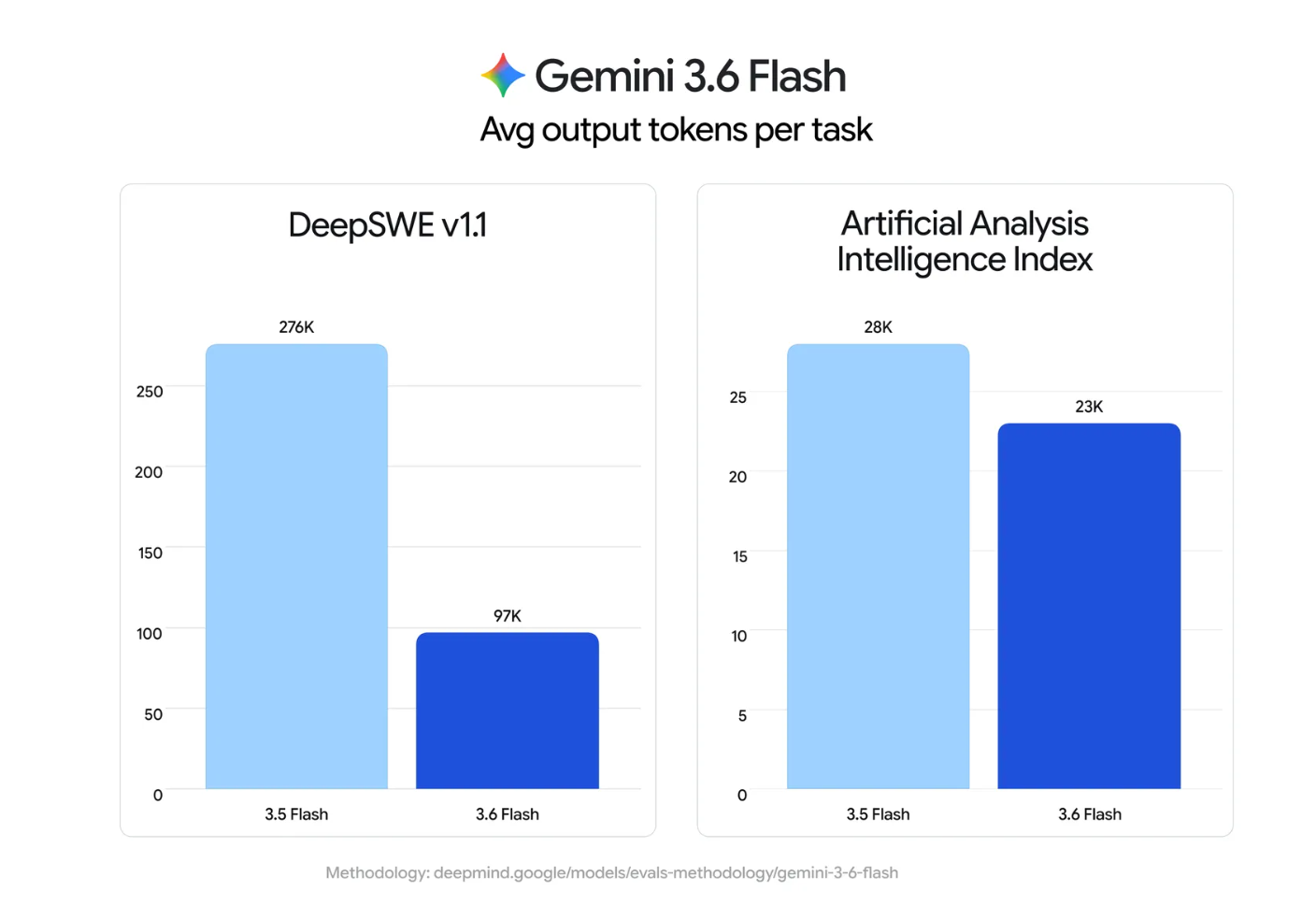
On certain coding benchmarks like DeepSWE, Google reports token reduction of up to 65%. Fewer tokens means lower costs per task and faster completion times.
Pricing: Output tokens dropped from $9.00 to $7.50 per million. Input pricing stays at $1.50 per million tokens. Combined with the token efficiency gains, the effective cost per task drops meaningfully.
Performance benchmarks (Google-reported): DeepSWE coding scores improved from 37% to 49%. MLE Bench (ML research tasks) jumped from 49.7% to 63.9%.
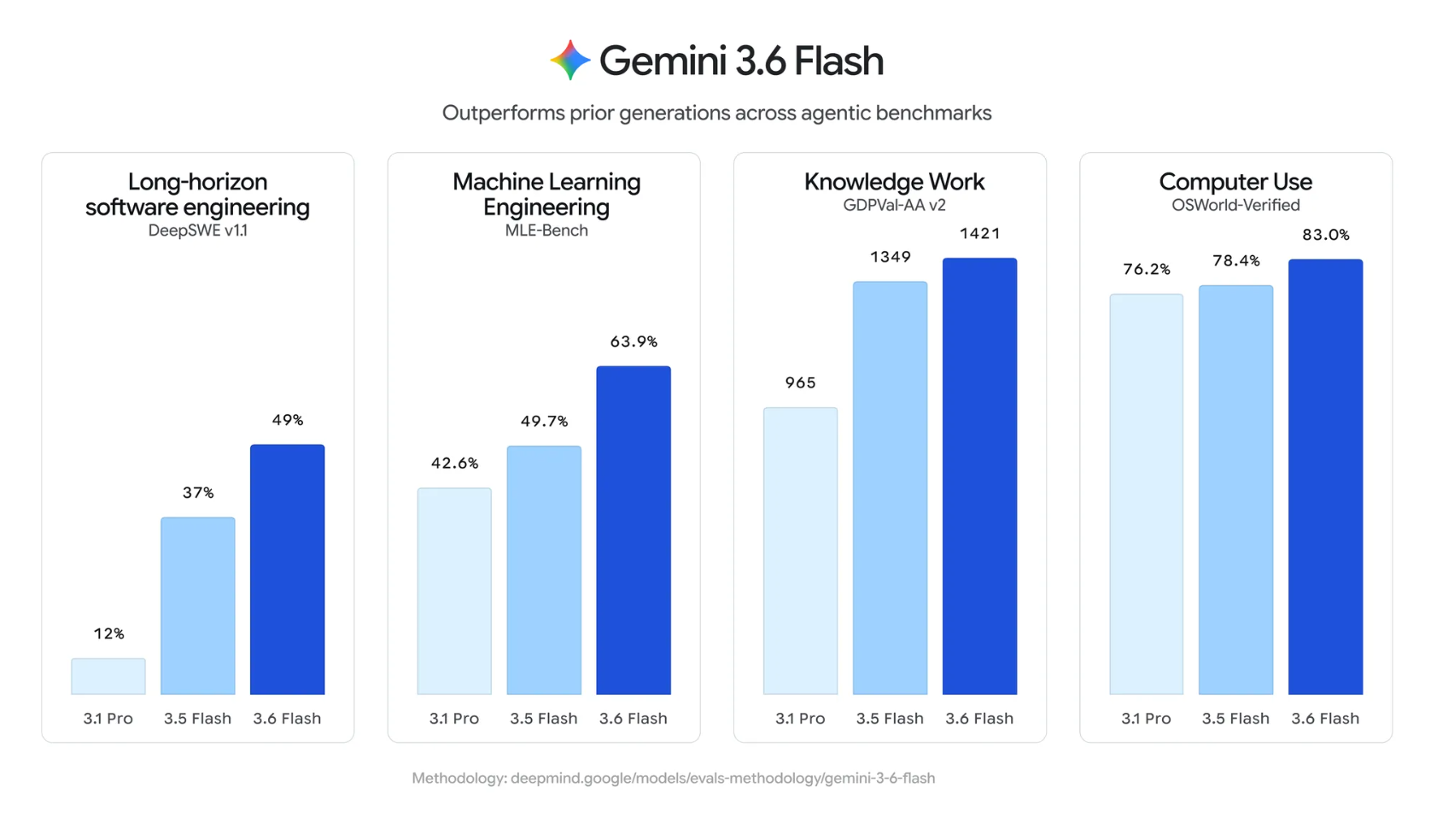
Computer use capabilities on OSWorld-Verified rose from 78.4% to 83.0%. Knowledge work scores on GDPval-AA v2 went from 1349 to 1421.
Knowledge cutoff: Updated from January 2025 to March 2026, meaning the model now knows about events through early this year without needing to search the web.
Context and output limits: The 1 million input token context window and 65,536 output token limit carry over from 3.5 Flash.
It's worth noting that all benchmark figures above are self-reported by Google. Independent third-party evaluations will take time to confirm these numbers across real-world use cases.
Two More Models Arrived with It
Google didn't just launch 3.6 Flash. Two additional models shipped the same day.
Gemini 3.5 Flash-Lite is built for high-volume, high-speed tasks. It runs at 350 output tokens per second according to Artificial Analysis, and is priced at just $0.30 per million input tokens and $2.50 per million output tokens.
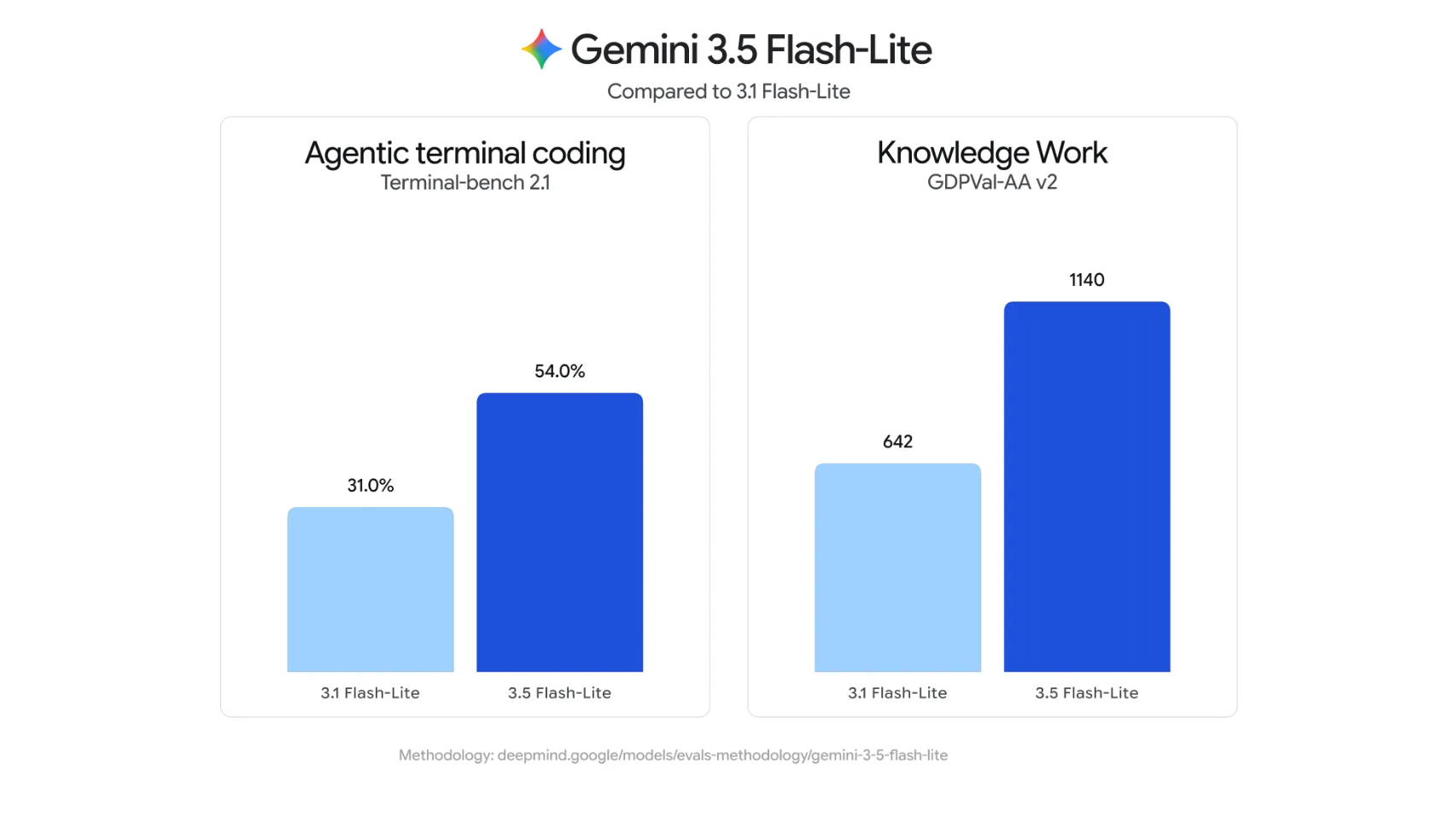
Google says it significantly outperforms the older 3.1 Flash-Lite on coding and agentic benchmarks.
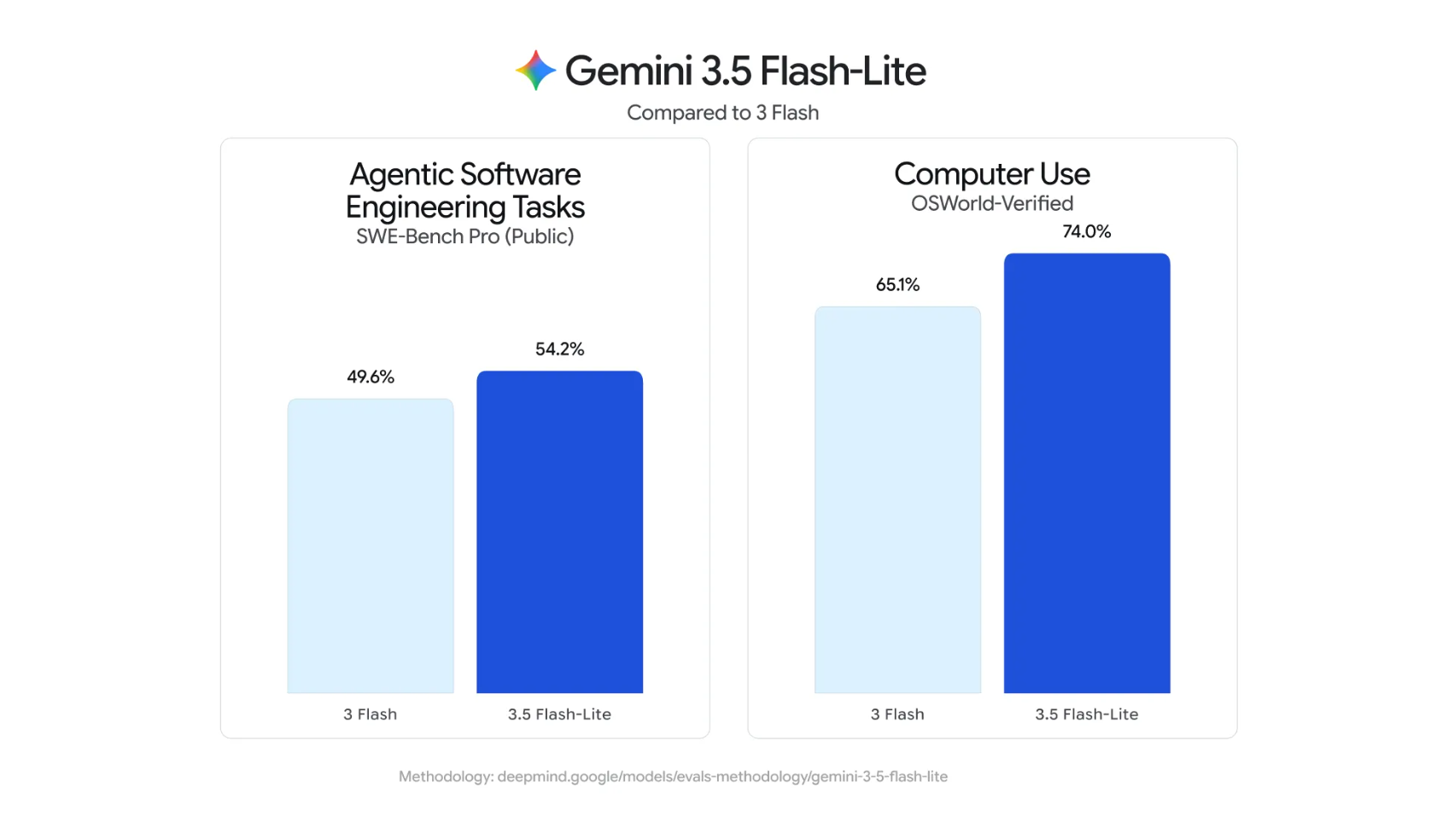
For builders running large-scale data processing, translation, or document handling, Flash-Lite is the budget option that still delivers meaningful quality.
Gemini 3.5 Flash Cyber is a specialized model fine-tuned for detecting and patching security vulnerabilities. It's paired with Google's CodeMender agent infrastructure and is not publicly available. Access is currently limited to governments and trusted partners through a pilot program. Google cited the dual-use nature of the technology as the reason for the restricted rollout.

On the CyberGym benchmark, Flash Cyber in CodeMender scored 83.2%, putting it in a tight cluster with GPT-5.6 Sol (83.6%), Mythos 5 (83.8%), and Mythos Preview (83.1%). GPT-5.5-Cyber led at 85.6%. The notable detail: Flash Cyber reaches that range using a smaller, cheaper Flash-class model with a maximum of five model calls, while the competitors rely on larger frontier models. Google is positioning this as efficient cybersecurity capability at a fraction of the compute cost. These are Google-reported figures and should be treated as vendor benchmarks.
The Bigger Picture: Where Is Gemini 3.5 Pro?
The most notable absence in this announcement is Gemini 3.5 Pro, Google's flagship model. Google originally said at I/O in May that 3.5 Pro would launch "the following month." That deadline passed without a public release.
Google's blog post acknowledges the delay indirectly, stating that 3.5 Pro "is currently testing with partners" with broad availability coming "as soon as it's ready." Bloomberg reported on July 16 that the model was running months behind schedule, with Google spending extra time on its coding capabilities.
In the same announcement, Google also confirmed that pre-training has begun on Gemini 4, which the team described as its "most ambitious pre-training run yet."
For builders, the practical takeaway is clear: Gemini 3.6 Flash and 3.5 Flash-Lite are what's available right now. If you're waiting for Google's most capable model, there's no firm timeline.
What This Means for Builders
Your tools just got a quiet upgrade
If you're a non-technical founder or creator, model updates like this matter even when you're not calling APIs directly. Gemini Flash models power features inside the Gemini app, Google Search, Google Antigravity, and many third-party tools. When the underlying model improves, the tools built on top of it improve too. If your favorite AI writing assistant, code generator, or workflow automation runs on Gemini, it just got a quiet upgrade.
Lower costs, more room to build
Lower token costs also flow downstream. When the cost per output drops, platforms building on Google's API can pass savings to users or expand what's possible within the same budget. For anyone running a product with AI behind the scenes, cheaper inference means more room to grow.
Built-in computer use and faster workflows
Two specific changes are worth watching. First, computer use is now a built-in capability in 3.6 Flash, meaning AI agents can interact with software interfaces (clicking, typing, navigating) without custom integrations. That lowers the barrier for anyone experimenting with AI automation. Second, the 17% token efficiency gain doesn't just save money. It makes every AI-assisted workflow faster and more reliable. Over hundreds or thousands of tasks, that compounds.
The broader signal is clear: AI models are getting cheaper and more efficient, not just smarter. You don't need the biggest model available. You need the one that does the job reliably, quickly, and affordably. The practical question for builders isn't whether to pay attention to model releases. It's whether the tools you're building with are keeping up.
Platforms like Emergent that integrate the latest models let you tap into these improvements without managing APIs or infrastructure yourself, so you can focus on turning ideas into working products.
Stay tuned to Emergent News for more on AI tools, launches, and what they mean for builders.


on Emergent today




