


Gemini Robotics ER 2 Launches with Multi-Robot Collaboration

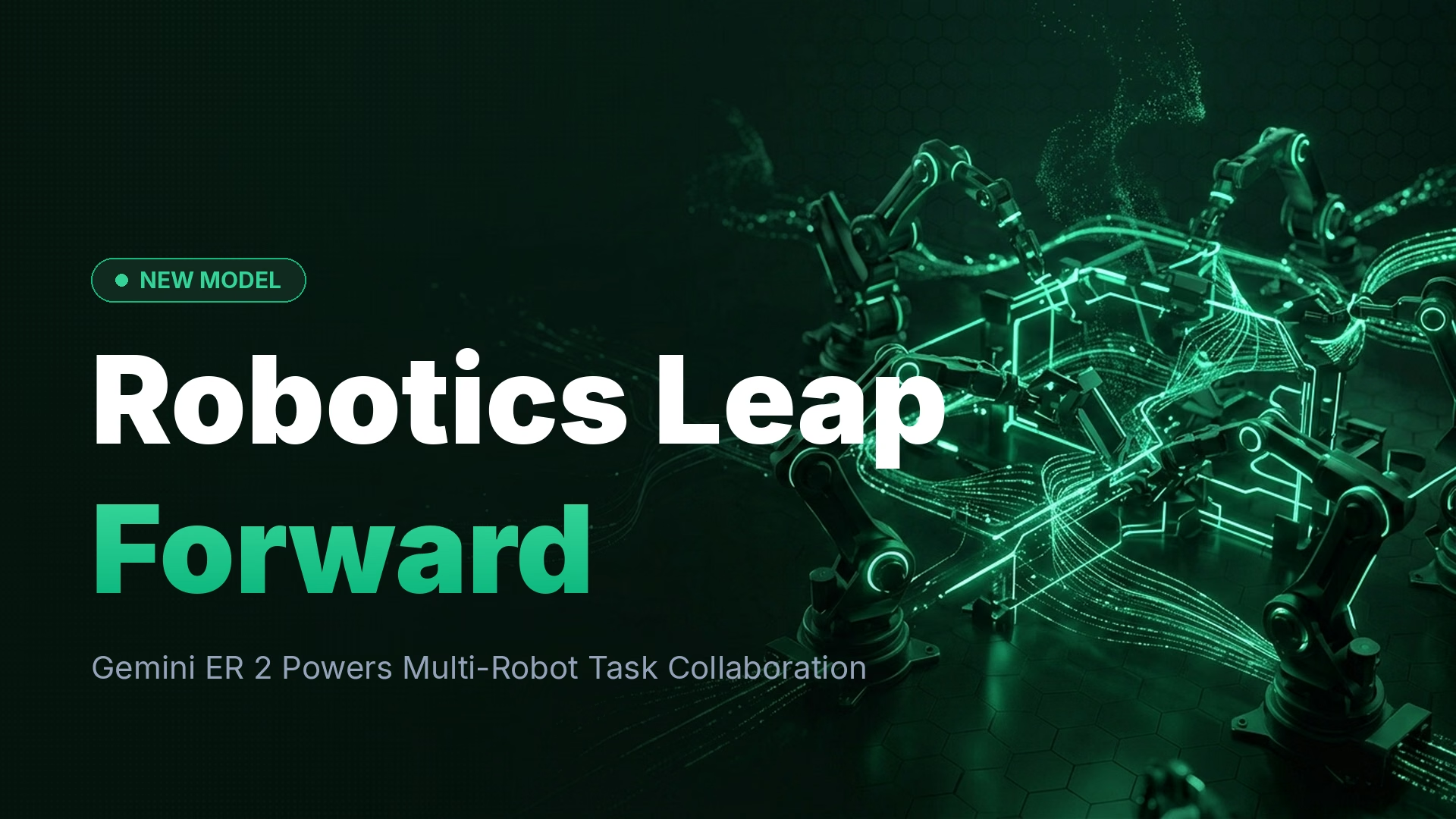
Google DeepMind has officially launched Gemini Robotics ER 2, a second-generation model designed to power advanced robotic applications through enhanced video understanding, task orchestration, and multi-robot collaboration. The release marks a significant evolution in how AI enables physical agents to reason about their environment, coordinate with other machines, and execute complex real-world tasks autonomously.
Release Date and Availability
Gemini Robotics ER 2 was officially launched on July 30, 2026, according to Google DeepMind. The model is now available for research and commercial robotics applications, representing the lab's latest effort to bridge the gap between large language models and embodied AI systems. DeepMind positions ER 2 as a foundation model specifically tuned for robotic perception, planning, and execution.
Video Understanding Capabilities
A core advancement in Gemini Robotics ER 2 is its ability to process and reason about video streams in real time. Unlike earlier robotics models that relied heavily on structured sensor data, ER 2 interprets raw visual input to understand spatial relationships, object dynamics, and task context. This video understanding capability allows robots to adapt to unstructured environments without extensive pre-programming.
The model can parse complex scenes, identify relevant objects, and infer the next logical steps in a task sequence. For example, a warehouse robot using ER 2 can watch a human demonstrate a packing procedure once, then replicate the workflow across varying box sizes and item configurations. This flexibility reduces the need for manual calibration and accelerates deployment timelines.
Task Orchestration and Tool Use
Gemini Robotics ER 2 introduces sophisticated task management capabilities, enabling robots to break down high-level goals into executable sub-tasks. The model can reason about which tools or subsystems to invoke at each step, whether that involves activating a gripper, querying a vision API, or requesting assistance from another agent.
This orchestration layer is critical for real-world applications where robots must switch between perception, manipulation, and communication modes fluidly. According to DeepMind, ER 2 can autonomously decide when to delegate a sub-task to a specialized module or when to escalate an issue to a human operator. The system maintains a working memory of task state, allowing it to resume operations after interruptions or failures.
Multi-Robot Collaboration
One of the most notable features of Gemini Robotics ER 2 is its native support for multi-agent coordination. The model enables multiple robots to share spatial maps, negotiate task allocation, and synchronize actions without centralized control. Each robot runs its own instance of ER 2, communicating via a lightweight protocol to avoid collisions and optimize coverage.
In a manufacturing scenario, ER 2-powered robots can collaboratively assemble a product by dividing labor based on each agent's current state and proximity to required components. If one robot encounters an obstacle, it can broadcast a re-routing request, and peers adjust their paths accordingly. This decentralized approach scales more gracefully than traditional master-slave architectures, particularly in dynamic environments where conditions change frequently.
What This Means
Gemini Robotics ER 2 represents a meaningful step toward general-purpose robotic intelligence. By integrating video understanding, task planning, and multi-agent communication into a single foundation model, Google DeepMind has reduced the complexity of building robust robotic systems. For enterprises exploring automation in logistics, manufacturing, or healthcare, ER 2 lowers the barrier to deploying fleets of collaborative robots that can adapt to novel tasks with minimal human intervention. As the robotics industry shifts from narrow, scripted solutions to flexible AI-driven agents, models like ER 2 will likely serve as the cognitive backbone for the next generation of physical automation platforms.

on Emergent today




