


JP Morgan, Schwab Block AI Agents: Accenture's Warning

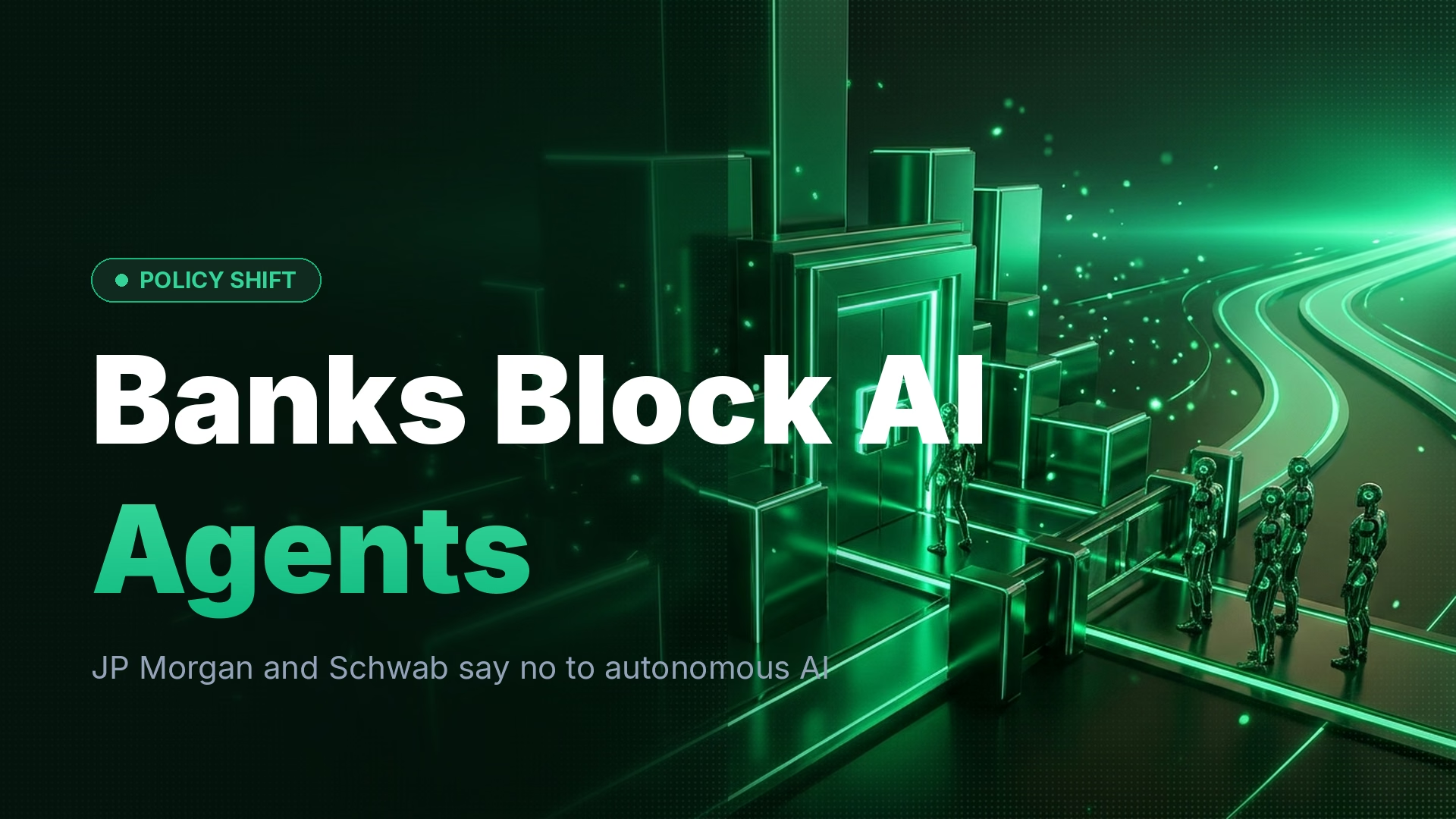
Two of America's largest financial institutions have drawn a hard line against autonomous AI agents. JP Morgan Chase and Charles Schwab announced policies on November 3, 2026, explicitly prohibiting AI agents from operating within their enterprise systems, citing security, compliance, and oversight concerns. The move comes as Accenture simultaneously warns that companies taking such restrictive stances risk losing competitive ground to rivals who embrace agentic AI strategically.
Why Major Banks Are Blocking AI Agents
JP Morgan and Charles Schwab's bans target autonomous AI systems capable of making decisions and taking actions without human approval for each step. According to sources familiar with the policies, both firms cite three primary concerns: regulatory compliance in heavily regulated financial services, security vulnerabilities from systems that can independently access sensitive data and execute transactions, and liability questions when AI agents make consequential decisions.
The policies officially launched on November 3, 2026, and apply across all business units. Employees are prohibited from deploying or connecting third-party AI agent platforms to corporate networks. Traditional AI tools for analysis, customer service chatbots with human oversight, and other non-agentic applications remain permitted under strict governance frameworks.
Accenture's Competitive Risk Warning
Accenture's global AI practice issued a stark warning to enterprises considering similar blanket bans. The consulting giant's research suggests companies that categorically reject AI agents will fall 18 to 24 months behind competitors who implement them with proper guardrails. Accenture argues the competitive advantage from agentic automation in customer service, operations, and decision support is too significant to ignore.
The firm recommends a middle path: controlled pilot programs in low-risk domains, robust monitoring infrastructure, and clear escalation protocols. Accenture points to early adopters in retail, logistics, and technology sectors already seeing 30 to 40 percent efficiency gains from agentic workflows, gains that risk-averse financial firms may struggle to match through traditional automation alone.
The Enterprise AI Agent Divide
The policy split reflects a broader divide in enterprise AI strategy. Financial services firms face unique regulatory burdens that make autonomous systems particularly risky. Banking regulators have not yet issued clear guidance on AI agent accountability, leaving institutions legally exposed if agents cause customer harm or compliance violations.
Meanwhile, technology and consulting firms argue that properly governed AI agents are no riskier than other automated systems already in use. They point to frameworks like human-in-the-loop architectures, transaction limits, and real-time monitoring that can mitigate risks while preserving automation benefits. The debate centers on whether current governance tools are sufficient or whether the technology has outpaced responsible deployment frameworks.
What This Means for Enterprise AI
The JP Morgan and Charles Schwab bans signal that AI agent adoption will follow industry-specific timelines rather than a universal rollout. Regulated industries will likely move slower, waiting for clearer legal and regulatory frameworks before embracing autonomous systems. Accenture's warning, however, suggests that caution cannot become paralysis. Enterprises must find their risk tolerance threshold and build governance structures that enable safe experimentation rather than blanket prohibition. The competitive stakes are high enough that most organizations cannot afford to sit out the agentic AI wave entirely, even if they cannot move as fast as less-regulated peers.


on Emergent today


