


Mino Hackable ROS 2 Robot Launches with Local LLM

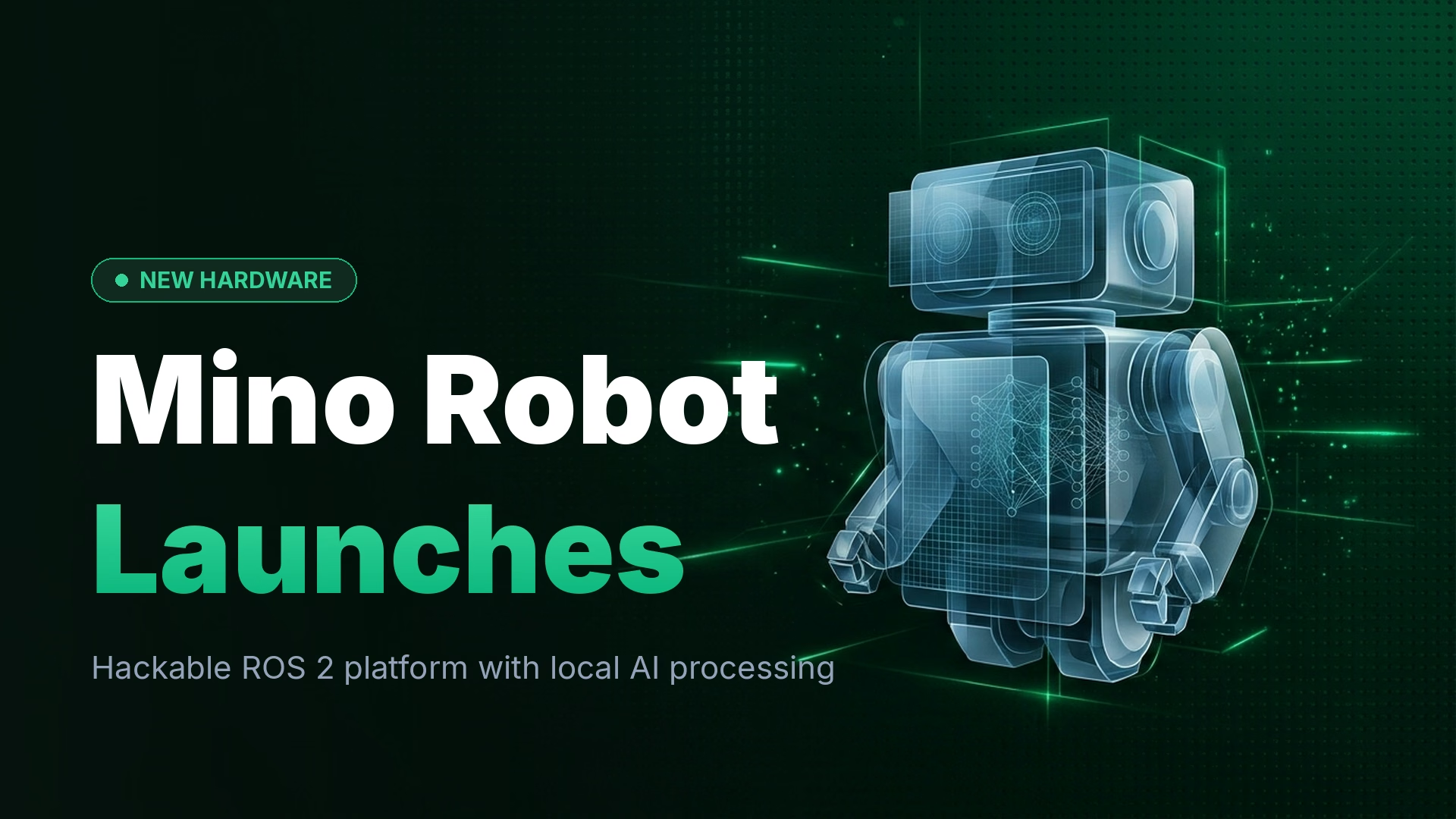
A new robotics platform combining ROS 2 architecture with on-device artificial intelligence has entered the developer market. Mino robot officially launched on November 17, 2026, offering researchers and engineers a hackable foundation for building autonomous systems that process visual data and language models locally without requiring cloud connectivity.
Local LLM Processing Architecture
The Mino platform runs a complete language model directly on its embedded hardware, eliminating network latency and enabling real-time decision-making in autonomous navigation scenarios. This on-device approach addresses a critical bottleneck in current robotics: the dependency on external servers for natural language understanding and reasoning tasks. Developers can interact with the robot using conversational commands that the system interprets and executes through its local inference engine.
The integration of local language processing with ROS 2's modular architecture allows teams to build custom behaviors without rewriting core navigation or perception stacks. Early adopters can leverage existing ROS 2 packages while extending functionality through the natural language interface.
Stereo Vision System
Mino incorporates a stereo camera array that generates depth maps for spatial awareness and obstacle avoidance. The vision system feeds directly into both traditional computer vision pipelines and the language model, creating a multimodal understanding of the robot's environment. This dual processing path enables scenarios where visual context informs language-based task planning.
The stereo setup operates at frame rates suitable for real-time navigation in dynamic environments. Developers access raw depth data through standard ROS 2 topics, maintaining compatibility with established robotics workflows while gaining the option to query visual information through natural language prompts processed by the local LLM.
Open Development Platform
Built on the Robot Operating System 2 framework, Mino provides full source code access and hardware schematics for modification. The platform supports standard development tools including RViz for visualization, MoveIt for motion planning, and Nav2 for autonomous navigation. Teams can flash custom firmware, swap sensors, or redesign mechanical components while maintaining software compatibility.
- Complete ROS 2 Humble distribution with pre-configured navigation stack
- GPIO access for adding custom sensors and actuators
- Docker containerization support for reproducible development environments
- Python and C++ APIs for both high-level scripting and low-level control
The documentation includes tutorials for common robotics tasks: SLAM mapping, waypoint navigation, object detection integration, and voice command processing through the local language model.
Release Date and Availability
Officially launched on November 17, 2026, the Mino robot is now available for purchase through the project website at mino.bot. The platform ships with pre-installed software and a quick-start guide for first-time setup. Developers receive access to a community forum and GitHub repository containing example code for typical use cases.
The launch targets three primary audiences: academic researchers exploring human-robot interaction, hobbyists building home automation systems, and startups prototyping commercial service robots. Pricing details and hardware specifications are listed on the official product page.
What This Means
The convergence of ROS 2, stereo vision, and local LLM inference in a single accessible package reduces barriers to entry for robotics development. By eliminating cloud dependencies, Mino enables applications in environments with limited connectivity or strict data privacy requirements. The open architecture allows the community to extend capabilities through shared packages, potentially accelerating innovation in autonomous systems that combine spatial reasoning with natural language understanding. This launch signals growing maturity in edge AI hardware capable of running sophisticated models on resource-constrained platforms.



on Emergent today


