


OpenAI Codex Powers Aerodynamic Engineering at Mazda

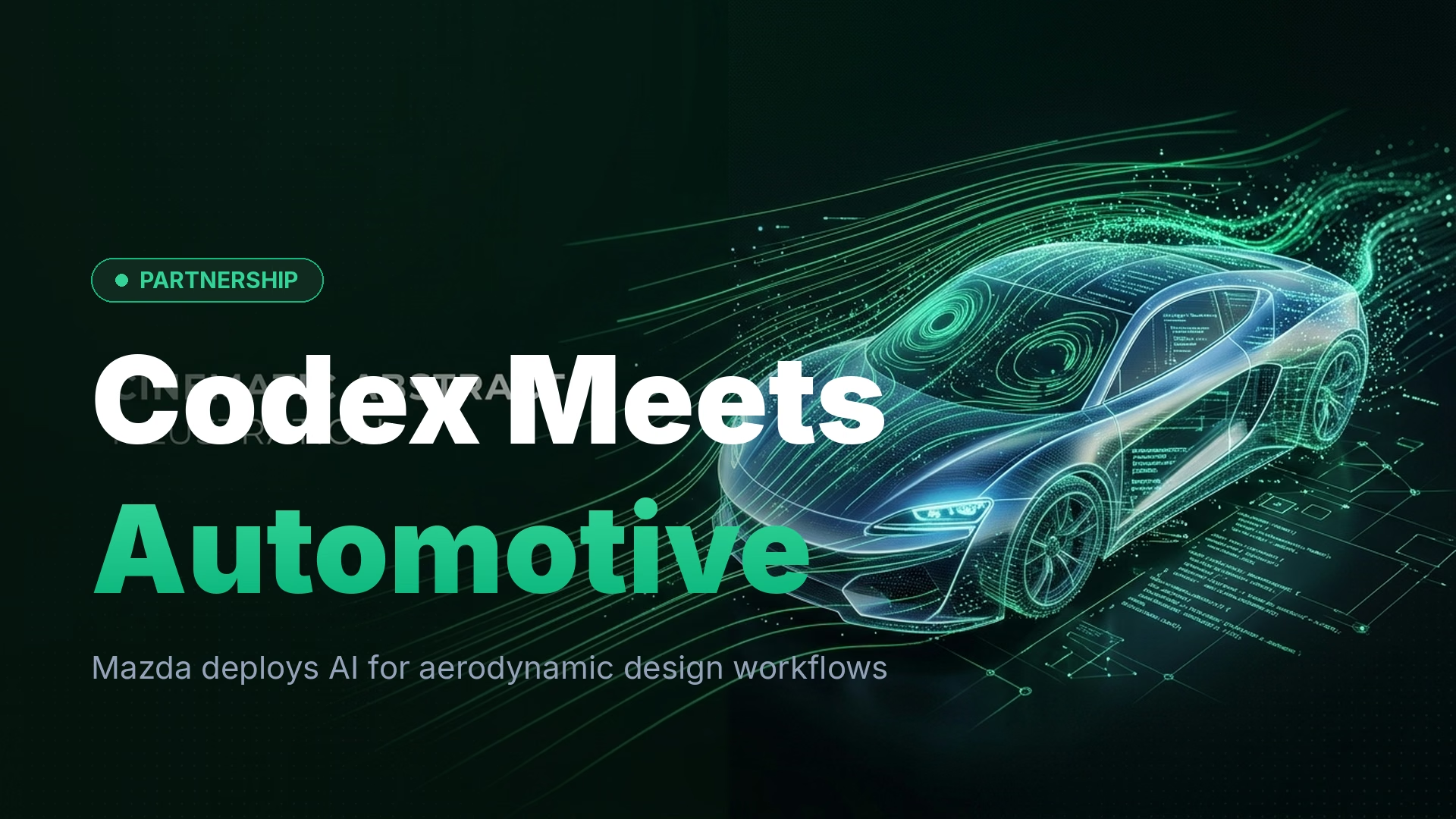
Mazda has integrated OpenAI Codex into its aerodynamic engineering pipeline, marking one of the first major automotive applications of the AI code generation model beyond traditional software development. The Japanese automaker is using Codex to automate computational fluid dynamics simulations and accelerate the vehicle design process, according to a technical briefing released today.
Officially Launched on November 4, 2026
The partnership between Mazda and OpenAI was officially announced on November 4, 2026, with initial deployment already underway at Mazda's research facilities in Hiroshima. Engineers are using Codex to generate and optimize simulation scripts that model airflow patterns around vehicle prototypes, a task that traditionally required weeks of manual coding and parameter tuning.
According to Mazda's engineering team, Codex reduces the time required to set up complex aerodynamic simulations by approximately 40 percent. The model translates natural language descriptions of design parameters into executable code for industry-standard computational fluid dynamics software, allowing engineers to iterate faster on vehicle shapes and surface geometries.
Engineering Applications Beyond Software
While Codex has primarily been adopted for software development tasks, Mazda's implementation demonstrates the model's capability in specialized engineering domains. The system assists with:
- Automated generation of mesh configurations for aerodynamic modeling
- Parameter optimization for drag coefficient reduction
- Script creation for turbulence simulation and boundary layer analysis
- Documentation of simulation assumptions and results
Mazda engineers report that Codex understands domain-specific terminology related to vehicle aerodynamics, including concepts like pressure gradients, separation points, and wake structures. This contextual awareness allows the model to generate more accurate simulation code compared to generic code generation tools.
Impact on Development Cycles
The integration is expected to compress Mazda's vehicle development timeline by several months. Traditional aerodynamic optimization involves hundreds of simulation runs, each requiring custom scripts to test different design variations. By automating much of this scripting work, Codex enables faster exploration of the design space.
The automaker plans to expand Codex usage to other engineering domains, including structural analysis and thermal management. Mazda has not disclosed the commercial terms of the partnership but confirmed that the implementation uses the same Codex API available to enterprise customers.
What This Means
Mazda's adoption of OpenAI Codex signals growing interest in applying large language models to specialized engineering workflows outside pure software development. As AI code generation becomes more sophisticated, we can expect similar integrations across manufacturing, aerospace, and other industries where simulation-driven design is critical. The 40 percent efficiency gain reported by Mazda provides a concrete benchmark for organizations evaluating AI-assisted engineering tools.



on Emergent today


