


Polimill Builds Japan's Public AI Infrastructure with GPT

💡 TL;DR
- Polimill deploys OpenAI GPT and Codex to build next-generation AI infrastructure for Japanese municipal governments.
- The platform enables local administrators to search administrative knowledge bases and accelerate policy development workflows.
- This launch represents a significant expansion of GPT models into public sector infrastructure in Japan.
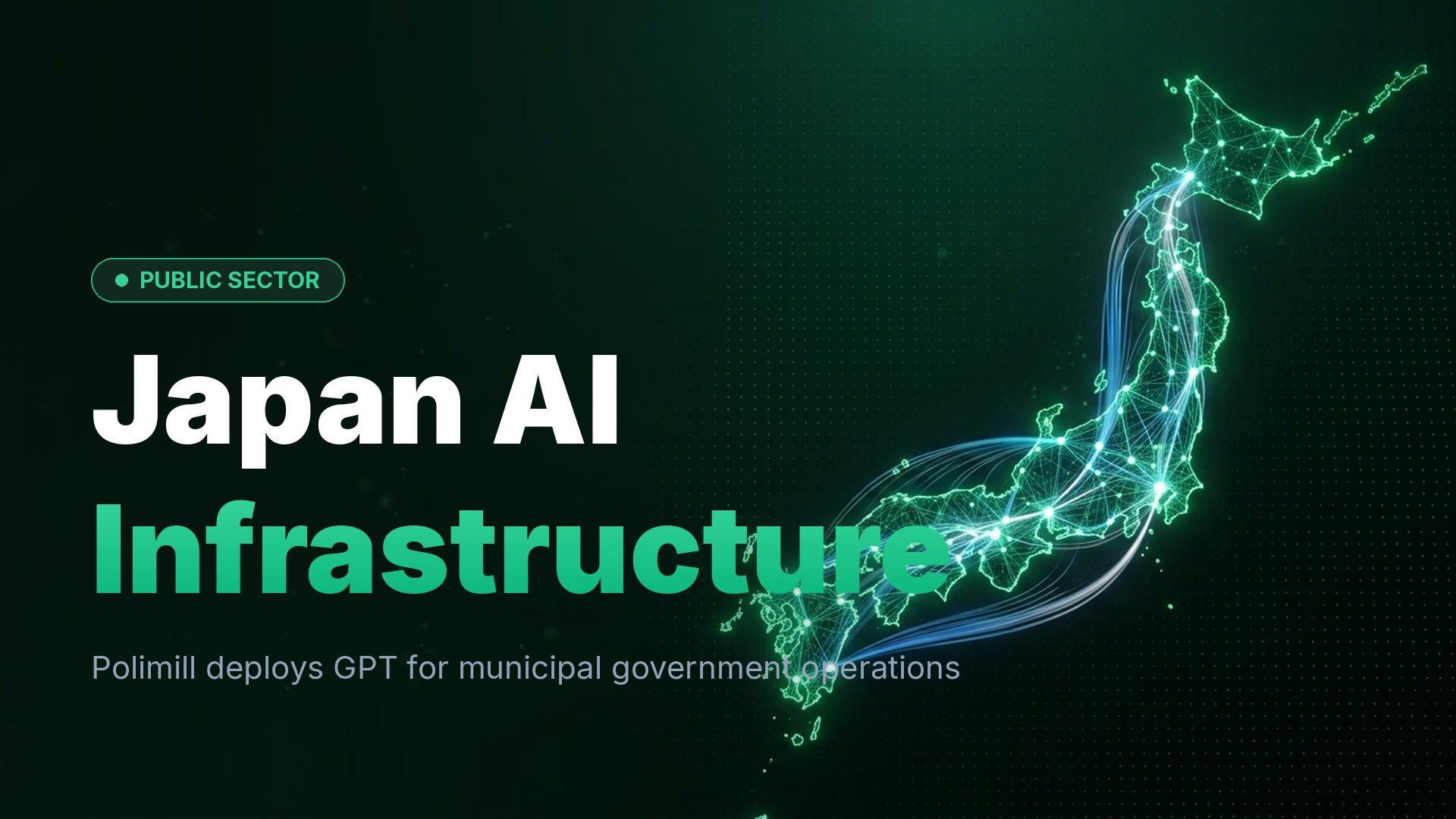
Polimill has launched a GPT-powered AI infrastructure platform designed specifically for Japanese municipal governments, marking one of the first large-scale deployments of OpenAI models in public administration. The platform leverages GPT and Codex to help local government officials search administrative knowledge bases and accelerate policy development.
Platform Architecture and Capabilities
The Polimill system integrates OpenAI's GPT models for natural language understanding and Codex for development acceleration. Municipal administrators can query complex administrative databases using conversational language, retrieving relevant policies, regulations, and procedural documents without navigating fragmented legacy systems. The platform indexes knowledge across multiple municipalities, enabling cross-regional learning and standardization.
According to OpenAI's announcement, the implementation focuses on three core functions: administrative document search, policy drafting assistance, and workflow automation. Codex handles the technical layer, automating routine coding tasks that previously required external contractors or specialized IT staff.
Municipal Use Cases
Early adopter municipalities report significant time savings in policy research and drafting. Local governments use the platform to:
- Search historical administrative decisions and precedents across thousands of documents
- Generate draft policy language based on regional examples and legal frameworks
- Automate repetitive administrative coding tasks for public-facing digital services
- Translate complex regulatory language into citizen-friendly explanations
The system maintains strict data sovereignty requirements, with all processing occurring within Japan's regulatory boundaries. Polimill has implemented custom safeguards to prevent the models from generating policy recommendations that conflict with existing legal frameworks.
Release Date and Deployment Timeline
Officially launched on January 2025, the platform is now available to Japanese municipalities through Polimill's government licensing program. The initial rollout targets mid-sized cities with populations between 100,000 and 500,000, where administrative staff shortages create the most acute need for AI augmentation.
Polimill plans to expand access to smaller towns and rural prefectures throughout 2025, with customization for region-specific administrative structures. The company is also developing specialized modules for disaster response coordination and public health administration.
Technical Infrastructure Requirements
The platform operates on cloud infrastructure that meets Japan's stringent public sector data regulations. Municipalities connect through secure API endpoints, with all queries processed through GPT models fine-tuned on Japanese administrative language and legal terminology. Polimill maintains separate model instances for each prefecture to ensure data isolation between regions.
Integration with existing municipal IT systems occurs through standardized connectors that work with common Japanese government software platforms. The implementation does not require municipalities to migrate existing databases, reducing deployment friction and preserving institutional knowledge stored in legacy formats.
What This Means
Polimill's deployment represents a template for public sector AI adoption in countries with strict data sovereignty requirements. By demonstrating that advanced language models can operate within regulatory constraints while delivering measurable efficiency gains, the platform may accelerate similar initiatives across Asia-Pacific governments. The focus on code generation through Codex also addresses a critical bottleneck in municipal digital transformation, where many local governments lack in-house development capacity. As municipalities publish performance metrics over the coming year, this implementation will provide concrete data on AI's viability in resource-constrained public administration contexts.


on Emergent today




