


RTX Spark Mini-PCs Launch with 128GB Unified Memory for AI

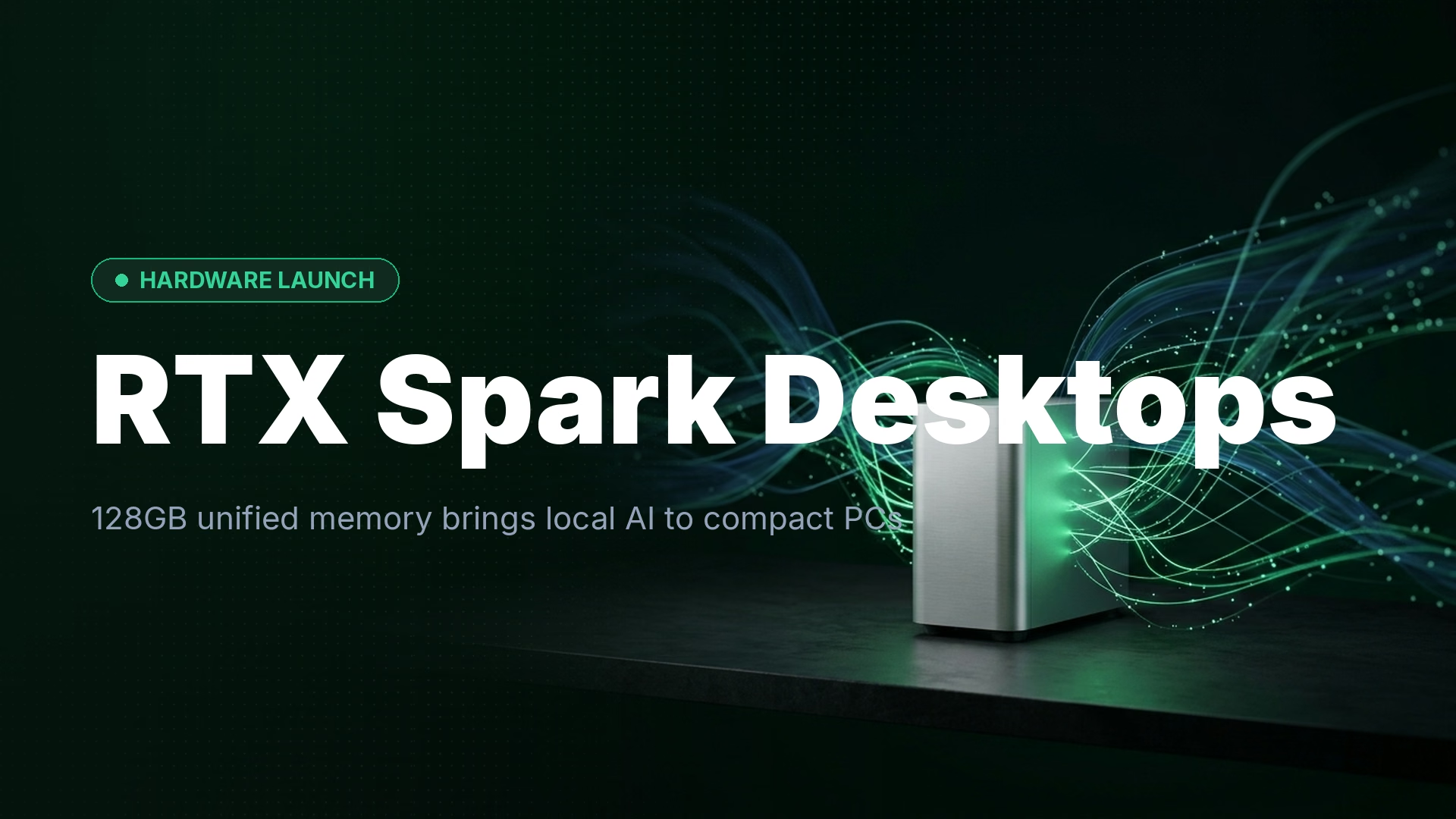
NVIDIA has officially launched compact RTX Spark desktop systems through ASUS, Dell, and MSI, bringing up to 128GB of unified memory and one petaflop of AI performance to small-form-factor Windows PCs designed for creators, developers, and AI practitioners. Officially released on November 18, 2026, the systems pair a 20-core Grace CPU with a Blackwell RTX GPU carrying up to 6,144 CUDA cores, enabling users to run language models with as many as 120 billion parameters entirely on-device.
Desktop Specifications and Availability
The first systems available include the ASUS ProArt GR1X mini PC and MSI Edge Mesa N AI+ Series, with MSI's entry configuration starting at $4,699. Additional compact desktops from Acer, GIGABYTE, and HP are expected to follow, alongside the Microsoft Surface RTX Spark Dev Box. Each desktop combines NVIDIA's Grace CPU architecture with a Blackwell-generation RTX GPU, delivering configurations that share up to 128GB of memory across both processing units.
That unified memory pool addresses a common bottleneck in creative and AI workflows: moving large datasets between CPU RAM and GPU VRAM. According to NVIDIA, RTX Spark desktops can render 3D scenes exceeding 90GB in real time, edit 4:2:2 video without stuttering, and load supported language models up to 120 billion parameters without offloading portions to disk or cloud services.
Local Processing and Cost Implications
The desktop form factor complements existing RTX Spark laptops by offering a stationary machine that can remain in a studio or office, handling overnight renders, asset processing, or continuously running agents while the laptop is used elsewhere. Local processing also eliminates the per-token API costs associated with cloud-hosted models, a consideration for teams running frequent inference jobs or iterating on creative prompts.
Keeping project data on-device means source files, training datasets, and proprietary code remain within the organization's infrastructure rather than being transferred to external services. For workflows involving sensitive client material or regulated data, this can simplify compliance requirements and reduce attack surface.
Adobe Software Integration
The desktop launch arrives alongside expanded Adobe support for RTX Spark systems. Adobe Premiere now uses NVIDIA TensorRT-RTX acceleration for Enhance Speech, Object Mask, Scene Edit Detection, and Auto Reframe, with GPU acceleration extending to Film Impact transitions and professional format support covering Canon RAW, RED RAW, ARRI RAW, ARRICORE, ARRI HDE, ProRes RAW, long-GOP video, and H.264 and HEVC in MXF. NVIDIA reports over 50 percent faster turnaround on common H.264 deliverables.
Adobe Photoshop now uses TensorRT-RTX acceleration for the Remove Tool, while native Camera Raw support allows photographers to work with RAW images on RTX Spark without emulation layers. At Adobe MAX 2026, Adobe previewed a new GPU-accelerated image-processing engine featuring interactive Gaussian Blur and Light Leaks filters. Substance 3D Painter 12.2 is available as a native Windows on Arm public beta for RTX Spark, allowing 3D artists in games, VFX, and visualization to run the tool without compatibility layers. Illustrator and InDesign also ship native Windows on Arm versions, with Illustrator reportedly delivering up to 30 percent better performance than its emulated counterpart.
Adobe MAX Demonstration
NVIDIA demonstrated the capabilities of mobile RTX Spark systems through a collaborative installation at Adobe MAX 2026. Visitors drew a creature at kiosks powered by RTX Spark laptops from Microsoft, ASUS, MSI, HP, and Dell. A pipeline running entirely on-device then converted the drawing into a rendered character, developed a scene around it, and generated an animation before adding the result to a shared video wall inspired by Miami.
The complete process ran without making cloud calls. NVIDIA's Hermes agent framework coordinated separate tools for transforming the sketch, directing the scene, and generating the animation. Sketch transformation took approximately 80 seconds, scene direction around 15 seconds, and video generation between 90 and 120 seconds, allowing visitors to move from pencil drawing to animated creature in under five minutes. The installation demonstrated how a compact RTX Spark system can coordinate multiple substantial creative processes locally, using the same hardware now moving into desktop configurations intended for persistent workloads.
What This Means
The RTX Spark desktop launch represents NVIDIA's effort to bring unified-memory, high-performance AI processing into compact, studio-friendly form factors. By pairing Grace CPU cores with Blackwell GPU architecture and sharing up to 128GB of memory across both, the systems address workflows that struggle with the memory limitations of traditional discrete GPU setups. For creators and developers working with large models, high-resolution assets, or multi-step AI pipelines, the desktop option offers a persistent, on-premises alternative to cloud services and laptops. RTX Spark laptops remain available from ASUS, Dell, HP, Lenovo, Microsoft, and MSI, with prices starting at $2,599.


on Emergent today


