


Siemens Robot Foundation Models Unpack Component Reels

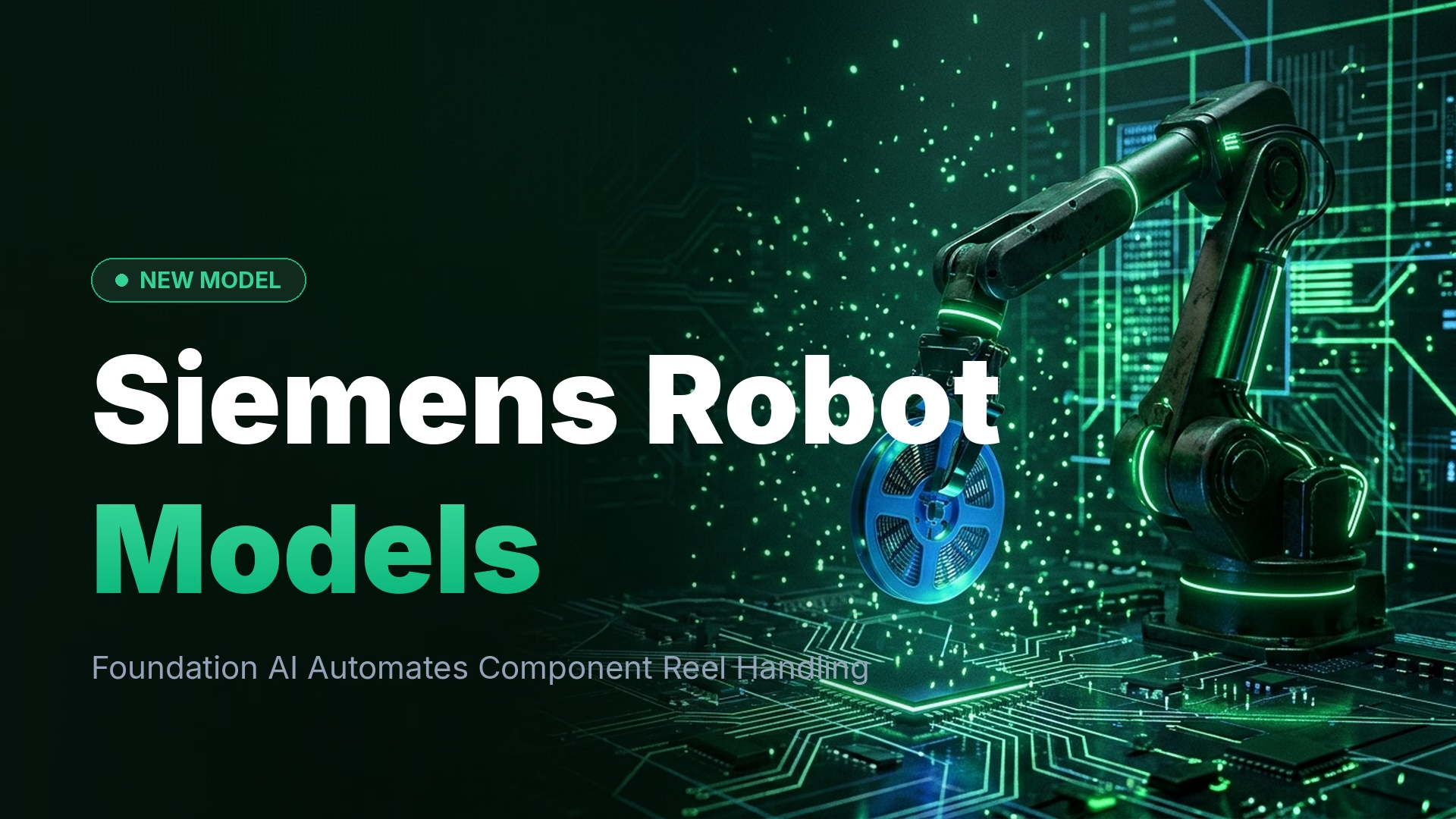
Siemens has officially released robot foundation models designed to autonomously unpack and handle component reels in electronics manufacturing environments. The models enable industrial robots to perform complex packaging removal tasks without custom programming for each variation, addressing a persistent bottleneck in factory automation where humans still handle most material preparation workflows.
Autonomous Component Reel Processing
The foundation models train robots to identify diverse packaging materials, extract electronic components from reels, and position parts for downstream assembly operations. Unlike traditional robotic systems that require explicit programming for each packaging configuration, these models generalize across tape-and-reel formats, blister packaging, and tube containers commonly used in electronics supply chains.
Robots equipped with the models can process components ranging from surface-mount resistors to integrated circuits without operator intervention. The system uses vision inputs to assess reel condition, detect damaged packaging, and adapt handling strategies based on material properties. Manufacturing facilities can deploy the technology across multiple production lines with minimal site-specific training.
Foundation Model Architecture for Manufacturing
Siemens built the models using large-scale datasets of component handling scenarios collected from operational factories. The foundation model approach allows the system to transfer learned behaviors to new packaging types and component geometries without retraining from scratch.
- Pre-trained on millions of component handling sequences from diverse manufacturing environments
- Fine-tunable for specific production line requirements in hours rather than weeks
- Integrates with existing factory control systems and quality inspection workflows
The models run on standard industrial compute hardware and interface with common robot controllers used in electronics manufacturing. Siemens reports deployment times reduced from weeks to days compared to traditional vision-guided robotics implementations.
Release Date and Availability
Officially launched on November 26, 2026, the robot foundation models are available through Siemens industrial automation channels. The company is initially targeting high-volume electronics manufacturers where component preparation represents a significant labor cost and throughput constraint.
Pilot customers have reported cycle time reductions of 30 to 40 percent in material handling operations after deploying the models. Siemens plans to expand the foundation model library to cover additional manufacturing tasks including wire harness assembly and optical inspection workflows in 2027.
What This Means
This launch demonstrates foundation models moving beyond software and language tasks into physical manipulation domains where reliability and precision requirements are stringent. By standardizing robot training for common manufacturing operations, Siemens is reducing the engineering overhead that has limited robotic automation adoption in mid-sized facilities. The component reel handling models create a template for future robotics foundation model applications in logistics, food processing, and pharmaceutical packaging where similar material handling challenges persist.



on Emergent today


