


Stanford Open-Sources Memorilla Memory Module for LLMs

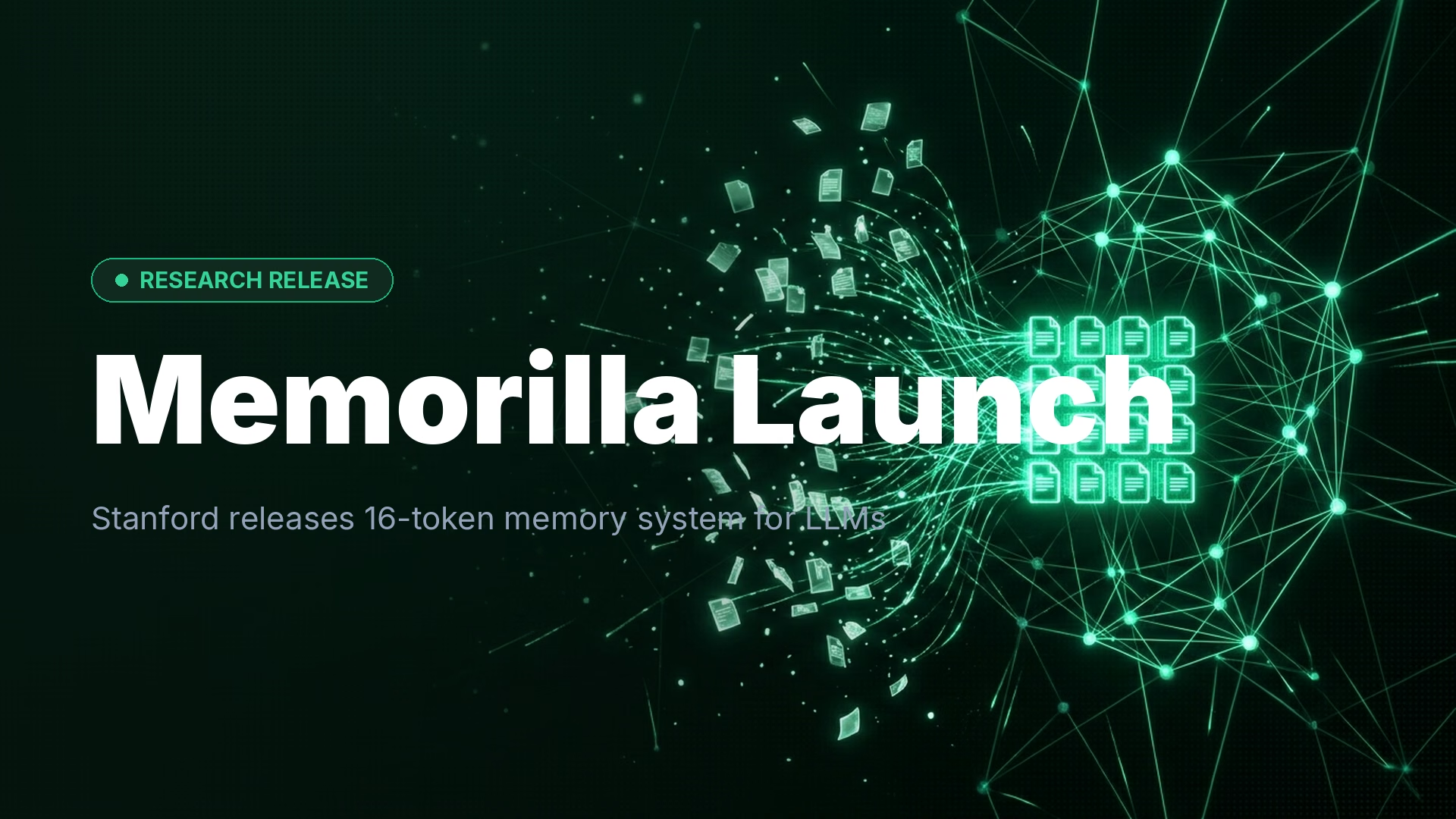
Stanford researchers have officially released Memorilla, an open-source latent memory module designed to dramatically improve how frozen large language models handle document collections. Officially launched on November 14, 2026, the system compresses entire knowledge bases into just 16 memory tokens, achieving 84.33% accuracy on the FactKG benchmark while using 108 times fewer document tokens than traditional full-context approaches. The release marks a significant step forward in making LLM memory systems both efficient and accessible to the research community.
How Memorilla Compresses Knowledge
Memorilla introduces a novel approach to memory management in language models by encoding document collections into a compact latent representation. Rather than requiring models to process thousands of document tokens each time they answer a question, the system distills the essential information into 16 specialized memory tokens. These tokens are learned during training and capture the semantic essence of entire knowledge bases in a form that frozen LLMs like Qwen3-8B can efficiently utilize.
The compression ratio represents a breakthrough in memory efficiency. Traditional retrieval-augmented generation systems must pass large chunks of documents through the model's context window, consuming both computational resources and time. Memorilla's 108x reduction means that tasks requiring access to extensive document collections can now run with a fraction of the memory overhead, opening new possibilities for deployment on resource-constrained devices.
Benchmark Performance and Accuracy
On the FactKG benchmark, which tests factual knowledge retrieval across diverse topics, Memorilla achieved 84.33% accuracy using its compressed 16-token representation. This performance demonstrates that aggressive compression does not necessarily sacrifice retrieval quality when the memory encoding is carefully designed. The system maintains competitive accuracy while dramatically reducing the token budget required for knowledge access.
The researchers tested Memorilla with Qwen3-8B, a frozen base model that receives no fine-tuning or parameter updates. This constraint proves that the memory module can augment existing models without requiring expensive retraining cycles. Organizations running production LLMs can potentially integrate similar memory systems without disrupting their current model deployments.
Release Date and Open-Source Availability
Stanford officially released on November 14, 2026 the complete Memorilla codebase, training protocols, and evaluation benchmarks under an open-source license. The research team has made the system available on GitHub, allowing developers and researchers to experiment with latent memory architectures in their own applications. The release includes pre-trained memory encoders for common document collections, along with documentation for training custom memory modules on domain-specific knowledge bases.
The open-source release aims to accelerate research in efficient LLM memory systems. By providing a working implementation and reproducible results, Stanford has lowered the barrier for teams exploring alternatives to traditional retrieval-augmented generation. The community can now build on Memorilla's foundation, testing variations in token count, encoding strategies, and integration patterns with different base models.
Implications for Frozen LLM Architectures
Memorilla's success with frozen models addresses a critical challenge in production AI systems: how to extend model capabilities without retraining. Most enterprises cannot afford the computational cost of fine-tuning billion-parameter models each time their knowledge base updates. A memory module that works with frozen weights offers a practical path to keeping models current while preserving their original training investments.
The 16-token constraint also suggests new directions for memory-augmented architectures. Rather than treating memory as an unlimited context window, Memorilla demonstrates that carefully learned compact representations can capture sufficient information for many retrieval tasks. This insight may influence future model designs, where dedicated memory tokens become a standard component alongside traditional attention mechanisms.
What This Means
Stanford's release of Memorilla represents a meaningful contribution to making LLM memory systems more practical and accessible. The combination of dramatic token compression, strong benchmark performance, and open-source availability gives researchers and developers a concrete starting point for building more efficient knowledge-augmented models. As the AI community continues exploring alternatives to ever-larger context windows, compact latent memory modules like Memorilla offer a compelling path toward sustainable, scalable language model architectures that balance performance with computational efficiency.


on Emergent today


