


Torus Raises $500M for Modular AI Data Center Container

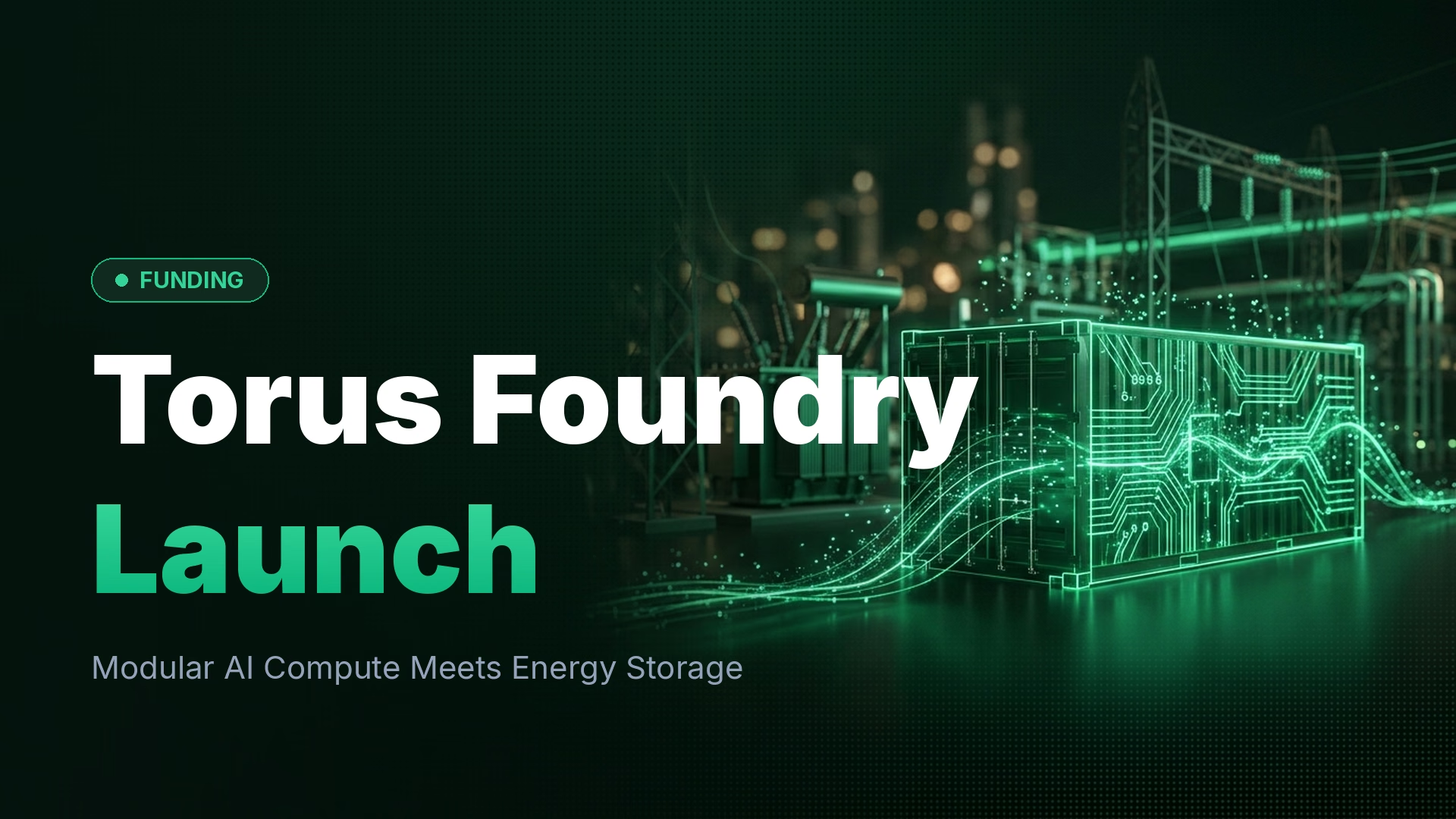
Officially launched on November 11, 2026.
Torus, a Salt Lake City-based energy-storage startup, announced it has secured $500 million in Series C funding to manufacture Foundry, a shipping container-sized product that integrates battery storage with artificial intelligence computing hardware. The round was led by Magnetar, with participation from Iconiq Capital, Origin Ventures, and Trinity Capital, positioning the company to address mounting power constraints in the AI infrastructure sector.
Product Architecture and Deployment Model
Foundry represents a departure from traditional data center construction. Each unit is designed as a self-contained system ranging from one to 20 megawatts of capacity, specializing in AI inference workloads rather than model training. According to Torus CEO and founder Nate Walkingshaw, the containers can be installed at businesses or factories where electrical grids already have excess power capacity, enabling AI compute deployment without requiring expensive infrastructure upgrades that drive up utility costs.
The modular approach reduces deployment timelines to approximately four months, a significant acceleration compared to conventional data center builds that can take years to complete. Hydra Host, an AI infrastructure company, has already signed on as a customer, signaling early market validation for the distributed compute model.
Release Date and Market Timing
Torus officially launched Foundry on November 11, 2026, as data center developers across the United States scramble to secure sufficient power for energy-intensive AI applications. The timing coincides with a shifting regulatory landscape following last week's midterm elections, where Democrats who campaigned on tighter data center restrictions won gubernatorial races in key states including Texas and Ohio. These political changes threaten to extend approval timelines and increase scrutiny for sprawling data center campuses that can consume as much electricity as entire cities.
Strategic Response to Infrastructure Bottlenecks
Walkingshaw framed Foundry as a direct response to emerging constraints in AI infrastructure development. The product represents what the company calls a "distributed data center approach," relocating compute resources to existing power availability rather than constructing new generation capacity or transmission infrastructure. This strategy sidesteps many of the noise, pollution, and grid-strain concerns that have fueled political opposition to large-scale data center projects.
Before Foundry, Torus focused on selling modular battery systems that help commercial and industrial customers manage energy consumption and reduce power expenses. The new product extends that expertise into AI compute, coupling energy storage with inference-optimized hardware in a single deployable unit.
Funding Allocation and Manufacturing Scale
The $500 million injection will primarily support manufacturing operations for Foundry units, enabling Torus to scale production to meet anticipated demand from enterprises seeking flexible AI infrastructure without the capital intensity of traditional data center construction. The funding structure reflects investor confidence in distributed compute models as viable alternatives to centralized hyperscale facilities, particularly as regulatory and grid-capacity headwinds intensify in major data center markets.
What This Means
Torus's launch of Foundry signals a tactical shift in AI infrastructure deployment, prioritizing distributed, grid-friendly installations over centralized mega-campuses. For enterprises constrained by local power availability or facing long timelines for data center approvals, the modular approach offers a near-term path to deploy inference workloads at scale. The product's success will test whether distributed models can compete with hyperscale economics while navigating an increasingly complex regulatory environment for AI infrastructure development.



on Emergent today


