
On October 7, 2026, Anthropic released Claude Haiku 5.5. The release also introduced a 50% decrease in Sonnet 5.5's prompt-cache read pricing. For prompts under 100,000 tokens, Haiku 5.5 costs $0.10 per million input tokens and $0.50 per million output tokens. Sonnet 5.5 costs $2 and $10 per million input and output tokens, respectively.
This matters for founders, developers, and teams building AI-powered applications. A model that meets your workload, budget, response time and quality requirements.
In this guide, we compare Haiku 5.5 and Sonnet 5.5 on pricing, benchmarks, coding, reasoning, speed and usefulness.
We also explore model-selection approaches with our the AI app-building platform Emergent.
What Are Claude Haiku 5.5 and Sonnet 5.5?
Haiku 5.5 is geared more towards efficiency, while Sonnet 5.5 is geared towards more demanding tasks that require more reasoning and coding power.
According to Anthropic, Haiku 5.5 is its most powerful and efficient small model yet. It is efficient for repetitive tasks and works well for larger agents. Sonnet 5.5 performs slightly better for complex work tasks.
Here are some of the differences between their roles.
Claude Haiku 5.5
Well-suited tool for Speed and cost efficiency. When your application is making frequent model calls, Haiku 5.5 is a good fit. Consider support ticket classification, short summaries, data extraction, and real-time support.
Claude Sonnet 5.5
Rationality and complex action are core to Claude Sonnet 5.5. Users may consider Sonnet 5.5 for more complex coding scenarios, multiple-step computer tasks, and situations where the computer is used to interpret context and make a series of related decisions.
This helps the app builder. A single application might require fast reactions and complex problem-solving. This is based on the requirements of each task, not how new a model is.
Haiku 5.5 vs Sonnet 5.5: At-a-Glance Comparison
Haiku 5.5 wins on providing standard API token pricing, while Sonnet 5.5 leads on selected benchmarks published by Anthropic.
*Standard API rates are for prompts up to 100,000 tokens. Long context pricing, prompt caching and other charges can change the total cost.
Source: Anthropic
The practical takeaway is straightforward. Haiku 5.5 is attractive when you need to process lined-up requests at an affordable price. Sonnet 5.5 is better when incorrect or incomplete tasks cost more.
Pricing Comparison: How Much Cheaper Is Haiku 5.5?
Haiku 5.5 has a substantial advantage in token pricing over Sonnet 5.5. Haiku 5.5 is worth evaluating for applications with frequent AI calls. Here, Anthropic releases the token prices per million tokens:
Rates shown for prompts up to 100,000 tokens. Haiku's standard rates increase for longer prompts. Pricing is in USD.
What does this difference mean in practice?
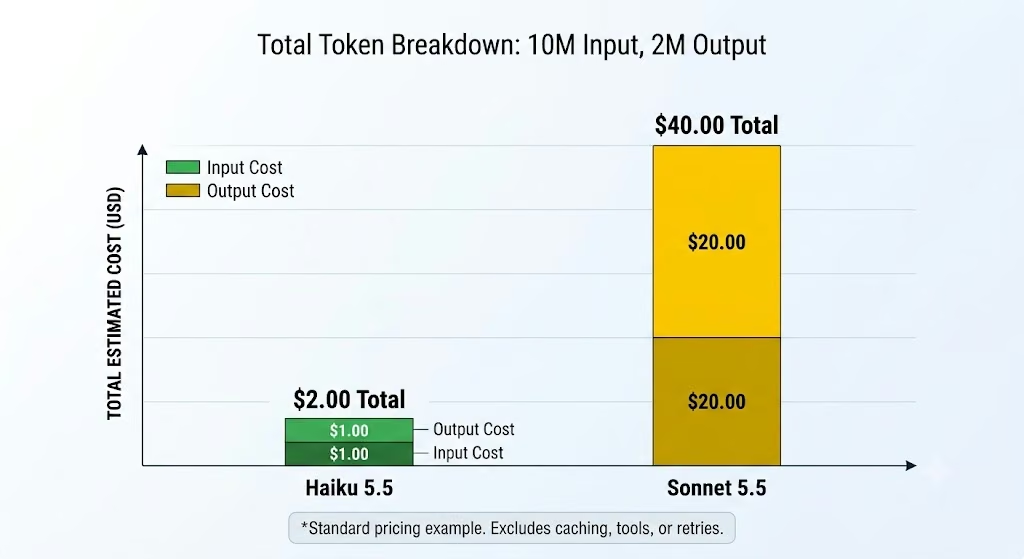
Consider an illustrative workload where you need to give 10 million input tokens and generate 2 million output tokens.
This example only uses standard prices. It excludes caching, tools, retries, and other charges.
For the same workload, Haiku 5.5 costs 95% less than Sonnet 5.5. The reduction from $40 to $2 is in token costs when you use Haiku 5.5 for the same workload.
Price is not the only factor in value. If Haiku 5.5 needs several retries to complete a task, Sonnet 5.5 completes it correctly on the first attempt. Consider comparing the cost per successful task, not just token pricing.
What about longer prompts?
When the limit exceeds 100,000 tokens, Haiku 5.5 uses higher rates. Input pricing rises to $0.50 per million tokens, while output pricing rises to $2.50 per million tokens.
The shift matters when you work with large documents, extensive conversation histories, or substantial codebases. Review the applicable price tier before estimating your monthly budget.
Performance Benchmarks: Where Does Haiku 5.5 Lead?
Sonnet 5.5 outperforms Haiku 5.5 in several benchmarks, including agentic coding, computer use and knowledge work.
The figures below are reported benchmarks. They do not guarantee performance on your application. The numbers are published by Anthropic on its Haiku 5.5 launch page.
Benchmark remarks are based on Anthropic formats. GDPval-AA and AA-Briefcase use scores rather than percentages. Results can depend on evaluation settings, tools, and effort levels.
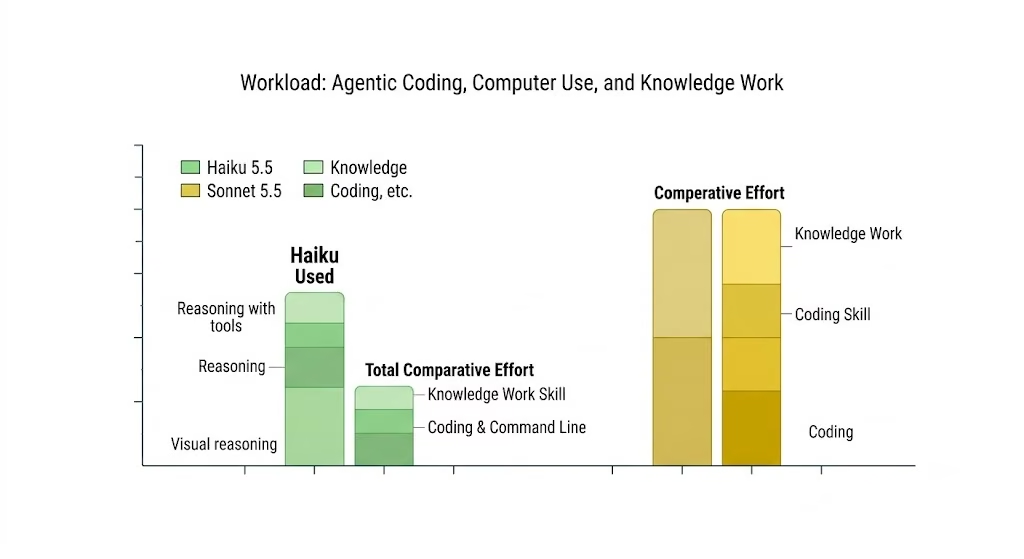
What do these scores tell you?
Haiku's results are still impressive for a small model. A lower-cost model can do meaningful work, based on its 72.4% OSWorld score and 1620 GDPval-AA score. This depends on your workflow's complexity and reliability needs.
Sonnet 5.5 is well suited to complex coding situations. Its Terminal-Bench 4.0 score is 70.6%, compared with 39.2% for Haiku 5.5. That gap matters when an agent must take multiple steps to perform a complex action while operating a terminal.
Sonnet also leads OSWorld 2.1, which rates computer-use agents. This suggests a benefit when an application needs to communicate with a graphical interface rather than just text.
One caution: Benchmarks are defined tests. Make your own assessments on actual user requests before deciding which model to use.
A Haiku upgrade costs less than a Sonnet move. Our Haiku 5.5 vs Haiku 4.5 comparison covers what it buys.
Coding and AI Agents: Which Model Should Developers Use?
For more complex agentic coding, Sonnet 5.5 is a good starting point. But Haiku 5.5 is better for smaller coding tasks and supporting roles in an AI workflow.
What a coding agent needs to do makes the difference more apparent. Creating a short function is one thing, and creating several is another. Understanding an unfamiliar codebase, finding a bug, modifying multiple files, running tests, and resolving issues is yet another.
In the second scenario, Sonnet 5.5 is more impressive. Terminal-Bench 4.0 makes it the more attractive option. In addition, Anthropic calls Haiku 5.5 suitable as a subagent for coding, alongside Sonnet 5.5 and Opus 5.5.
Here is a practical breakdown.
These are not set rules. If the logic is security-sensitive, then Sonnet is still suitable for a small coding task. On more challenging prompts, tools, and efforts, Haiku can be very effective as well.
Can you combine both models in one workflow?
Yes. A multi-model workflow can be configured so that routine work is conducted in Haiku and escalates to Sonnet for more complex work.
For example, if you are developing an AI-powered project management app, Haiku 5.5 could categorize incoming tasks, summarize updates and extract deadlines. Sonnet 5.5 could help with a complex scheduling bug or a multi-step implementation.
This can be implemented to lower the cost of the model while still allowing it to have different capabilities for different tasks. It does add orchestration overhead; be sure to measure the added latency and routing complexity.
If moving up a tier is the only way to get what you need, it’s worth checking other vendors first. Our Haiku 5.5 alternatives guide covers the field.
Speed and Response Quality: Which One Feels Better?
For workloads that demand speed, Haiku 5.5 is a better option; for workloads that don't, Sonnet 5.5 is better.
Anthropic says Haiku 5.5 is the fastest model at their default speed, though it adds that Haiku is slower than Opus in Fast Mode.
Speed does not just refer to how long a model takes to produce an answer for an application. It also affects an interface's responsiveness.
Consider these scenarios:
- Live customer support: Haiku can work well if users have standard questions they need answered promptly.
- Short rewrites, summaries, and content classification: Haiku can help with this type of writing in the app.
- Research assistance: If the research is complex and you need to synthesize multiple sources and think through competing explanations, Sonnet might be worth the added price.
- AI coding assistance: Sonnet is a better place to begin with complex debugging and multi-step code modifications.
As always, remember: being fast doesn't guarantee a good user experience. Response time can vary based on retrieval, database queries, external API calls, tool execution, network latency, etc.
Do end-to-end latency testing on the actual application rather than relying on model-level claims.
The gap between these two is mostly a price gap. Our Haiku 5.5 pricing guide covers what that looks like at volume.
How Does This Comparison Matter When Building Apps With Emergent?
With an AI-powered application built with Emergent, the most important thing to keep in mind is that model selection should be based on what the application actually needs, not just on its capabilities.
Emergent is an AI app-building platform that converts a description into a working, full-stack application that can be deployed. It's valuable to recognize which tasks require speed, which require deeper thinking, and where AI is most useful when planning a product.
When a user builds an application on Emergent, the process follows a workflow. The general lesson is useful for founders: choose the model that best fits the workflow, then define that workflow. This helps you understand your business's actual experience and costs before scaling up.
Reliability, Safety, and Practical Limitations
No model is foolproof, and it is up to the individual to decide which to use based on the consequences of a wrong answer.
According to Anthropic, Haiku 5.5 alignment evaluations are improved over those of Haiku 4.5. It also uses more restrictive cybersecurity protections than Haiku 4.5, but fewer than Sonnet 5.5.
To developers, there are three things to consider:
- Test and validate outputs: Test both models with real examples, ambiguous requests and edge cases.
- Secure critical operations: Implement permission controls and validation before an AI agent modifies records, handles payments or takes other actions with significant impact.
- Review total cost: Cost of retries, cost of calls, cost of caching, cost of failed tasks.
Increasing benchmark scores does not remove the need for testing. Also, it is not the cheaper choice if the lower-cost model is more error-prone or requires more processing.
Haiku 5.5 vs Sonnet 5.5: Final Verdict
Choose Haiku 5.5 when speed and cost are your primary constraints. Sonnet 5.5 is better suited for complex reasoning and task completion. You may combine the two in applications with varied workloads to achieve a better practical balance.
Use this decision guide:
The best model meets your quality standards at a reasonable operating cost. Use a representative set of tasks, run both models and assess the outcome before deciding on a production architecture.
When designing a product, know the steps, test the user experience and measure the model's success in meeting its task requirements.
Start building with Emergent.
Most AI app builders stop at prototypes. Emergent creates production-ready apps you can actually launch.
- Production-ready apps
- Web & mobile apps
- Deploy in minutes