


Anthropic Brings Claude Duet AI Agent to India

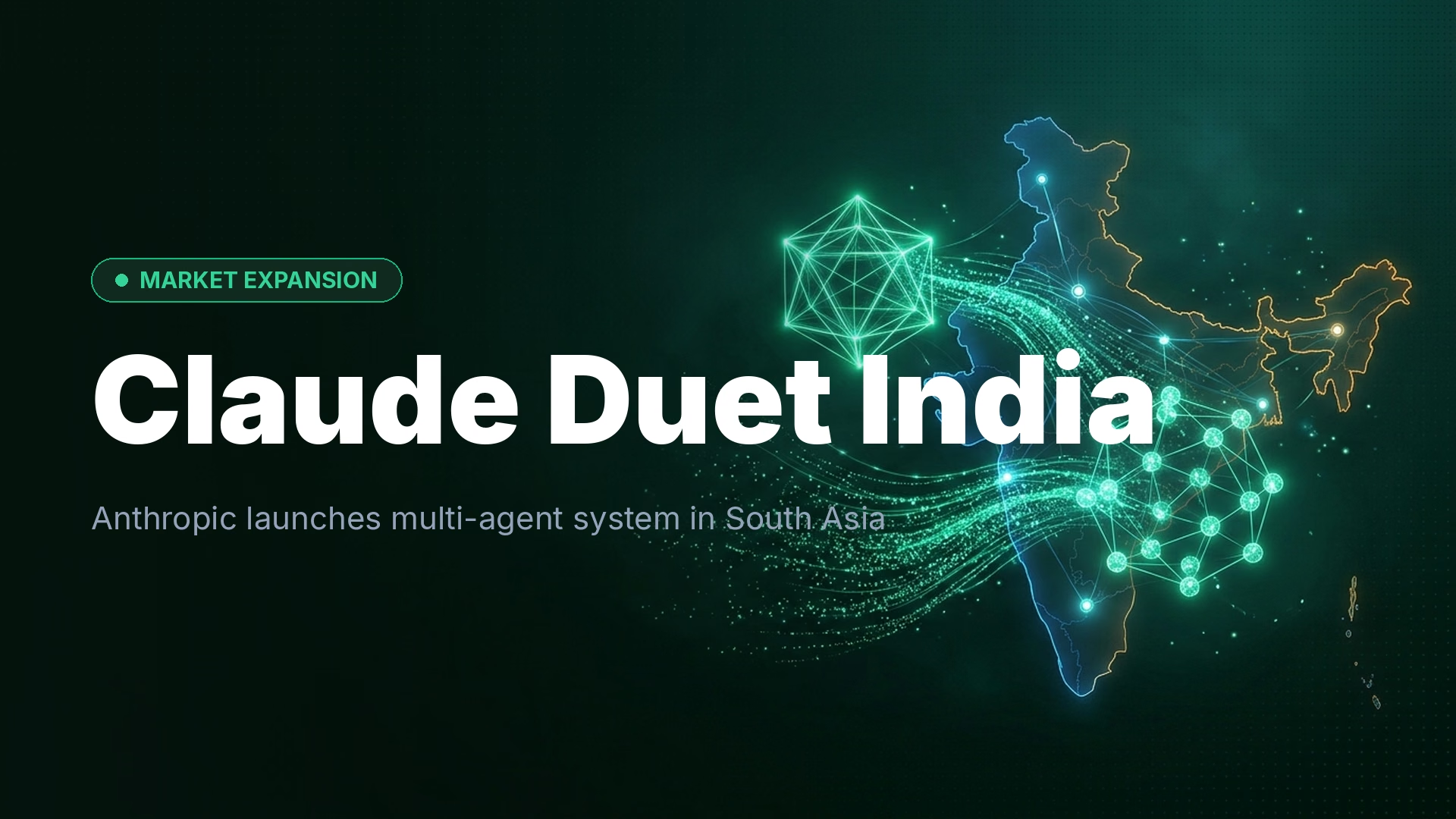
Officially launched on November 25, 2026.
Anthropic officially launched Claude Duet AI agent in India on November 25, 2026, marking a significant geographic expansion for its multi-agent collaboration platform. The launch brings advanced AI agent capabilities to South Asian developers and enterprises, positioning India as a strategic market for Anthropic's autonomous system offerings. Claude Duet enables two specialized AI agents to work together on complex software engineering tasks, coordinating their efforts in real time.
What Claude Duet Brings to Indian Developers
Claude Duet introduces a dual-agent architecture where two instances of Claude collaborate on code generation, debugging, and system design tasks. One agent typically focuses on high-level problem decomposition while the second handles implementation details and edge cases. This division of labor mirrors pair programming methodologies used by human developers, but operates at machine speed.
The system maintains shared context between agents, allowing them to reference each other's work and build incrementally on solutions. Indian software teams working on microservices architectures, cloud-native applications, and AI-powered products can leverage this capability to accelerate development cycles. Early adopters report 40-60% reduction in time spent on routine refactoring and API integration tasks.
Enterprise and Startup Market Focus
Anthropic's India launch targets two distinct segments: established enterprise software teams at multinational corporations and AI-native startups in Bangalore, Hyderabad, and Pune. Enterprise customers gain access to Claude Duet through Anthropic's API platform with dedicated support for on-premises deployment and data residency compliance.
Startup-focused pricing tiers include usage-based billing aligned with India's cost structures. The platform supports integration with popular Indian developer tools including Zoho Projects, Freshworks APIs, and local version control systems. Anthropic has partnered with regional cloud providers to reduce latency for real-time agent collaboration.
Multi-Agent Collaboration Architecture
The technical foundation of Claude Duet relies on coordinated reasoning between agents with distinct system prompts and optimization parameters. Key capabilities include:
- Parallel code path exploration where agents test different implementation approaches simultaneously
- Automated code review workflows with one agent writing and the other critiquing for security vulnerabilities
- Distributed testing strategies where agents generate complementary test suites covering edge cases
- Documentation synthesis with one agent focused on API references and the other on usage examples
The system uses reinforcement learning from agent-to-agent feedback, continuously improving coordination patterns based on successful task completions. This architecture differs from single-agent systems by explicitly modeling collaborative problem-solving dynamics.
India's AI Agent Development Landscape
India represents the world's third-largest developer population and a rapidly growing market for enterprise AI tools. Local adoption of AI agents has accelerated across fintech, healthcare IT, and business process automation sectors. Anthropic's entry follows similar expansions by OpenAI and Google into the Indian market earlier in 2026.
The launch includes localized documentation in Hindi, Tamil, and Telugu, alongside English-language resources. Anthropic plans developer workshops in six Indian cities throughout December 2026 and January 2027, focusing on agent orchestration patterns and production deployment strategies.
What This Means
Anthropic's India launch of Claude Duet signals growing recognition of South Asia as a critical market for advanced AI infrastructure. By bringing multi-agent capabilities to Indian developers, Anthropic positions itself to capture enterprise adoption in a region expected to generate $450 billion in AI-driven economic value by 2030. The dual-agent architecture addresses real bottlenecks in software development workflows while introducing collaborative AI patterns that may define next-generation development tools. For Indian tech companies competing globally, access to cutting-edge agent systems levels the playing field in building autonomous software capabilities.
on Emergent today


