


Canada Embraces AI Data Centers While US Pushes Back

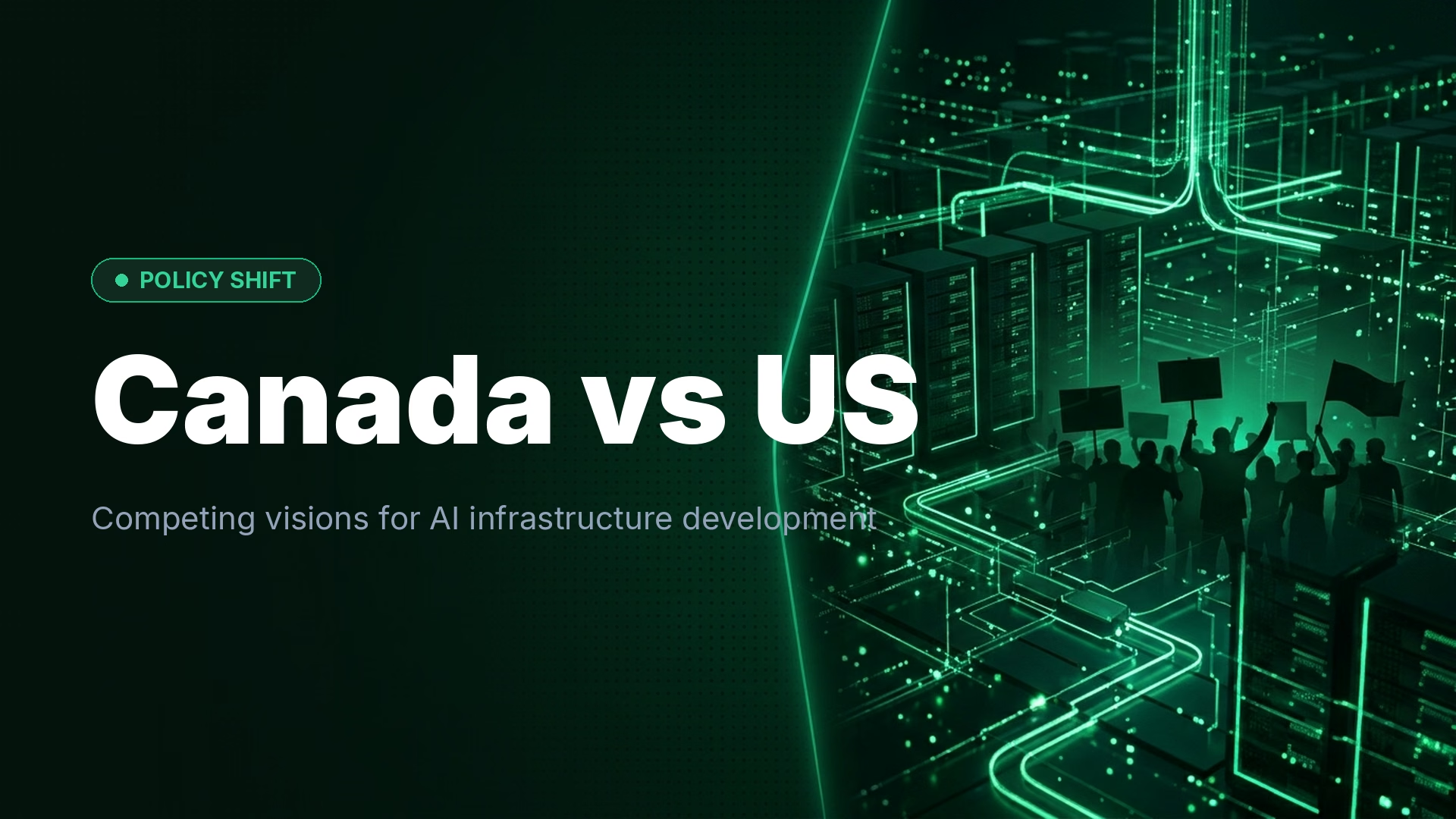
Canada is positioning itself as the preferred destination for AI data center development while US communities increasingly resist new infrastructure projects. The policy divergence marks a critical inflection point as AI labs race to secure compute capacity for next-generation models. Canadian federal and provincial governments are offering streamlined permitting, energy partnerships, and tax incentives that contrast sharply with mounting US opposition to data center expansion.
Canada's Strategic Infrastructure Push
The Canadian government announced a coordinated national strategy to attract AI data center investment in November 2026. The initiative includes expedited environmental reviews reducing approval timelines from 18 months to under six months, dedicated renewable energy allocations from provincial utilities, and corporate tax relief for facilities meeting sustainability benchmarks. Quebec, Ontario, and British Columbia have committed to reserving combined grid capacity exceeding 2 gigawatts specifically for AI infrastructure through 2028.
Anthropic became the first major AI lab to sign a Canada data center deal under the new framework, selecting a Quebec location with access to hydroelectric power. Industry observers expect similar announcements from other hyperscalers as Canadian provinces compete to offer the most attractive energy economics and regulatory certainty.
US Communities Mount Resistance
American resistance to AI data center expansion has intensified throughout 2026, with local governments in Virginia, Ohio, and Oregon voting to block or severely restrict new projects. Community concerns center on power consumption, water usage for cooling systems, and infrastructure strain without commensurate local employment benefits. US AI data centers now consume more electricity than several small states combined, triggering utility commission scrutiny and rate hike debates.
Environmental groups have successfully delayed multiple projects through litigation, arguing that AI compute facilities undermine state renewable energy transition goals. The regulatory fragmentation across municipal, county, and state jurisdictions creates unpredictable approval timelines that deter capital investment compared to Canada's coordinated federal approach.
Energy and Economic Calculations
Canada's advantage stems from surplus renewable energy capacity and existing transmission infrastructure originally built for resource extraction industries. Provincial utilities can offer long-term fixed-rate contracts that provide budget certainty for facilities with 10-15 year operational horizons. The Canadian model bundles energy access with workforce development programs, creating skilled labor pipelines that address one of data center operators' primary concerns.
US data center economics face headwinds from aging grid infrastructure requiring costly upgrades often passed to developers through connection fees and capacity charges. The lack of federal coordination means operators must navigate 50 different state regulatory frameworks, multiplying compliance costs and legal risks.
Release Date and Adoption Timeline
Officially launched on November 20, 2026, Canada's national AI infrastructure strategy has already attracted expressions of interest representing over $8 billion in potential investment. The first facilities under the program are expected to begin construction in Q1 2027, with initial capacity coming online by late 2027. Industry analysts project Canada could capture 20-25% of North American AI data center investment through 2028 if the policy framework remains stable.
What This Means
The Canada-US infrastructure divide signals a fundamental shift in how nations compete for AI industry investment. Canada's proactive approach treats data center capacity as strategic national infrastructure, while US resistance reflects local democratic control colliding with centralized industry needs. This policy divergence will likely influence where AI labs locate future research facilities and training operations, potentially reshaping North American AI development geography. Organizations planning multi-year compute roadmaps now face a choice between regulatory certainty in Canada and established ecosystem advantages in US tech hubs, with no clear optimal strategy as both markets evolve through 2027.


on Emergent today


