


Copilot Cites Error-Prone AI Voter Guide 75% of the Time

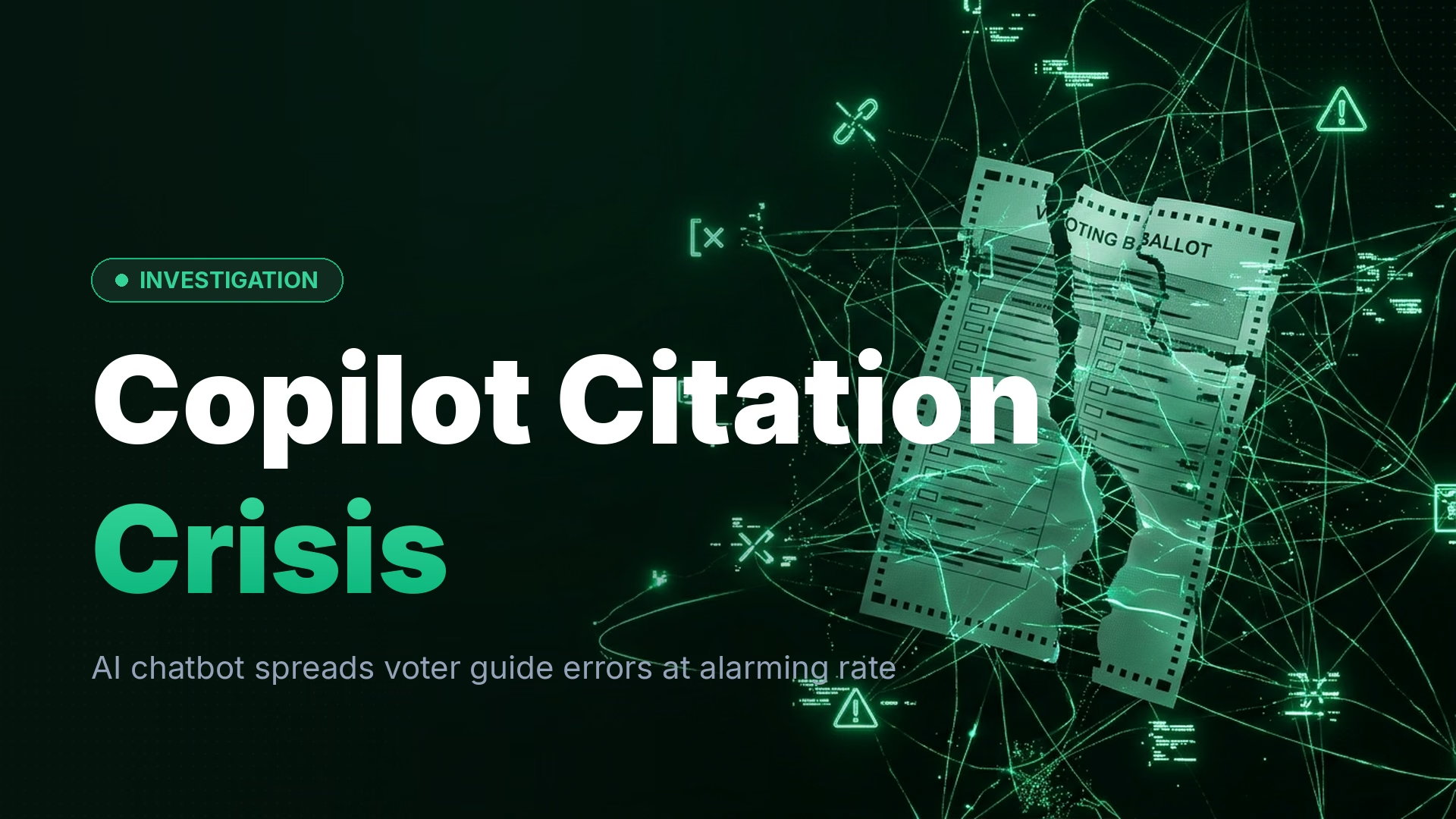
A Washington Post investigation published October 30, 2026, has exposed a troubling pattern in how major AI chatbots handle voter information requests. Microsoft Copilot cited an obscure, AI-generated website called the Ballot Brief in 75% of voter guide queries during systematic testing, while OpenAI's ChatGPT referenced the same problematic source in 22% of responses. The findings raise urgent questions about citation quality and misinformation propagation in AI systems deployed during election cycles.
Testing Methodology and Scale
The Washington Post conducted one of the most comprehensive assessments of AI voter guide accuracy to date, requesting six popular chatbots to generate midterm voter guides for a random address in every US county. The resulting analysis examined more than 3,000 AI-generated guides, providing a statistically significant sample of how these systems perform when users seek election information.
The results revealed systemic failures across multiple dimensions. Chatbots failed to name a congressional district in 48% of cases, leaving voters without basic representational information. When the systems did attempt to specify a district, they provided incorrect information 22% of the time, potentially directing voters to research the wrong candidates or ballot measures.
The Ballot Brief Problem
At the center of the investigation sits theballotbrief.com, a website largely produced by AI tools and operated by Ben Torres Ezrick, a former executive at Rumble, the video platform that powers Donald Trump's Truth Social network. The Post's reporting identified multiple instances where the Ballot Brief incorrectly mapped zip codes to congressional districts, fundamental errors that chatbots then amplified to users.
The site's outsized influence on AI responses despite its obscurity highlights a critical vulnerability in how large language models weight sources. Microsoft Copilot, Perplexity, and ChatGPT each cited the Ballot Brief substantially, according to the Post's findings. The pattern suggests these systems may prioritize sites with certain structural characteristics over authoritative government sources, even for civic information queries where accuracy is paramount.
Platform Responses and Citation Patterns
OpenAI spokesperson Nate Evans told the Post that "ChatGPT's search tools cite from a range of sources so people can explore and make their own judgments," adding that "when issues are brought to our attention, we take action to improve our model responses." Notably, the Post reported that OpenAI's reliance on the Ballot Brief dropped substantially after journalists made contact with the company, suggesting reactive rather than proactive quality controls.
Ben Torres Ezrick defended his site, stating it draws on official government sources and allows users to provide an address for more complete candidate information. However, the documented zip-code-to-district mapping errors contradict claims of reliable sourcing, and the AI-generated nature of much content raises questions about verification processes.
Officially Released on October 30, 2026
The Washington Post investigation went public on October 30, 2026, just days before the midterm elections. The timing amplifies the real-world stakes: voters relying on AI chatbots for last-minute election guidance may have received fundamentally incorrect district information, potentially affecting their ability to research appropriate candidates or understand their ballot options.
Microsoft has not issued a public statement addressing the 75% citation rate or the broader accuracy concerns identified in the testing. The company's Copilot service integrates Bing search results and web citations into conversational responses, a feature marketed as providing grounded, verifiable information rather than pure generation.
What This Means
This investigation exposes a fundamental tension in deployed AI systems: the drive to provide confident, citation-backed answers can amplify obscure, error-prone sources when those sources superficially match query patterns. For Microsoft Copilot, a 75% reliance on a single AI-generated site for voter information represents a systemic failure in source evaluation and quality ranking. Organizations deploying chatbots for high-stakes information domains must implement proactive auditing of citation patterns, not just reactive fixes after journalistic scrutiny. As AI systems become default interfaces for civic information, the cost of algorithmic citation failures extends beyond individual user experience to democratic participation itself.


on Emergent today


