


Gemini 4 Argon for Robotics Launches with Real-Time Control

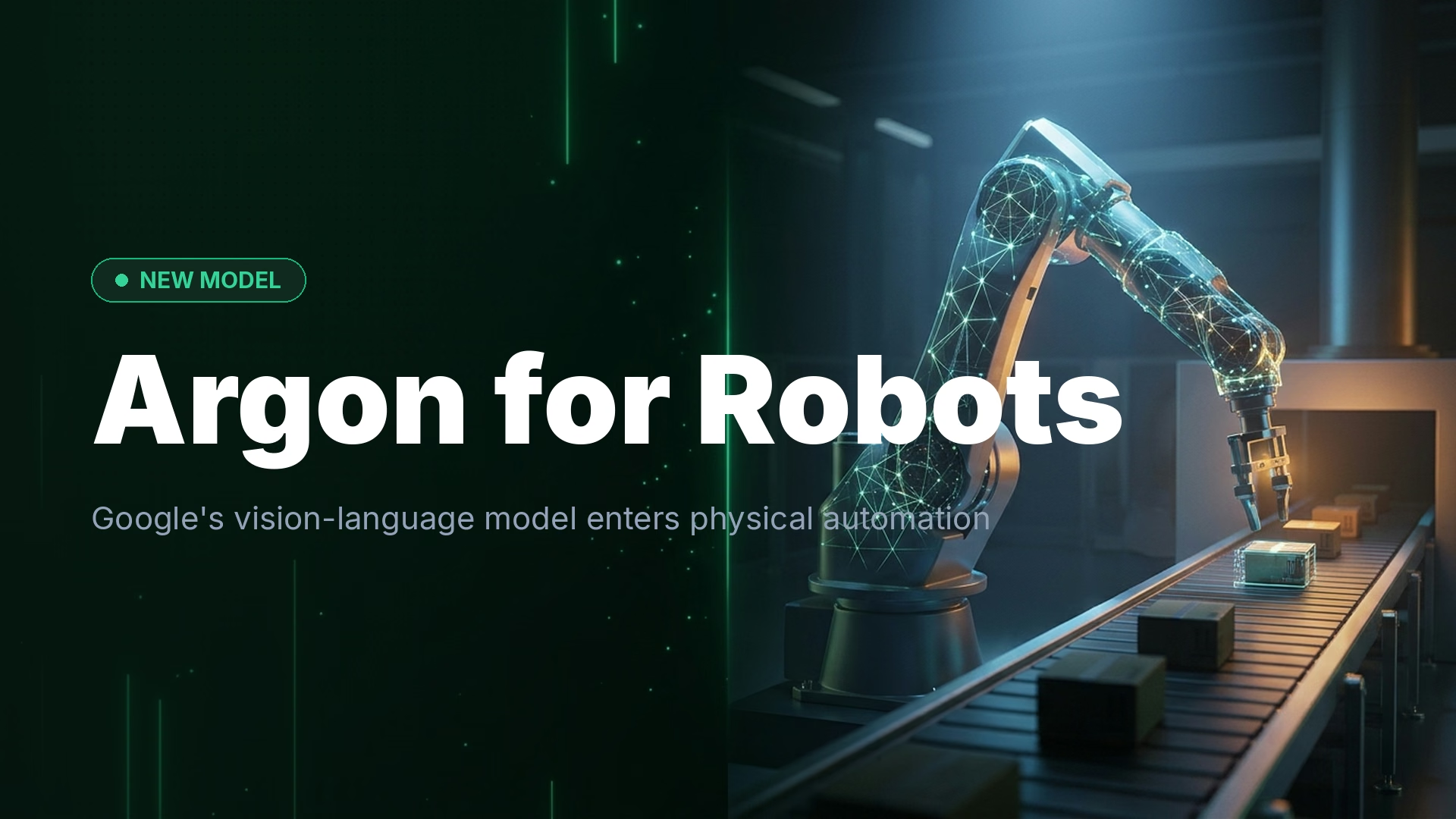
Google DeepMind has extended its Gemini 4 Argon model into the physical world with a robotics-specific variant designed for real-time control of autonomous systems. Officially launched on October 13, 2026, Gemini 4 Argon for Robotics brings vision-language understanding to manufacturing floors, warehouses, and logistics operations where robots must interpret complex environments and execute multi-step tasks with minimal human intervention.
Real-Time Vision-Language Control
The robotics variant inherits Gemini 4 Argon's multimodal architecture while adding low-latency inference optimizations for physical control loops. The model processes visual input from cameras and depth sensors alongside natural language instructions, enabling robots to understand commands like "move the red box to the left pallet" without explicit coordinate programming. According to Google DeepMind, the system achieves sub-100 millisecond response times, critical for safe operation in dynamic environments where humans and machines work alongside each other.
The model supports both cloud-based and edge deployment configurations. Manufacturing partners can run lightweight versions directly on robotic control units for offline operation, while cloud connectivity enables fleet-level coordination and continuous learning from aggregated experience across multiple robots.
Manufacturing and Logistics Applications
Early production deployments span three primary use cases. In warehouse pick-and-place operations, robots use Gemini 4 Argon to identify objects by description rather than barcode, reducing the need for standardized packaging and enabling more flexible inventory systems. Manufacturing assembly lines leverage the model's ability to verify component placement and detect defects through visual inspection, tasks that previously required custom computer vision pipelines for each product variant.
- Natural language task assignment without traditional robot programming
- Visual defect detection across product lines without retraining
- Adaptive grasping for irregular or unfamiliar objects
- Multi-robot coordination through shared language understanding
Performance Benchmarks and Integration
Google DeepMind reports that pilot partners achieved 40 percent faster task completion rates compared to traditional programmed routines, primarily due to the model's ability to handle variation without explicit exception handling. Programming time for new tasks dropped by 60 percent, as operators can describe desired behaviors in natural language rather than writing motion planning code. The model integrates with standard robotic middleware including ROS 2 and Isaac Sim, lowering adoption barriers for existing automation infrastructure.
Pricing follows a consumption-based model tied to inference volume, with dedicated robotics tiers offering guaranteed latency and uptime commitments for production environments. Gemini 4 Argon pricing for robotics workloads starts at a base platform fee plus per-robot-hour charges that scale with fleet size.
What This Means
Gemini 4 Argon for Robotics represents a shift from special-purpose robotic systems toward general-purpose agents that learn tasks through demonstration and language rather than explicit programming. The launch positions Google DeepMind directly against specialized robotics AI providers while leveraging the company's foundation model infrastructure. For manufacturers, the technology promises shorter deployment cycles and more adaptable automation, though real-world validation at scale remains an open question as enterprises move beyond pilot programs into full production rollouts.


on Emergent today


