Google first announced and released Gemini 4 Argon on a limited basis to cybersecurity partners via the Fairwind Program on September 30, 2026. On 13 October 2026, Google globally released it for for developers, enterprises, and Google AI. Gemini 4 Argon a new Frontier AI model for coding, reasoning, science, finance, law, and multi-tasking in business processes.
Gemini Argon pricing is important for developers and businesses that want to use this model. Google has provided promotional API pricing until 30 November 2026. After that, input and output tokens will be charged at double the rate.
Gemini 4 Argon API pricing starts at $2 per million input tokens and $10 per million output tokens through November 30, 2026. From December 1, 2026, the rates will be $4 per million input tokens and $20 per million output tokens. Cached input tokens receive a 95% discount under the published pricing structure.
Gemini 4 Argon Pricing Table
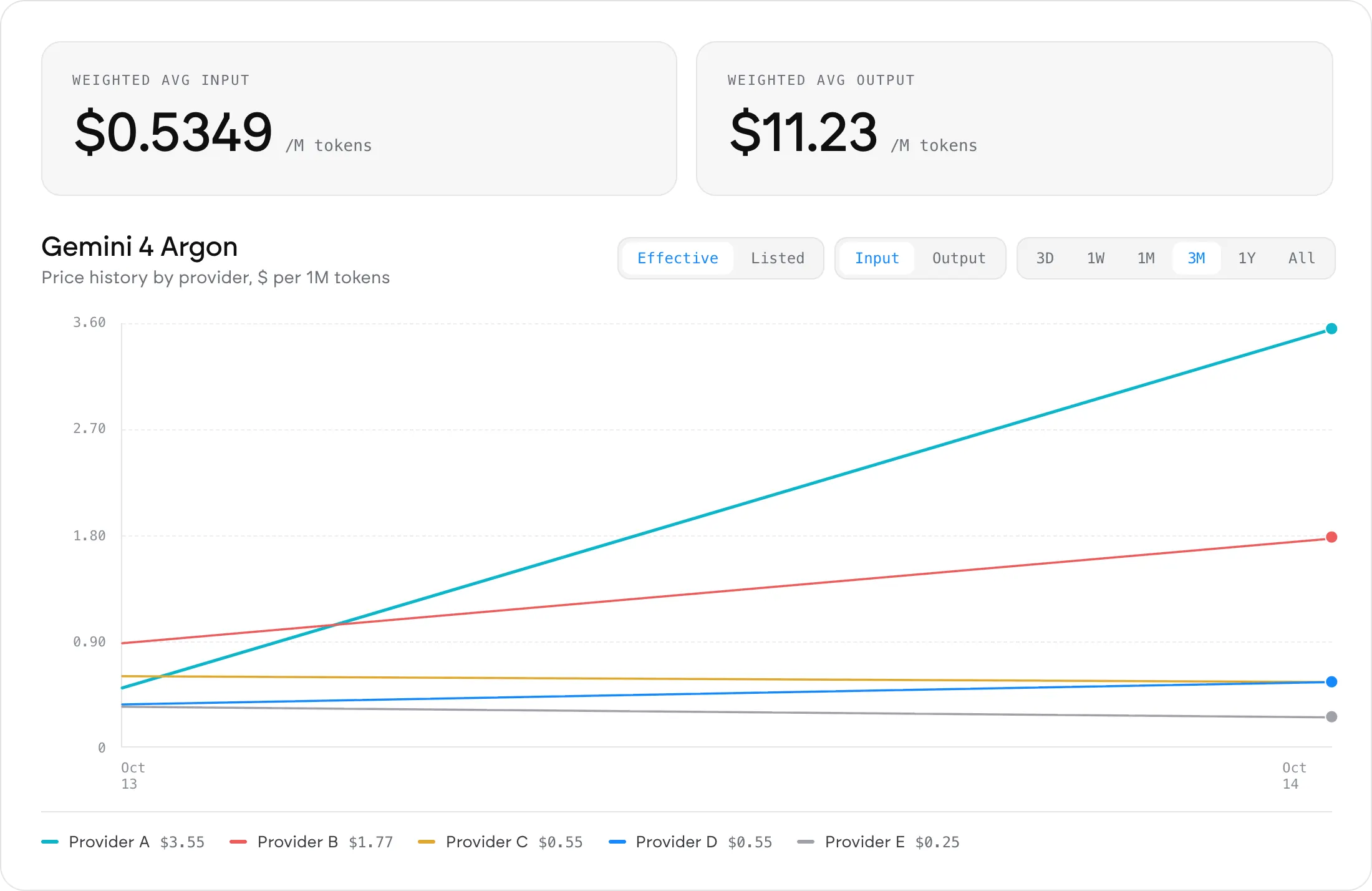
Google charges for input and output tokens separately. Input tokens represent the content you provide to the model, while output tokens include the text the model generates and its reasoning tokens. Gemini Argon is designed to operate in depth and with accuracy, meaning it can retain context throughout lengthy, multi-step procedures and draw on domain expertise throughout. Whether you need your staff to carry out sophisticated software builds, detailed financial and legal operations, or deploy cybersecurity applications such as CodeMender, Argon will help your team stay focused.
The following table summarises the published standard API rates.
1. Gemini Argon Input Token Pricing
Input tokens are the information sent to Gemini 4 Argon. This can include prompts, instructions, conversation history, source documents, and other supported input data.
During the introductory period, Google charges $2 for every million input tokens. The price rises to $4 per million input tokens from December 1, 2026.
For example, if an application processes 500,000 input tokens, the standard input cost during the introductory period would be $1, and from December it will increase to $2
2. Gemini Argon Output Token Pricing
Output tokens comprise the output from the model itself and tokens used for reasoning. This is important as the model doing complicated multi-step processes can consume many more output tokens compared to one that produces a short output.
The pricing for Gemini 4 Argon is $10 per million output tokens in its introductory stage. Starting December 1, 2026, the price will be raised to $20 per million output tokens.
For instance, generation of 100,000 output tokens will cost:
- During the introductory period: $1
- From December 1, 2026: $2
For accurate budgeting, developers should account for reasoning tokens as well as the final text returned by the model.
3. Gemini Argon Cached Token Pricing
The use of caching will help to save money if the application is working on similar input data many times. It is beneficial in the case of processes with recurring instructions, extensive reference data, or recurring context.
According to Google, there is 95% savings on cached input tokens. According to the standard price set by Google, the cost of cached input tokens is:
- Through November 30, 2026: $0.10 per million tokens.
- From December 1, 2026: $0.20 per million tokens.
Gemini 4 Argon supports implicit caching, which is enabled by default for prompts of at least 4,096 tokens when cache hits occur. Explicit context caching is not supported for this model, so developers should review the official model documentation before adapting existing applications.
How Much Does Gemini 4 Argon Cost in Practice?
The cost of using Gemini 4 Argon depends on how many input and output tokens an application consumes. The following examples illustrate estimated API costs using Google’s published standard rates.
These estimates exclude cached input tokens and other potentially applicable charges. They assume the standard input and output rates, with no additional service-tier adjustments.
Price is one of several things that differ between vendors. Our Gemini 4 Argon alternatives guide covers availability and limits too.
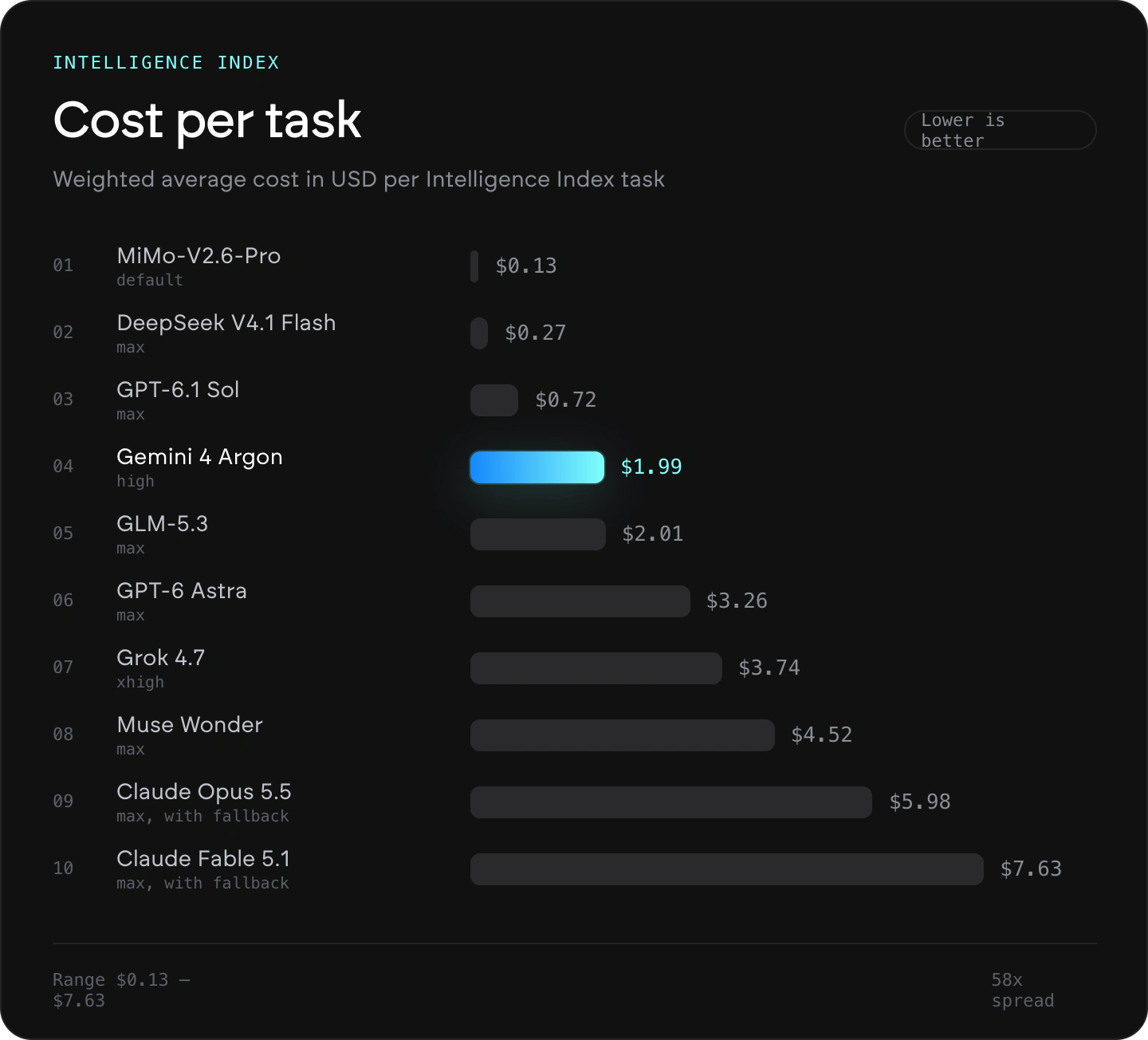
Argon Pricing: What does it cost against Opus 5.5 and GPT-6 Astra?
Starting today, Google AI Pro and Ultra subscribers can use Gemini 4 Argon via the Gemini app. Google AI Pro is priced at $19.99 per month. At I/O 2026, Google introduced an $100-a-month Ultra plan and cut its most expensive Ultra tier price from $250 to $200 per month.
This is lower than the prices charged by both main competitors. Anthropic charges $4 and $20 per million input and output tokens for Claude Opus 5.5, while GPT-6 Astra costs $10 and $50 per million tokens. The current news announcement talks about the Gemini app, but nothing is mentioned about the API access availability beyond what Google has announced before.
Is Gemini 4 Argon Available for Free?
According to Google’s Gemini API documentation, Gemini 4 Argon is available through the paid Gemini API tier in Google AI Studio and the Gemini platform. Google also offers access through Gemini for business and Google Antigravity, subject to the relevant product’s access and subscription requirements.
It is important to distinguish between API pricing and consumer or business subscriptions. A subscription that provides access to Gemini 4 Argon through a Google product does not necessarily include API usage or unlimited API access..
What Affects Gemini Argon API Costs?
Token rates are only one part of the total cost of running an AI application. The following factors can affect your bill.
Input and output volume
Long prompts, extensive conversation histories, large documents, and detailed responses can increase token consumption. Applications that generate long responses should monitor output usage carefully because output tokens cost more than input tokens.
Requirements for reasoning
Gemini 4 Argon is built for more sophisticated reasoning tasks and multiple-step processes. Reasoning tokens are counted as output tokens in Gemini 4 Argon, which means that tasks with more extensive analysis might become more expensive than regular requests.
Cache opportunities
Recurring context could qualify for implicit caching. With the help of cached input tokens, discounts are available. It should be mentioned that the discount depends on the effectiveness of cache hits.
Service tier and other services
Standard rates listed in this article do not apply to all scenarios. If you use priority or another service tier, search grounding, and additional platform services, please refer to the pricing page.
The change in pricing in December 2026
Introductory pricing will apply until November 30, 2026. After this date, standard input and output prices will double.
For teams planning long-term deployment of Gemini 4 Argon, it makes sense to consider both periods.
Context Window and Output Limit of 1 Million Tokens
According to Google, Gemini 4 Argon has an output limit of 1 million tokens, compared to 64,000 for its predecessor models, but no stated input context window. While some sources mention 1 million tokens as the input context window, we did not find any reference to that number from Google, and therefore cannot confirm it.
The output limit is the real factor that differentiates Gemini 4 Argon. According to MarkTechPost (2026), Claude Opus 5.5, Claude Fable 5.1, and GPT-6 Astra restrict responses to 128,000 tokens. Google mentions migrating C and C++ to Rust up to 800,000 lines of code, including the Fuchsia Zircon kernel, as the goal of using the agent.
The response of this size is both expensive and risky. At $10 per million tokens, a maximal response will cost up to $10 at the introductory pricing level and $20 at the standard one. Most importantly, a single 800,000-line output cannot be reviewed by humans line by line.
For the performance side, read our Gemini 4 Argon benchmarks breakdown.
How to Get Started With Gemini 4 Argon
Developers can access Gemini 4 Argon through Google AI Studio and the Gemini platform API using the model ID gemini-4 Argon. Google also lists availability through Gemini for Business and Google Antigravity.
Before deploying the model:-
- Review the Gemini 4 Argon model documentation.
- Set up access through a supported Google platform.
- Configure the model ID and test it against representative tasks.
- Track input, output, and cached token consumption.
- Set budget controls and estimate costs at both introductory and standard rates.
If you are building an AI-powered application around a model such as Gemini 4 Argon, you should also account for the application interface, backend services, integrations, testing, and deployment. The model’s API charges are only one component of the overall development and operating budget.
Final Thoughts
Gemini 4 Argon offers capabilities for coding, reasoning, financial analysis, legal workflows, and business automation. Its 1-million-token context window makes it worth evaluating for applications that need to process large volumes of information. However, the right model ultimately depends on performance requirements, API pricing, and the complexity of the task.
Once you have compared API costs across models, the next step is turning that research into a working application. Emergent makes this easier by allowing you to build full-stack applications using natural-language prompts and connect supported AI models through its Universal LLM Key, subject to availability and applicable billing requirements.
Before deploying an application to production, test the selected model against your specific use case, evaluate its output quality, and account for API usage and infrastructure costs to ensure the solution meets your performance and budget requirements.
Most AI app builders stop at prototypes. Emergent creates production-ready apps you can actually launch.
- Production-ready apps
- Web & mobile apps
- Deploy in minutes