


Google Antigravity Accelerates Drug Discovery Workflows

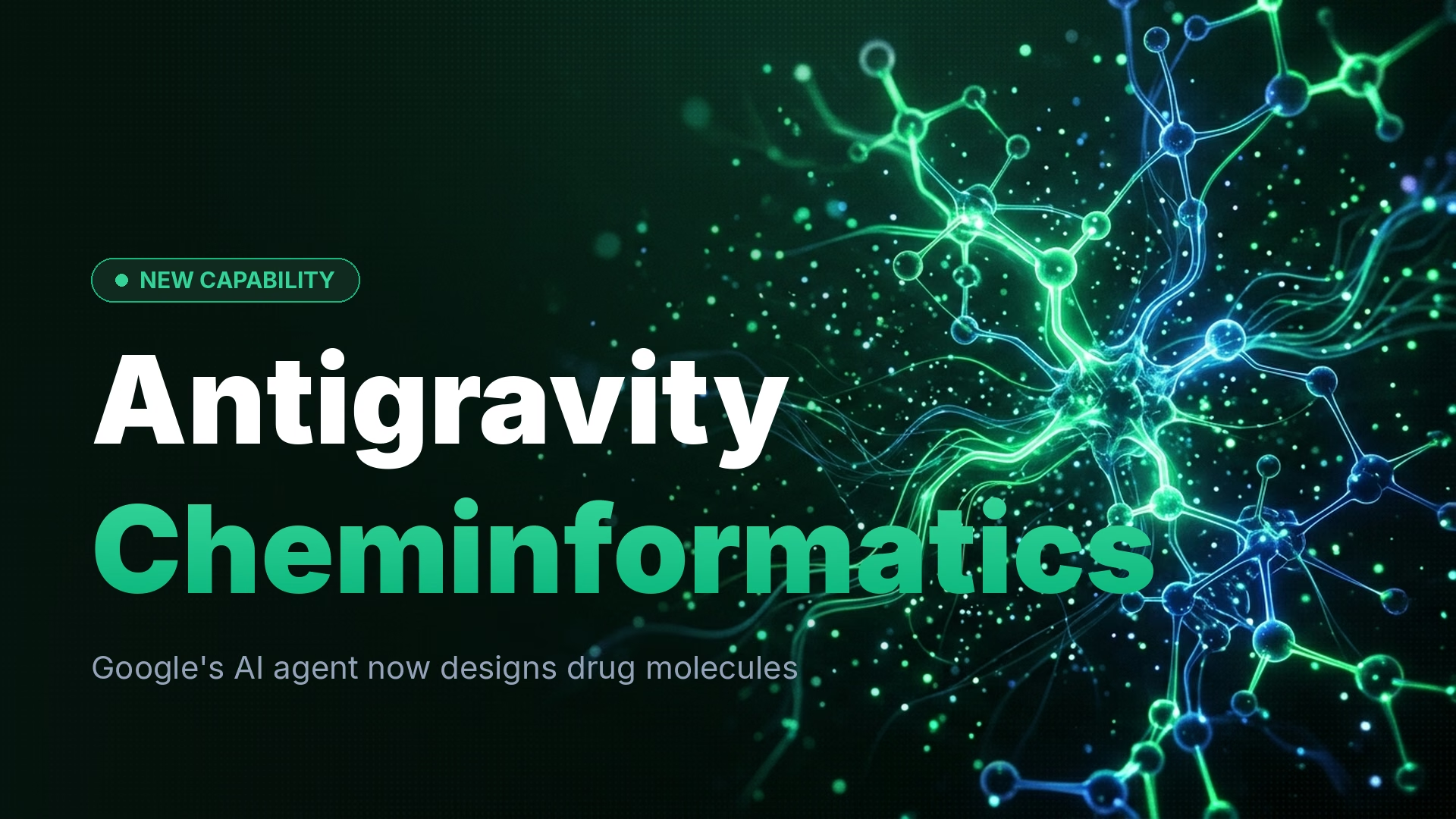
Google DeepMind today introduced Cheminformatics Skills for Google Antigravity, a specialized capability set designed to accelerate pharmaceutical research workflows. The update transforms Antigravity into an autonomous agent for compound discovery, enabling researchers to search molecular databases and propose novel drug candidates through natural language prompts. Officially launched on November 3, 2026, the system targets early-stage drug development bottlenecks that traditionally require weeks of manual computational chemistry work.
Autonomous Compound Search and Database Integration
The Cheminformatics Skills package connects Antigravity to major chemical structure databases including PubChem, ChEMBL, and proprietary pharmaceutical repositories. Researchers can now query millions of compounds using descriptive language rather than precise SMILES notation or InChI strings. The agent interprets requests like "find kinase inhibitors with improved blood-brain barrier penetration" and returns ranked candidates with predicted ADMET properties.
Integration with existing computational chemistry toolkits allows Antigravity to calculate molecular descriptors, predict solubility, and estimate binding affinities without requiring users to switch between multiple software environments. The system maintains context across multi-step workflows, automatically applying filters and refinement criteria as conversations progress.
Rigidified Macrocycle Design
A standout feature enables de novo design of rigidified macrocyclic structures, a promising but challenging drug class. Antigravity proposes conformationally constrained rings by analyzing target protein pockets and suggesting optimal cyclization points. According to the DeepMind blog post, the agent considers synthetic feasibility alongside binding predictions, prioritizing molecules that medicinal chemists can realistically synthesize.
The platform generates 2D structure diagrams and 3D conformer ensembles for proposed macrocycles, exporting files compatible with molecular dynamics packages like GROMACS and Amber. Early testers report that Antigravity's suggestions align with expert intuition while occasionally introducing non-obvious design elements that human chemists might overlook during manual iteration.
Workflow Acceleration and Collaboration Features
Google positions the update as a force multiplier for interdisciplinary teams. Biologists can explore structure-activity relationships without deep computational expertise, while computational chemists offload routine searches to focus on complex modeling tasks. Antigravity maintains audit trails of all queries and decisions, supporting regulatory documentation requirements for preclinical research.
- Natural language queries replace manual database searches across PubChem, ChEMBL, and proprietary libraries
- Automated ADMET prediction and molecular property calculations reduce experiment planning time
- Rigidified macrocycle proposals with synthetic feasibility scoring guide medicinal chemistry prioritization
- Context-aware conversations enable multi-step optimization without resetting project parameters
Availability and Pricing
Cheminformatics Skills are available today to Google Antigravity Enterprise customers through the standard platform interface. DeepMind has not disclosed separate pricing for the life sciences module, suggesting it bundles with existing Antigravity subscriptions. Academic institutions with Google Cloud research grants can request beta access through the DeepMind partnerships program.
What This Means
The launch signals Google's commitment to vertical AI applications beyond general-purpose coding assistants. By targeting pharmaceutical workflows with agentic capabilities, DeepMind addresses a sector where automation historically struggled with domain complexity. If rigidified macrocycle proposals prove reliable in wet-lab validation, the technology could compress early discovery timelines and enable smaller biotech teams to compete with Big Pharma computational resources. The true test will come when published studies reveal whether Antigravity-designed compounds advance through preclinical development at higher rates than conventionally discovered molecules.


on Emergent today


