


What Is Jev? TypeSafe AI's New System One Model, Explained

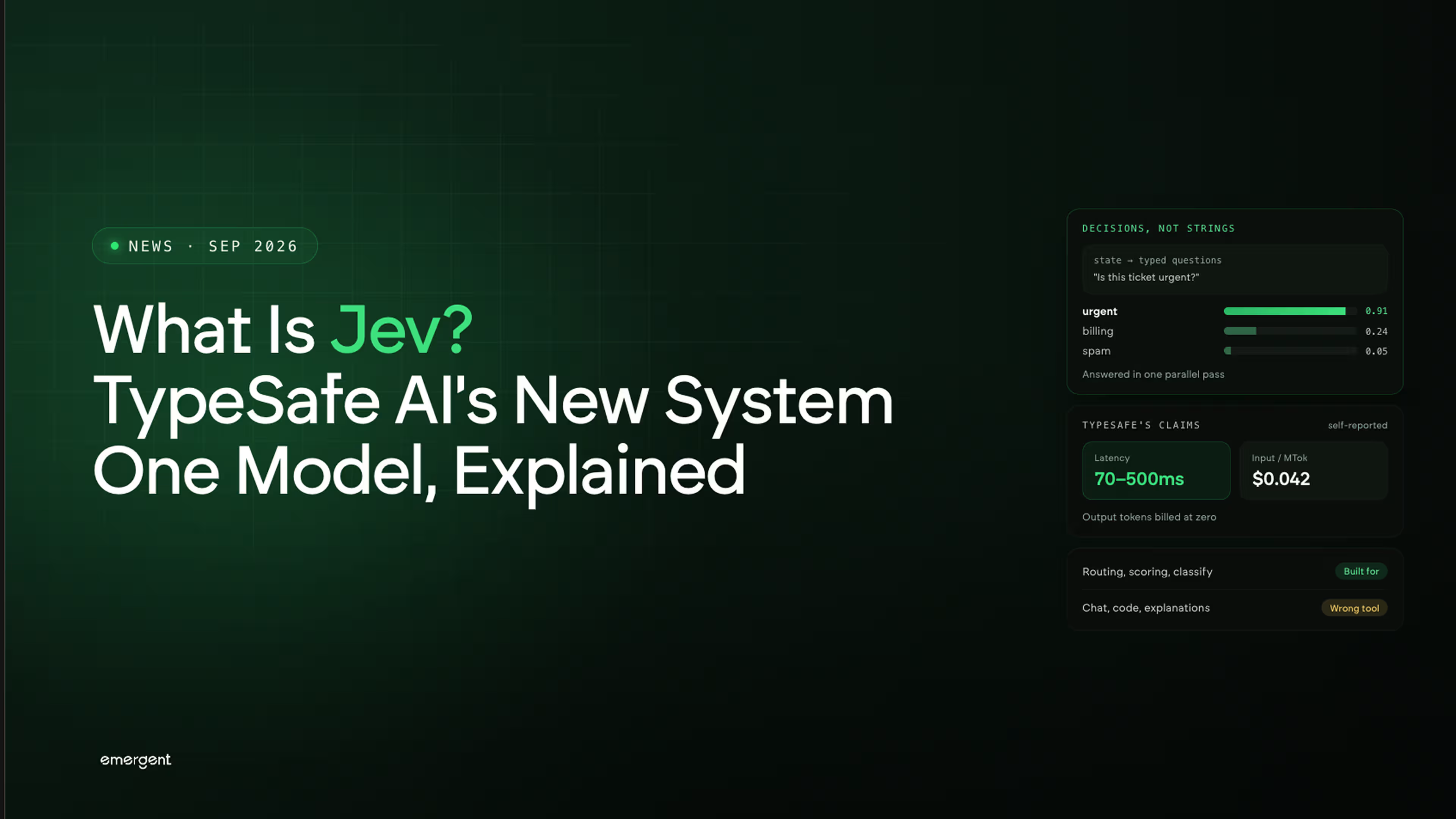
TypeSafe AI launched Jev on September 15, 2026, and it is not a large language model. Jev is the company's first "System One model," a decision engine that takes program state plus a set of typed questions and returns structured answers with what TypeSafe calls calibrated probabilities, evaluated in parallel within a single request. It never writes a sentence. That single design choice is what makes it fast and cheap: TypeSafe prices Jev at $0.042 per million input tokens, with output tokens free.
The launch drew immediate developer interest, enough that TypeSafe briefly ran past its own serving capacity. For anyone building AI-powered software, the release matters less as a chatbot rival and more as a signal about where cheap, reliable machine decisions are heading.
Jev outputs decisions, not text
Jev's core difference from an LLM is what comes out of it. A chat model generates a string one token at a time, and that string then has to be parsed, validated, and checked for errors before software can use it. Jev skips all of that. It defines the possible answers in advance and returns them as typed values, so there is nothing to parse and, by TypeSafe's account, no way for the model to return the wrong shape.
TypeSafe frames the model as "a frontier-intelligence function call: unstructured state in, typed probabilistic decisions out." Every answer arrives with a confidence score, so the surrounding code can act when confidence is high and escalate to a human or a larger model when it is not.
TypeSafe also claims Jev cannot hallucinate, and the claim is narrower than it first sounds. Because the set of valid outputs is fixed ahead of time, the model cannot invent an output type or return a malformed shape; schema matching is guaranteed by construction. That guarantees the answer is valid, not that it is correct. Jev can still return the wrong classification, score, or probability, so the surrounding code still has to decide when to trust a given decision. Even so, a structural schema guarantee is a more defensible claim than the blanket "hallucination-free" promises other vendors have made.
Why it is called a System One model
The "System One" name comes from Daniel Kahneman's distinction between fast, intuitive thinking and slow, deliberate reasoning. Chat and reasoning models chase System 2, the deliberate kind that works through a problem step by step. Jev is built for System 1: the snap judgment a knowledgeable person makes in a second or two, like recognizing a spam email without reading every word.
The model's own name honors William Stanley Jevons, the 19th-century economist behind the Jevons paradox. TypeSafe's thesis borrows directly from him. As the cost of a decision drops toward zero, demand for decisions should climb, putting small pieces of machine intelligence into far more software than expensive LLM calls ever could.
How fast and how cheap
TypeSafe reports end-to-end response times of 70 to 500 milliseconds, which it frames as 40 to 200 times faster than a frontier LLM on the same shaped work. On its own workflow evaluations, the company cites headline figures of 193.6 times faster and 444.6 times cheaper, while noting these sit at the higher end of what real-world use is likely to deliver. These come from TypeSafe's own evaluation setup, using other models as the reference, so they are vendor-reported rather than independent benchmarks.
The pricing is where the design choice becomes concrete.
Jev compared with existing LLMs on cost, speed, and output type. Figures as of September 2026, per TypeSafe AI.
Because Jev produces no output tokens to bill, TypeSafe meters input by the billion rather than the million. The company is candid that it cannot yet prove the pricing is unsubsidized, and says it expects costs to fall over time rather than rise.
Who built it, and how
Jev comes from Diogo Almeida, a former OpenAI researcher who helped develop the RLHF methods behind ChatGPT. He left OpenAI two years before the launch to found TypeSafe AI, driven by a question he has repeated often: models have been superhuman at chat for years, so where is all the automation?
His answer is that the bottleneck was never raw intelligence. It was that a model replying in prose is an awkward part to build reliable software on. TypeSafe trained Jev with a method it calls Reinforcement Learning for Calibrated Decisions, or RLCD, using synthetic data rather than scraped human text. Almeida is tight-lipped about the underlying architecture, which outside observers suspect sits on top of an open-weight model.
Where Jev fits in the agent stack
Jev is built to sit inside automation, not to replace the chatbot. TypeSafe positions it for the high-volume, repetitive decisions that LLMs handle slowly and expensively: classifying, routing, scoring, extracting, and branching where hand-written rules are too brittle. Early adopters have wired it into two roles in particular. As a model router, Jev decides which requests need an expensive model and which a cheap one can handle. As a guardrail, it screens tool calls for risk before they run, catching dangerous actions ahead of execution.
That places Jev alongside LLMs rather than against them. A larger model still does the open-ended reasoning; Jev handles the fast, structured judgment calls around it. The clearest early example came from Vercel. TechCrunch reported that the company swapped an OpenAI classifier for Jev on a command-safety check and saw results five to 18 times faster, with greater accuracy, according to a Vercel engineer.
What it means for AI app builders
For people building software rather than models, Jev is an early marker of a broader shift toward specialized, cheap decision layers rather than one large model doing everything. The likely near-term pattern pairs a frontier model for hard reasoning with small, fast specialists for routing, scoring, and safety checks, with ordinary code holding the rules together.
That shift shows up at the platform level too. Tools like Emergent, which lets non-technical founders and operators build production-grade applications by describing them, run on established production models such as GPT, Claude, and Gemini through a single Universal LLM Key.
Jev sits at a different layer. It is built for the decision plumbing inside an application, not for building the application itself, so the two solve different problems in the same stack. Its arrival still points to the same future Emergent is built for, where dependable AI becomes a standard component of everyday software rather than a novelty.
Jev is early. TypeSafe is opening early access, bringing developers off its waitlist, and says more System One models, in new modalities, are on the way. Whether the category grows depends on whether the reliability holds up outside the vendor's own evaluations. What the launch already shows is a real bet that the next wave of useful AI will be small, fast, and built to be trusted by code, not just admired by people. If you are building software today, that is the shift worth watching.
Start Building on Emergent to put current production models to work while the decision layer matures.
on Emergent today




