



Catherine Vandermeets spent 20 years on the compliance team of a Belgian-American bank, in a back-office role that never satisfied her. After two burnouts, and after all four of her children were diagnosed with ADHD, she was diagnosed too. ADHD became her hyperfocus, and she set out to understand all of it. She studied it in Belgium, France, Switzerland, England, Canada and the United States, and eight years ago she became a full-time ADHD coach. Her French-language brand, Parenthèse TDAH, has since grown into a large online community of adults and parents living with ADHD.
Most of that community could never book a session with her. Catherine wanted to give them her methods anyway, without a coach in the room. So she built Le Copilote TDAH, an ADHD coaching app for adults and families, on Emergent, shaped by eight years of client work and her own household.
Challenges
250,000 followers, and most couldn't afford coaching
Catherine's methods only reached people who could pay for one-to-one sessions, and most of the people asking her for help couldn't. Coaching costs money, and an ADHD diagnosis can be expensive depending on the country. That left most of her community without support, unsure where to start or why they froze in front of simple tasks.
The gap grew with her audience. The community began with one client who felt alone with his symptoms, and in less than a year more than 250,000 people were following her. Yet every tool she used, from reward systems to routines to breaking big tasks into small ones, lived inside her sessions, where she explained it and walked a client through it step by step.
"Coaching has a cost, and not everyone can pay that," she said. "I wanted something that could help everybody in my community."
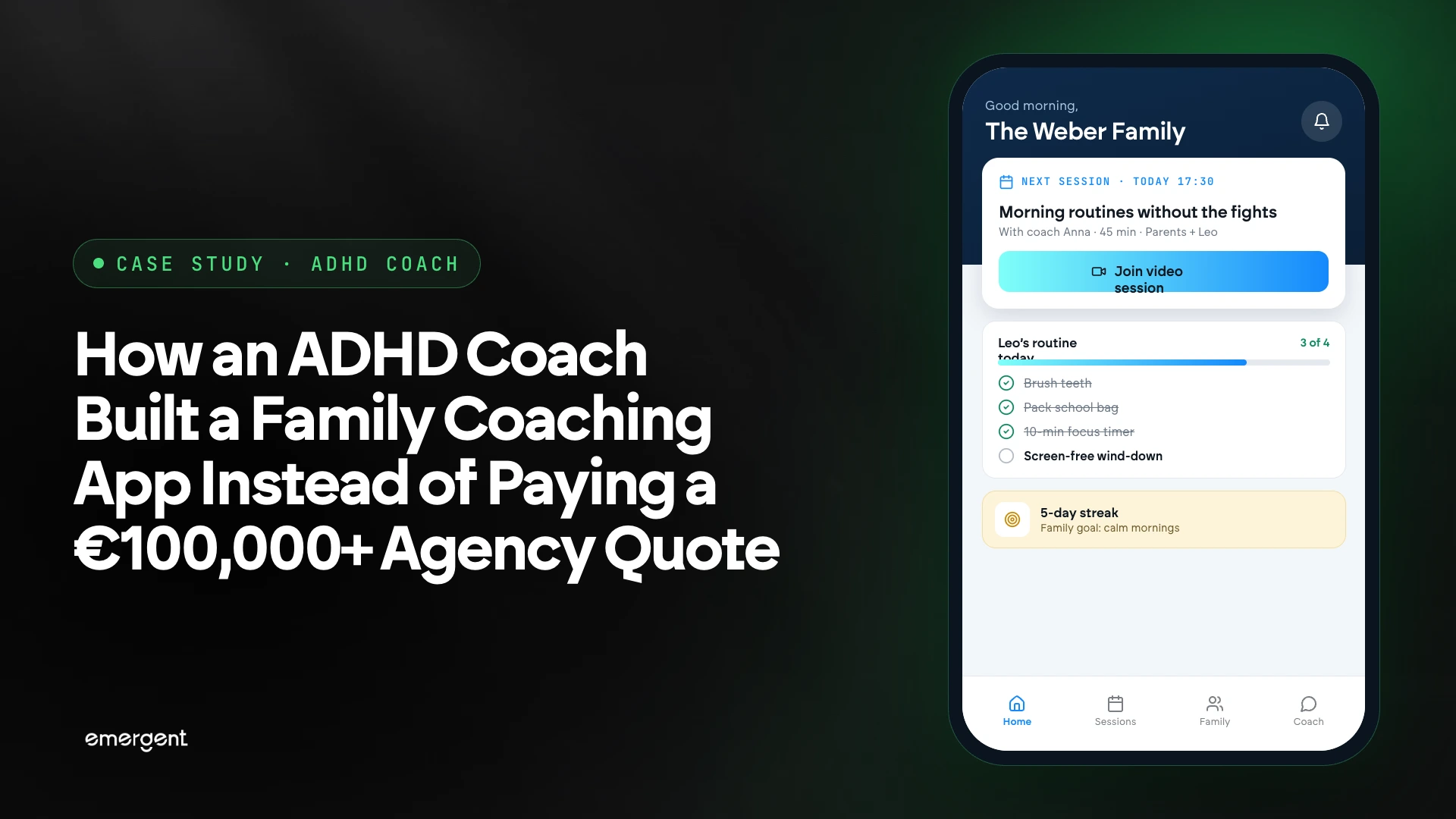
Agencies quoted €100,000 to €150,000 to build it
Catherine assumed her idea was too complex for a no-code platform. So she went to app development companies, sat through meetings, and explained what she wanted. The estimates came back between €100,000 and €150,000, and the agencies warned the final bill could go higher.
That number ended the conversation. "I was thinking that my dream could not be achieved on my own," she said.
Crowdfunding or an agency meant giving up control of her idea
In February, people around her suggested crowdfunding. She could publish the project, set a target of around €100,000, and give backers a stake in return. Catherine didn't want to. Everything in the app came from her own experience, and handing pieces of it to strangers felt wrong.
Hiring a company raised a similar problem. Every feature would pass through someone else's interpretation, at someone else's pace. "I had the impression that asking a company to build it would limit me," she said.
Solution
From plain-language prompts to a full app
At the end of March 2026, Catherine saw an Emergent ad, opened a new professional account, and started building. She described each feature in plain language. Emergent's built-in AI assistant helped her sharpen those descriptions into better prompts. When a deploy didn't show her latest changes, the assistant flagged the problem, checked it, rolled back, and handed her a prompt to get unstuck. The few times she needed a person, Emergent's support team sent a fix in under an hour. "It's really, really easy to work with Emergent," she said.
Catherine credits her ADHD for a creative streak that never switches off, and the app kept growing to match it. One feature led to the next, then the next. By mid-September, about five and a half months after she started, she felt the app covered everything she had in mind and scheduled her commercial launch. "My brain imagines," she said, "and Emergent does."
An app built from eight years of coaching and four children
Catherine turned her coaching toolkit into Le Copilote TDAH, a web app that works on phone and computer, in French, Dutch and English. Adults sit at the center of it, with a family space for parents and children built alongside.
For adults
- Daily task dashboard: Users set routines and tasks, like taking medication by 9 a.m., get daily reminders, and earn stars for each one they finish.
- Morning energy check-in: Users rate how they slept and how they feel, and the app scales the day's tasks to match.
- Coach Cathy for stuck moments: When a task feels impossible to start, Coach Cathy breaks it into tiny micro-actions. For a messy room, she reads a before photo, builds the to-do list, and checks an after photo before awarding stars.
- Brain-training games: Nine short games train reflexes, attention and memory, alongside an avatar game that trains focus. Play time is bought with stars from finished tasks, never with money.
For families
- Child boards: Each child gets a screen with morning and evening routines, calming exercises like blowing on a virtual hot chocolate to practice breathing, and audio for kids who can't read yet.
- Homework helper: Long assignments become short, visual, cartoon-style steps with one clear goal.
- A companion that listens: Kids talk to a virtual pet that responds with empathy, like a diary that answers, without giving advice. It tells a 10-minute bedtime story each night and sends parents a WhatsApp alert if a child says they are in danger.
- Star shop: Children trade stars for real rewards their parents set, like 180 stars for a friend's sleepover.
- Cheffe Cathy in the kitchen: An AI kitchen coach reads photos of the fridge, cupboards and receipts, then plans family meals around allergies, texture sensitivities and a weekly budget, with step-by-step cooking timers. It opens to users at the end of October.
Every feature is a tool Catherine had already used with clients or with her own sons. The avatar game, for example, asks players to catch one target while everything else falls past them, which is exactly the focus her clients struggle to hold. Her children used the homework helper to prepare for their June exams, and the results were strong. "It's me in your pocket," she tells users.
Outcomes
€100,000 to €150,000 in agency fees avoided, with no agency or backers taking a say in her idea
Catherine built the app herself on Emergent instead of accepting a development quote of €100,000 to €150,000. She didn't crowdfund, and she didn't give anyone a stake in her idea. Every feature on the roadmap is still hers to decide, and she added them on her own schedule as new ideas came.
40 users in three languages before the commercial launch
By mid-September, 40 people were already using the app in French, Dutch and English. That was before Catherine had started promoting it to her wider community.
Conclusion
Catherine Vandermeets turned eight years of ADHD coaching into an app that handles adult routines, children's routines, homework and family meals, in three languages, without hiring an agency or crowdfunding. The build also earned her first place and the $50,000 top prize in the Fabrizio Romano x Emergent Builders' Contest, which drew more than 4,300 entries. Her next step is the Google Play Store and Apple App Store, once more of her community is using the app.
If you are a coach, therapist or specialist whose methods only reach the clients you can see in a week, Catherine's build is a useful template. She started with tools she already used in sessions, described each one in plain language, and kept adding until the app matched how she actually works. Your expertise is the hard part, and you already have it. Emergent turns it into a working product your clients can open on their phones, without a €100,000 quote standing in the way.
Emergent turns your idea into a full-stack web or mobile app, no coding required.
 No coding required
- Web & mobile apps
- Deploys instantly


on Emergent today




