



Dean Foster leads software development for Castlewood Software, a company in the North East of England that builds applications for the UK's domestic retrofit industry, the work of making existing homes warmer and more energy efficient. Castlewood works closely with CPH Retrofit, a retrofit assessment and coordination firm in the same region. Dean has four to five years of software development experience and also runs his own managed IT services business. He coordinates every application Castlewood's two-person development team builds. Most of those applications are built on Emergent.
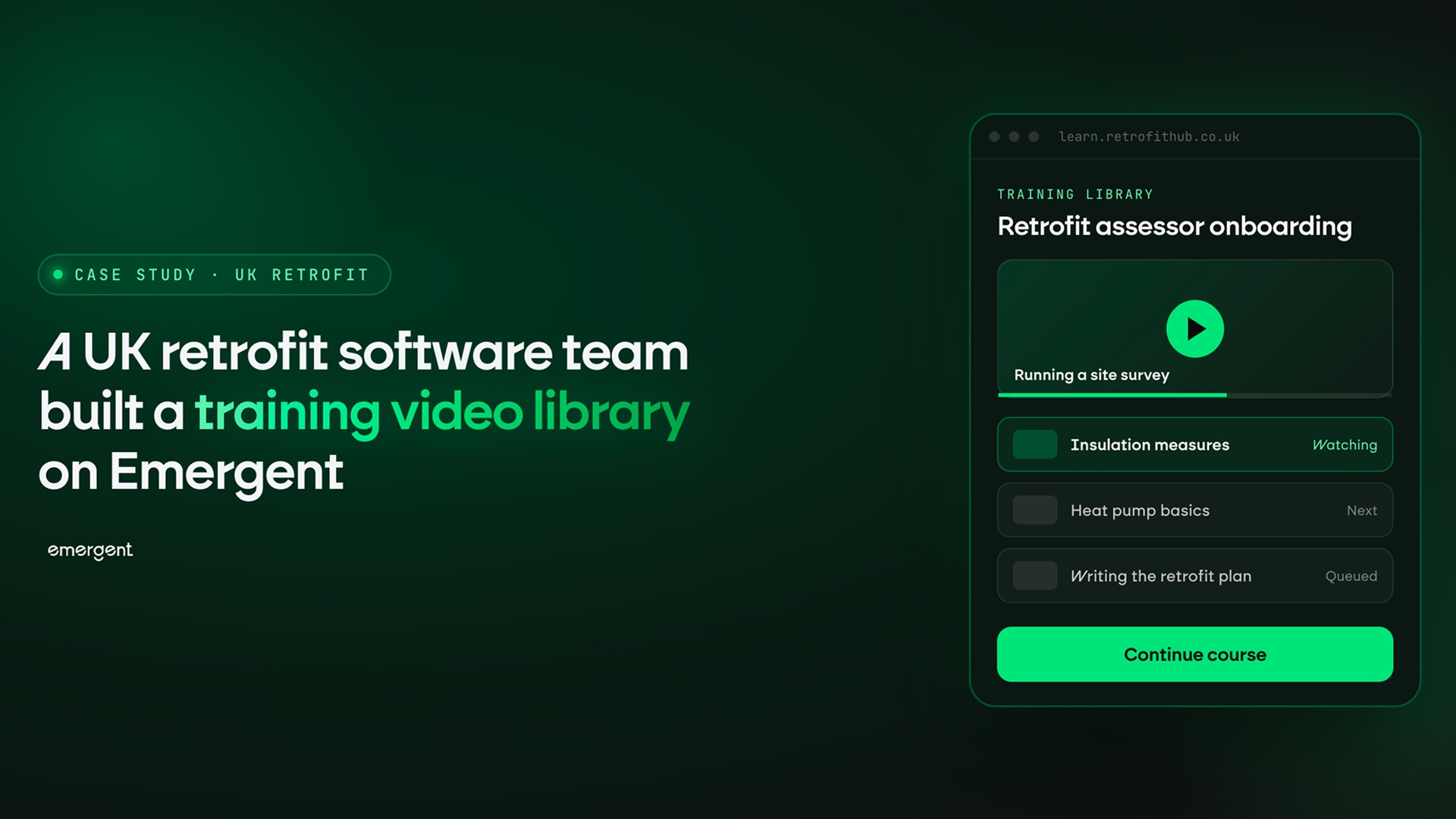
One of them is a learning management platform that teaches retrofit skills to learners across the UK. A training platform like that needs more than written modules, but Castlewood had no practical way to produce video for it. Dean's team found the answer in Emergent's AI video generator.
Challenges
A training platform with text, old photos, and zero video
Castlewood's learning platform is built around courses like Introduction to Domestic Retrofit, which walks learners through the measures a retrofit project can include. Retrofit is physical work. Learners need to see a wall panel go up or watch how a radiator works, and paragraphs of text only get them so far.
The team had nothing to show them. Castlewood had no video content for its courses, and its image library was a set of old photos taken years earlier on old cameras. The alternatives were sourcing videos from elsewhere or paying for professional production. For Dean, short help videos are about credibility as much as teaching: "They help create a huge trust factor with the app, instead of just having literature and text to read from."
Two days of manual editing for a single event video
When the team did need video, they made it by hand. Days before Dean learned about Emergent's video agent, he spent two days building a production video for an event in Manchester. "It took us two days to piece together all the videos, stitch them together and do all the content on top of it," he said.
Soon after, a colleague told him Emergent could now create videos. "I wish it had been out a day or two before," Dean said.
Solution
Lifelike how-to videos made for retrofit learners
Dean's team uses Emergent's video agent to produce short help and guidance videos for the learning platform, along with a few videos for the wider business:
- Realistic how-to demos: lifelike walkthroughs of hands-on tasks, such as installing a wall panel or explaining how a radiator works.
- Course supplements: short explainers for courses like Introduction to Domestic Retrofit, explaining how retrofit works and the measures it can cover.
- Business announcements: the team's first video celebrated an open day at a partner training centre, and it went out for real use.
The format rules came from the team. Most videos run 30 to 60 seconds, and only a few stretch to three minutes when a topic can't be cut shorter. "We don't want someone watching a video for three minutes and getting bored after a minute," Dean said.
From a colleague's tip to a first video in one sitting
Once his colleague had mentioned the new feature, the two sat down together to try it. They worked through it together and had their first video done in that same sitting. "We were impressed straight away," Dean said.
The workflow has stayed light. For small fixes, the team writes short prompts themselves. For a new batch of videos, they first run their context through an AI chat assistant to turn it into a larger, more detailed prompt, then hand that to Emergent, which plans the scenes and produces the videos. Dean said the videos are good from the first attempt and rarely need much work: "There's only a few changes that usually go into them once the first draft's on our table."
The realism is what sold the team. Showing a recent repair video made for the training platform, Dean said: "That's what impresses us, how close to lifelike it is."
Outcomes
About 22 videos in two to three weeks
Before Emergent, Castlewood had no video content for its products. Two to three weeks after the first open day video, Dean's video library held about 22 finished pieces, from event announcements to hands-on repair demos for the training platform. "I've kind of lost count," he said.
15 videos from a single detailed prompt
In one session, the team filled in a single large prompt and Emergent produced around 15 separate videos from it, each with its own scenes. Most landed in the 30 to 60 second range the team wanted, with a few running up to three minutes.
Roughly an hour per video, down from two days
The last video the team built by hand took two days of cutting and stitching. Dean estimates each video now takes about an hour on Emergent, counting the review and the few changes most drafts need.
Conclusion
Castlewood Software started with no video for its learning platform, only text and old photos, and a team that had just spent two days hand-editing a single event video. A few weeks later, it has a library of about 22 lifelike videos that take about an hour each to make. The video agent sits on top of a deeper commitment: eight of the team's nine applications are built on Emergent, and Dean now plans to use Emergent's videos for a home monitoring app the team built on another platform. "Even though we haven't created the application with Emergent, we're still looking to improve it with Emergent," he said. With most of its applications far along in development, Castlewood is preparing to move them into production in 2027.
If your product teaches people how to do physical work, and video keeps sliding down your list because production costs too much or takes too long, Castlewood's experience is a useful benchmark. A two-person development team with no training videos built a working library in weeks by describing what learners needed to see. You can start with one prompt and one short demo, then scale to a full course once the first draft proves itself. Build your course platform on Emergent too, with an LMS website builder.
Emergent turns your idea into a full-stack web or mobile app, no coding required.
 No coding required
- Web & mobile apps
- Deploys instantly


on Emergent today


