




Different teams need different ways to build. Windsurf is an AI first local editor that supercharges coding inside your own repositories. Replit is a browser based IDE with instant environments and one click deployments. Emergent is a full stack vibe coding platform that turns natural language into complete applications across UI, backend, database, integrations, hosting, and deployment. This guide is tailored to these three products so you can decide based on real workflows rather than surface features.
Windsurf vs Replit vs Emergent: Comparison Overview
About Windsurf
Windsurf is an AI powered coding IDE designed for modern app development. It pairs familiar editor ergonomics with an agent that can plan, generate, and modify code across files, run commands in an integrated terminal, and coordinate iterative changes. It fits teams that want an AI centric editor while keeping their repos, CI, and cloud.
Read More About: 7 Best Windsurf Alternatives and Competitors
About Replit
Replit is a cloud IDE where you code, run, and deploy from the browser with zero local setup. It supports many languages, includes Replit Agent for AI assisted coding, and offers one click deployments. It is popular for education, prototypes, internal tools, and smaller to moderate hosted apps.
Read More About: 7 Best Replit Alternatives and Competitors
About Emergent
Emergent is a full stack vibe coding platform. You describe the app in natural language and Emergent generates UI, backend logic, database schemas, APIs, integrations, hosting, and deployment. Multiple agents plan, build, test, and ship. You keep full code ownership, can sync with GitHub, and push and pull from VS Code and GitHub.
Here’s the Windsurf vs Replit vs Emergent table comparison overview:
| Parameter | Windsurf | Replit | Emergent |
|---|---|---|---|
| Development Approach | AI first local editor | Browser based cloud IDE | Natural language app creation end to end |
| Primary Interface | Editor with chat and agent actions | Code editor with AI Agent | Conversational chatbox to build and modify apps |
| Coding Required | Yes | Yes | Not required to start; you can extend |
| Full Stack from Prompts | No by design | Partial in hosted IDE | Yes, UI to DB to deploy |
| Hosting and Deploy | Bring your own stack | One click to Replit hosting | Built in hosting with automated deploy |
| Database Handling | Use your DB stack | Basic managed DB options | Prompt based models, schema, APIs |
| Collaboration | Git workflows and code reviews | Real time sharing in browser | Shared cloud workspace across roles |
| Code Ownership | Your repos and CI | Projects in Replit workspaces | Full code ownership, GitHub sync, VS Code push and pull |
| Best For | Pro devs seeking AI acceleration in their repos | Learning, prototypes, quick hosted apps | MVPs and complex full apps without stitching tools |
Windsurf vs Replit vs Emergent: General Feature Comparisons
Zero-Setup Development Environment
Local setup and environment drift waste days. A platform should minimize setup so teams can create value faster.
Windsurf: Installs as a desktop app and points at your local or remote repo. You keep control of runtimes and databases while the agent accelerates scaffolding and multi file edits.
Replit: Opens in the browser with no local setup. Runtimes, dependencies, and previews are ready in the workspace. Ideal for onboarding, workshops, and quick demos.
Emergent: No local configuration. Describe the app and get a running deployment that includes UI, backend, DB, and integrations. Non technical teammates can contribute via prompts from day one.
Database and Hosting
Data modeling and dependable hosting are the backbone of production software. Without them, delivery slows on infrastructure work.
Windsurf: Uses whatever database and hosting you already run. Good for teams with established cloud patterns and platform ownership.
Replit: Offers simple managed databases and platform hosting for small to moderate apps. Very fast path to live; heavy scale often migrates to dedicated services.
Emergent: Converts data requirements in prompts into schemas, relationships, and APIs, then provisions hosting with SSL and domains. Data and runtime stay in sync as the app evolves.
Deployment
The path from working code to a live URL should be short, repeatable, and reversible.
Windsurf: Not a host. You deploy with your CI and cloud. Fits teams that prefer existing pipelines and release gates.
Replit: One click deploys in the IDE with environment variables and logs in the browser. Great for shipping quickly and iterating live.
Emergent: Build, test, and deploy in the same environment. The same conversation that creates features also ships them, with quick rollback and re run options.
Security and Authentication
Strong authentication, validation, and policy enforcement prevent mistakes from becoming incidents.
Windsurf: The editor helps generate secure patterns, but you implement and review auth and protections through your framework and libraries.
Replit: Secrets storage and an isolated runtime are built in. You own auth flows, hashing, session strategies, validation, and rate limits with your chosen libraries.
Emergent: Generates secure auth flows with best practices by default. Validation, rate limiting, and safe storage are wired into the stack and adapt as requirements evolve.
UI and UX Interface
Fast UI feedback loops reduce churn. The interface should support rapid design and validation.
Windsurf: Editor centric with inline agent changes and diffs. Suits devs who iterate UI inside code and component libraries with tight review cycles.
Replit: Cloud IDE with a preview pane for web apps. Good for code first teams that want to see UI and logic evolve together in the same workspace.
Emergent: Conversational UI building with live screens and flows. PMs and engineers iterate together on copy, state, and transitions across multiple views while Emergent maintains structural coherence.
AI Powered Code Generation and Assistance
AI should remove boilerplate, accelerate cross file changes, and preserve maintainability.
Windsurf: Agent coordinates multi step edits, runs commands in terminal, and applies diffs across the repo. Strong for refactors and scoped feature work with developer review.
Replit: Replit Agent helps create and modify code inside the hosted workspace. Effective for common patterns and iterative improvements.
Emergent: Produces a coherent full stack application, connecting UI, backend, data, and integrations, then deploys. Cross module changes happen in one conversation instead of many pull requests.
Windsurf vs Replit vs Emergent: Advanced Feature Comparisons
Thinking Token for Deep Research
Thinking in large contexts lets the model reason across more specs and artifacts before writing code.
Windsurf: Context handling suits multi file coding and agent tasks. Public materials do not position extreme context sizes for deep research at massive scale.
Replit: Agent context is model dependent and best for small to medium tasks. Large codebases benefit from splitting work into steps.
Emergent: Offers 200K to 1M context windows on select plans. This enables the system to analyze long specs and related assets before generating. Useful for complex projects and deep planning.
External Tool and API Integration
Connecting third party tools and APIs is essential to deliver functional products that use real data and services.
Windsurf: Works with your CLI, package managers, and SDKs. You wire API keys and services inside your repo and scripts, keeping full control.
Replit: You add SDKs in code and store secrets in the platform. Flexible for developers; webhook reliability and retries are your responsibility.
Emergent: Prompts for required tools and connection methods, then wires them with your keys. Generates routes, handlers, retries, and secure storage to reduce repetitive integration work.
Flexible LLM Model Selection
The right model per task balances cost and quality across reasoning, generation, and speed.
Windsurf: Supports multiple models depending on plan and provider settings. Emphasis is on developer ergonomics over model tinkering.
Replit: Model selection is platform managed inside Agent. Simple to use but not exposed for per task tuning.
Emergent: Lets users choose preferred models for flows. Supports Claude Sonnet 4.0, 4.5, and GPT 5 by default with sensible per task defaults.
Credit Transferring for LLM API Requests
Apps that call LLMs directly benefit from billing flexibility without managing extra provider keys.
Windsurf: Editor usage and in app LLM calls are separate. Direct LLM usage in your app uses your provider billing.
Replit: Usage credits apply to Agent and platform resources only. External LLM calls require provider accounts.
Emergent: Universal Key allows transferring platform credits to LLM API calls from your app. Reduces operational overhead and avoids duplicative billing.
Pre Deploy Test Mode
Testing in realistic conditions before going live prevents regressions and broken flows.
Windsurf: You run tests and apps in your environment using the built in terminal and your frameworks. Production parity depends on your setup.
Replit: Run and preview in the browser during development. It provides a fast early signal and live iteration loop.
Emergent: Dedicated pre deploy testing validates UI flows, APIs, and data interactions in realistic conditions for confident releases.
Built In Payment Integrations
Payment flows require secure checkout, webhooks, and plan logic that are easy to get wrong when hand built.
Windsurf: You integrate Stripe or other providers in your codebase and write webhooks and policy logic. Full flexibility with engineering effort.
Replit: No built in payments. Integrate SDKs and write your own webhook handling in the hosted project.
Emergent: Built in patterns for Stripe and Razorpay. Provide keys and the platform generates checkout, webhooks, and subscription logic end to end.
Multi Agent Orchestration
Coordinating repetitive, multi step work benefits from a main coordinator and specialized sub agents.
Windsurf: Offers agent tasking for edits and commands. User configurable main plus sub agent orchestration is limited.
Replit: No user facing main and sub agent orchestration. Use scripts or external tools for repeatable automation.
Emergent: A coordinator agent delegates to builder, designer, quality, and deploy agents. Users can define custom main and sub agents for recurring tasks.
Multi Language Support (Interface Language)
Localized interfaces widen adoption for global teams and non English users.
Windsurf: Interface and docs are primarily English. Internationalization happens in your app code.
Replit: Interface and docs are primarily English. App level i18n is implemented by the developer.
Emergent: Supports multiple interface languages so teams can build and iterate in their preferred language.
Windsurf vs Replit vs Emergent: Detailed Pricing Comparisons
| Brand | Free or Starter | Pro or Core or Standard | Pro (Higher Individual) | Teams | Enterprise |
|---|---|---|---|---|---|
| Windsurf | Free plan | Pro available on site | n/a | Team plans available | Contact sales |
| Replit | Free starter | Core at 20 dollars per month billed annually or 25 dollars monthly | n/a | Teams around 40 dollars per user per month | Custom |
| Emergent | Free at 0 dollars per month | Standard at 20 dollars per month | Pro at 200 dollars per month | Team at 305 dollars per month | Contact sales |
Want to know what each plan costs before you dive in? Our Windsurf pricing guide covers every tier and where the quota math gets fuzzy.
What are the Key factors while choosing an AI development platform
- Build style: AI editor in your repo, cloud IDE with deploys, or prompt to full stack apps
- AI depth: Completions vs agent planning and multi step execution
- Full stack scope: UI only vs UI plus logic, data, integrations, and deploy in one platform
- Deployment path: Your CI and cloud vs Replit hosting vs built in hosting with automated deploy
- Collaboration and governance: SSO, roles, privacy, analytics, and auditability
- Cost predictability: Credits, overages, and model usage for your expected workload
Conclusion
Pick Windsurf if you want an AI centered editor that fits into your existing repos and cloud, with an agent that runs commands, applies diffs, and speeds refactors. Choose Replit if you want zero setup coding in the browser with fast deploys for learning, prototypes, and smaller hosted apps. Choose Emergent if you want to move from clear natural language to a running application that includes UI, backend, database, integrations, and hosting in one environment. Emergent suits both fast MVPs and complex full systems and supports GitHub sync with push and pull from VS Code and GitHub.
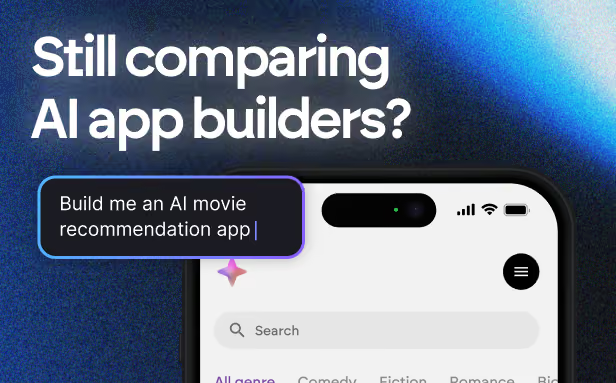
Most AI app builders stop at prototypes. Emergent creates production-ready apps you can actually launch.
- Production-ready apps
- Web & mobile apps
- Deploy in minutes







