


Emergent's CEO Mukund Jha Tells ET How Vibe Coding Is Turning Small Businesses Into Software Builders

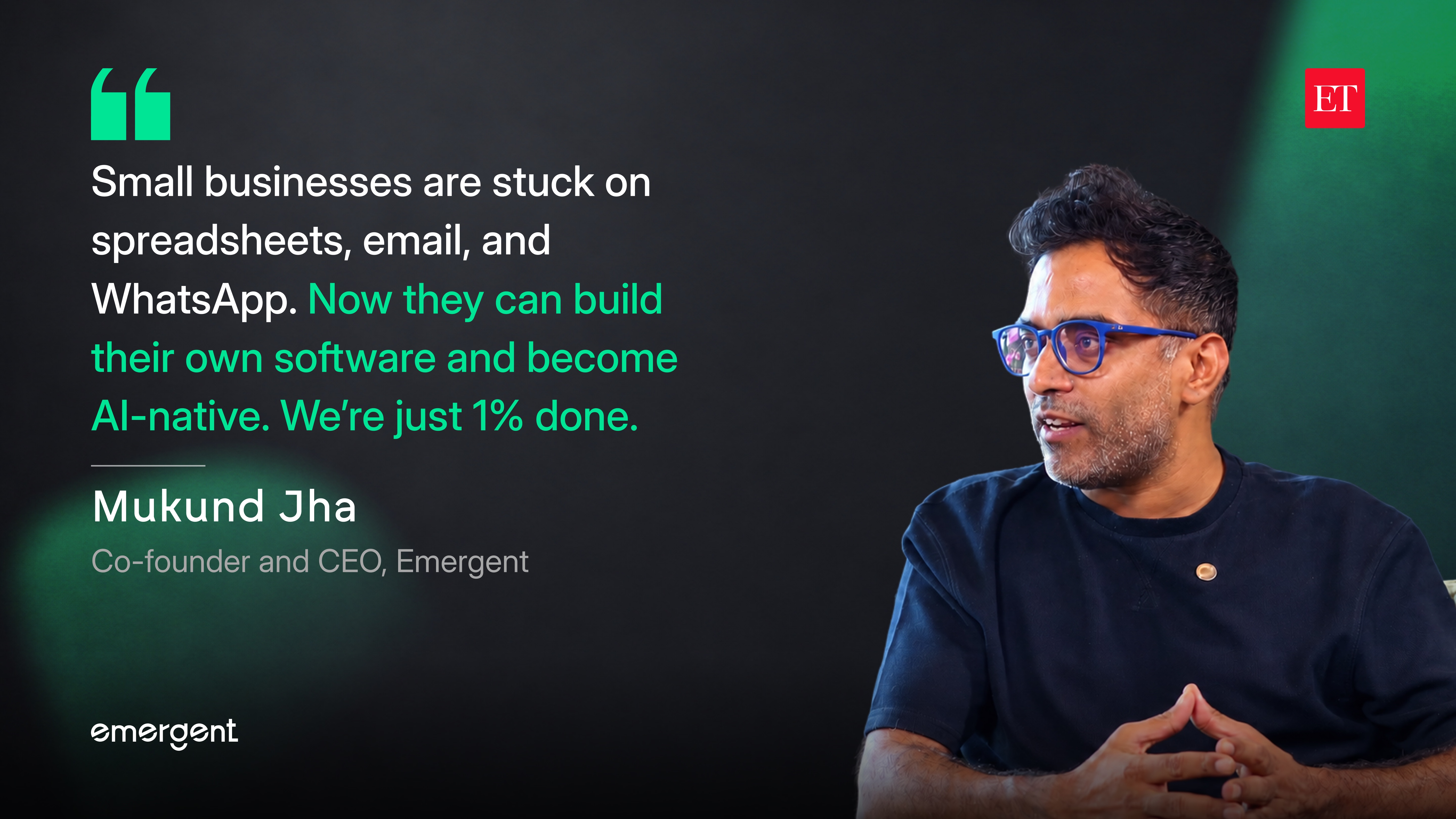
Small businesses that have long run on spreadsheets, email, and WhatsApp can now build their own software with vibe coding, without writing code, Emergent co-founder and CEO Mukund Jha said in an interview with Anirban Chowdhury of The Economic Times Digital. The conversation aired on October 27, 2026, as an episode of ET's Corner Office Conversation podcast.
Jha told Chowdhury that proving non-coders would build real, working software was one of two factors behind Emergent's rise to a $1.5 billion valuation. "Anybody who is closer to a problem and understands the domain really well is a builder today," he said.
The usage numbers back that up. About 18 million apps have been built on Emergent, and more than 200,000 of them are live. More than half of those live apps see weekly usage, and together they draw over 40 million monthly visitors. Emergent cannot track every app, but some of the ones it can track already make "probably more than 2 million, 3 million in revenue," Jha said.
When Chowdhury cited 12 million apps during the conversation, Jha updated the figure on the spot: "I think now it's probably 18 million." Emergent has users in 190 countries, with most of its revenue coming from the US and Europe.
Watch the full Corner Office Conversation episode below. Jha and Chowdhury discuss the making of a builder, the lessons of Dunzo, the speed of Emergent's rise, and who gets to build the next generation of software.
How Emergent reached a $1.5 billion valuation
Emergent's valuation rose from $300 million to $1.5 billion between January and July, a jump the podcast described as making it India's third AI unicorn.
Jha credited two things. The first was the business itself. "Every single thing that we care about in the business, whether it's our unit economics, our gross margin, our rate of growth, all of them accelerated," he said, referring to the months from December to March and April, when Emergent closed its round.
The second was proof of the company's thesis. "When we started the journey, a lot of people thought, is vibe coding going to be a real thing? Is this just for hobbyists?" Jha said. "What we saw during those months was our thesis, that people are going to build real software. There are going to be real businesses running on top of Emergent."
The apps themselves have grown more ambitious. Early users built simple websites, landing pages, and e-commerce stores. Today, Jha said, people are building full operating systems for their businesses, including inventory management and CRM, and many are embedding AI into what they build.
Small businesses are moving from spreadsheets to their own software
Emergent's first assumption about its users turned out to be wrong. "Our initial thought process was, this is a tool that's going to be used by senior developers and product managers," Jha said.
One of his first customer calls after launch was with a baker in the Philippines. She took cake orders offline and wanted a web page where customers could order online. "That's when we realized that we are actually opening up this massive new market," he said.
Traditionally, Jha said, software development has been "like a movie production," where companies put a lot of money in up front to build one-size-fits-all platforms. "Software economics don't work" for many small businesses, he said. He described a user who runs a cricket academy in San Francisco, one of hundreds in the US. "Nobody's building software for them," Jha said. Businesses like his have usually coordinated through spreadsheets, email, or WhatsApp. Now they can build custom software that helps accelerate their business.
Asked about Indian business owners, Jha pointed to a print shop owner in Jaipur who began receiving requests for AI-generated spiritual photos over WhatsApp. The owner built an app where customers scan a QR code, send their request on WhatsApp, receive five AI-generated options, pick one, and get it printed. He built it for his own shop first and plans to sell it to about 50 other print shops he knows nearby.
One of the top winners of Emergent's Raj Shamani Builder Challenge, a program that gives cash prizes to people to build their ideas, runs a petrol pump. He had managed it entirely on pen and paper. He built a company called Hisab X, with a mobile app that runs the whole pump digitally, and has since sold it to about 15 other petrol pumps in his region. "You're seeing this massive rise of local entrepreneurship, which has never existed before," Jha said.
The goal, he said, is to help these small businesses become AI native over time. "We think that we're just 1% done right now. There's a lot of work for us to do."
Production-ready apps, not demos
Emergent was not the first AI app builder on the market. Jha said the gap it saw in earlier tools was the last mile.
"All of them gave you an illusion of building software. It gave you a demo, it gave you front-end code," he said. "Nobody was actually able to deliver working software to users."
Emergent set out to cover that last mile: making sure an app works, scales, is production-ready, and can debug itself. Every app gets a URL and is always hosted, which Jha said takes that complexity away from users. Jha compared the vision to a self-driving car for software, "where you enter your destination, press a button, and it drives itself."
"We make it very, very easy for people to not worry about the complexity of technology," he said. "The platform takes care of that."
Next up: AI agents for small businesses
Emergent is now helping users build AI agents and workflows. Jha said small business owners have responded with curiosity. "They understand the business really well. They are also very curious about how AI can help them," he said. "They have very good understanding of what the levers for the business are."
Trust is the open question. A new business owner may not know whether the software they make is secure, whether it will scale, or whether the IP belongs to them. Jha said trust is a major area of focus for Emergent, and that much of Emergent's current effort goes into educating users on how to use these tools safely.
On wider AI risk, Jha separated two concerns. He called cyber attacks "very real" today, while misalignment, where autonomous AI pursues its objective in ways humans did not intend, is "probably a few years out."
Margins are improving as Emergent routes work between models
Jha said Emergent's margins "are now improving significantly across the board," and he pointed to how the platform picks models for each task.
"We now have an intelligent way of figuring out, does this task require a lot of intelligence? If it does, we'll send it to frontier models. If it does not require very sharp intelligence, we'll send it to open source," he said. Open-source models have become viable because capabilities have risen across the board. "Three months back, nobody was talking about open source," he noted.
Emergent has also learned from the volume of apps built on the platform. That lets it deliver "the same outcome with much lesser token spend," Jha said, alongside optimizations on the hosting side. The savings are shared: "As we make optimizations, we pass it back to the users, keep some share ourselves."
On the wider industry, Jha expects profitability to become a serious topic soon. "In a year's time, two years' time, people will start looking at profitability, especially with the capital spend that's happening right now," he said. Asked about a public listing, he said Emergent has no set target, but "timelines are going to be compressed in AI."
Lessons carried over from Dunzo
Jha helped build Dunzo before Emergent and said he carries two lessons from it. The first is that going from product-market fit to an enduring company takes discipline on "the commercials, unit economics, all of those things" as you scale. The second is focus. The store model was clearly working, Jha said, but Dunzo was "spread too thin," trying to run a marketplace, pick-up and drop, B2B, and dark stores at the same time.
At Emergent, he said, the team is "extremely focused on the value that we're trying to provide to our customers," and on making sure the business has the right economics as it grows.
He also played down the idea that Emergent is a second mover. "Things are so compressed, it's not like we are second right now. We're almost at the same pace," he said. "To a customer, it doesn't matter whether you're the first company or second company. What matters is, are you delivering the right value at the right price point?"
What Jha expects in the next 2 years
Jha's boldest prediction concerns how much software non-technical people will be able to build. "We feel in the next two years, you'll pretty much be able to build all of the software that exists today in the world on a platform like Emergent, without knowing anything about technology, without knowing anything about coding," he said.
Emergent is also preparing the third edition of VibeCon, its builder event, in San Francisco. The previous edition was held in Bengaluru, and Jha said the company is considering a global version held in multiple cities at the same time.
He sees software as only the beginning. "Software is the first easy task to accomplish," Jha said. Over the next decade, he expects a new crop of builders to use AI to work on genetics, life extension, and space travel.


on Emergent today




