



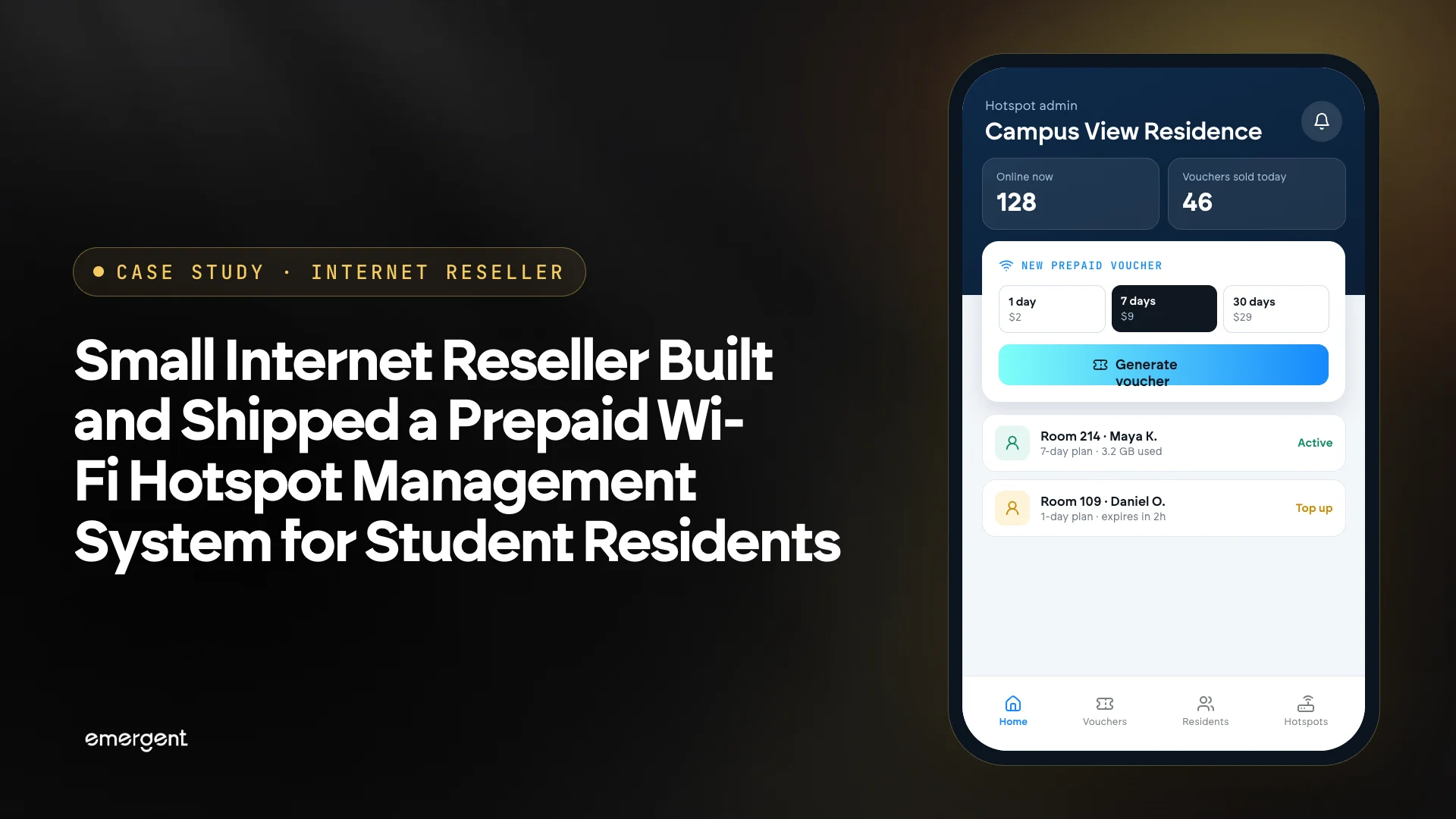
Students in shared residences need the internet for study, streaming and staying in touch, and many pay for it in small amounts as they go. One small internet access reseller in southern Africa has built its business around that need. It sells prepaid Wi-Fi vouchers to residents across several student properties. Residents buy access by the day, the week or the month, for one to four devices. Some buy direct, and some buy through a network of distributors who earn commission on each sale. With that spread of properties, plans and sales channels, every sale came with details to keep straight. The voucher code and price had to be right, and the money had to actually arrive. With no in-house development team, the operator was keeping track of all of it by hand.
Using Emergent's admin dashboard builder, the operator built a hotspot management system that brings that work into one web app. Voucher codes, plans and prices sit together for each property. The system works out part-month charges and checks distributor payments before commission is counted. Voucher codes and payment reminders go out to residents by SMS from the same place.
Challenges
Each property's voucher codes sat in separate batches with no shared view
Voucher codes came in batches, and each batch belonged to one residence and one plan. A two-device, four-week code from one property was meant for that property alone. Once a code was sold, it had to be marked as taken so it was not issued twice. Prices added another layer, because one residence might charge a custom rate on some packages and not sell others at all. Without one place to see every batch, the operator could not tell how many codes were left on a given plan at a given property. A residence could run short of a popular plan before anyone noticed. A code sent to the wrong resident, or sent twice, was hard to catch until the resident got in touch.
Residents who joined mid-month needed a fair part-month charge
Monthly multi-device plans are billed by the month, but residents do not all move in on the first. A student who signs up on the sixth should pay for the days left, not the full month. Working that out meant dividing the monthly rate by the days in that month, then multiplying by the days remaining. Months have 28, 30 or 31 days, so the daily rate changes each time. Done by hand at the point of sale, the sum was slow and easy to get wrong. Refunds raised the same problem in reverse.
Distributor sales were hard to check against what reached the bank
Distributors collect payment from residents and send proof of payment with a reference. The operator then had to find each reference in the business bank statement to confirm the money had arrived. Only confirmed sales should earn commission. With dozens of small payments a month, matching them line by line was tedious. Mistakes either underpaid a distributor or paid commission on money that never came in.
For a similar build in a different trade, we recommend our case study on how a digital goods distributor built a retailer signup site.
Chasing payments and sending codes one message at a time took hours
Residents need their voucher code as soon as they pay, and they need a nudge before their access runs out. Sending each code and each reminder from a phone, one at a time, took up a large part of the day. There was no record of what had been sent or whether it had gone through. When a resident said they never got their code, the operator had nothing to check.
Solution
One place for every voucher, plan and price
All voucher codes now live in one system, sorted by property and plan. The operator uploads each new batch of codes and tags it to the right residence. When a code is sold, it is marked as taken, so it cannot be issued twice. The operator can see at a glance how many codes are left on each plan at each property, and which active vouchers are close to expiring. Prices are set per property too, and packages a residence does not sell can be hidden.
Part-month charges and commission worked out by the system
The system does the sums the operator used to do by hand. For a resident joining mid-month, the operator picks the month, the start day and the plan, and the system shows the amount due and how it got there. A refund calculator works the same way in reverse. For distributor sales, the operator uploads the business bank statement and the system checks each distributor's proof of payment against it. Only matched payments count towards commission, so each distributor is paid on money that actually arrived.
We recommend our case study on a specialty contractor’s custom invoice app for another small business that took billing into its own hands.
Voucher codes and reminders sent by SMS, with a record of each one
Voucher codes and payment reminders now go out by SMS from the same system. The operator can message one resident or send reminders to every active customer at once. Each message is logged with whether it was sent or failed. Resident sign-ups, logins and purchases are logged as well, along with the reason when something goes wrong. When a resident says they never got their code, the operator has a record to check.
Read more: How to Build an Admin Dashboard With AI (Step by Step)
Conclusion
The person who sells Wi-Fi to students every day knows where the work piles up: codes per property, part-month charges, distributor payments and reminder messages. That is the person best placed to say what a hotspot management system should do. The operator described the business in plain English on Emergent, and the finished app, voucher pools by property and plan, CSV and PDF code upload, per-property pricing with hidden packages, instant voucher generation, expiry tracking, pro-rata and refund calculators, bank statement parsing, proof-of-payment matching, distributor commission totals, SMS reminders in single and bulk sends, message history, activity logs and a revenue dashboard, went from a description to a live, hosted application without a developer.
If you are an operator sitting on a product idea that solves a clear problem in your industry, Emergent can take you from description to deployment in the same session.
Emergent turns your idea into a full-stack web or mobile app, no coding required.
 No coding required
- Web & mobile apps
- Deploys instantly

on Emergent today




