
There has been a massive improvement in the capabilities of AI agents in the past couple of years. AI agents are no longer just restricted to answering queries or carrying out web searches. They have evolved to get actual work done across a range of business functions. Some common examples include handling customer queries, qualifying sales leads, monitoring IT systems, and managing routine business processes.
AI agents can take actions, use external tools, interact with users, and complete various tasks with varying levels of human involvement. But we need to understand the areas where AI agents make the most sense and what they can realistically accomplish. That largely depends on the task at hand, the systems involved, and the level of autonomy the agent needs.
In this article, we'll explore practical AI agent use cases across business functions and industries, look at real-world applications, and explain when a single agent or a multi-agent system might be the better choice.
What Is an AI Agent? (And What Counts as a Use Case)
An AI agent is a software system that can work toward a defined goal by understanding inputs, assessing and evaluating data, making decisions, using different tools, and taking actions. An AI agent is quite different from conventional software that follows fixed instructions, and it should not be confused with a basic chatbot.
A conventional AI chatbot primarily responds to user queries, but an AI agent can carry out multiple steps to complete a task, often without needing instructions at every step.
For example, consider a customer support agent. Instead of simply responding to customer queries, it can retrieve details such as shopping history, item details, and delivery status, and initiate the next appropriate step, such as raising a ticket or processing a refund. Its ability to take further actions depends on the permissions provided.
This brings us to what actually counts as an AI agent use case. It is a practical situation where an agent can use information, make task-specific decisions, and take actions to achieve a defined outcome.
However, not every task requires an AI agent. Many repetitive tasks involving fixed processes can be handled through traditional rule-based automation, without the need for an AI agent. AI agents are particularly useful when information is dynamic, tasks involve multiple systems, and decisions cannot be made based on predefined rules alone.
For businesses, a good starting point is to identify tasks that involve repetitive coordination, information from multiple systems, and decisions that vary by situation. Also consider whether the agent can access reliable data, what actions it should be allowed to take, and when human intervention is necessary.
AI Agent Use Cases by Business Function
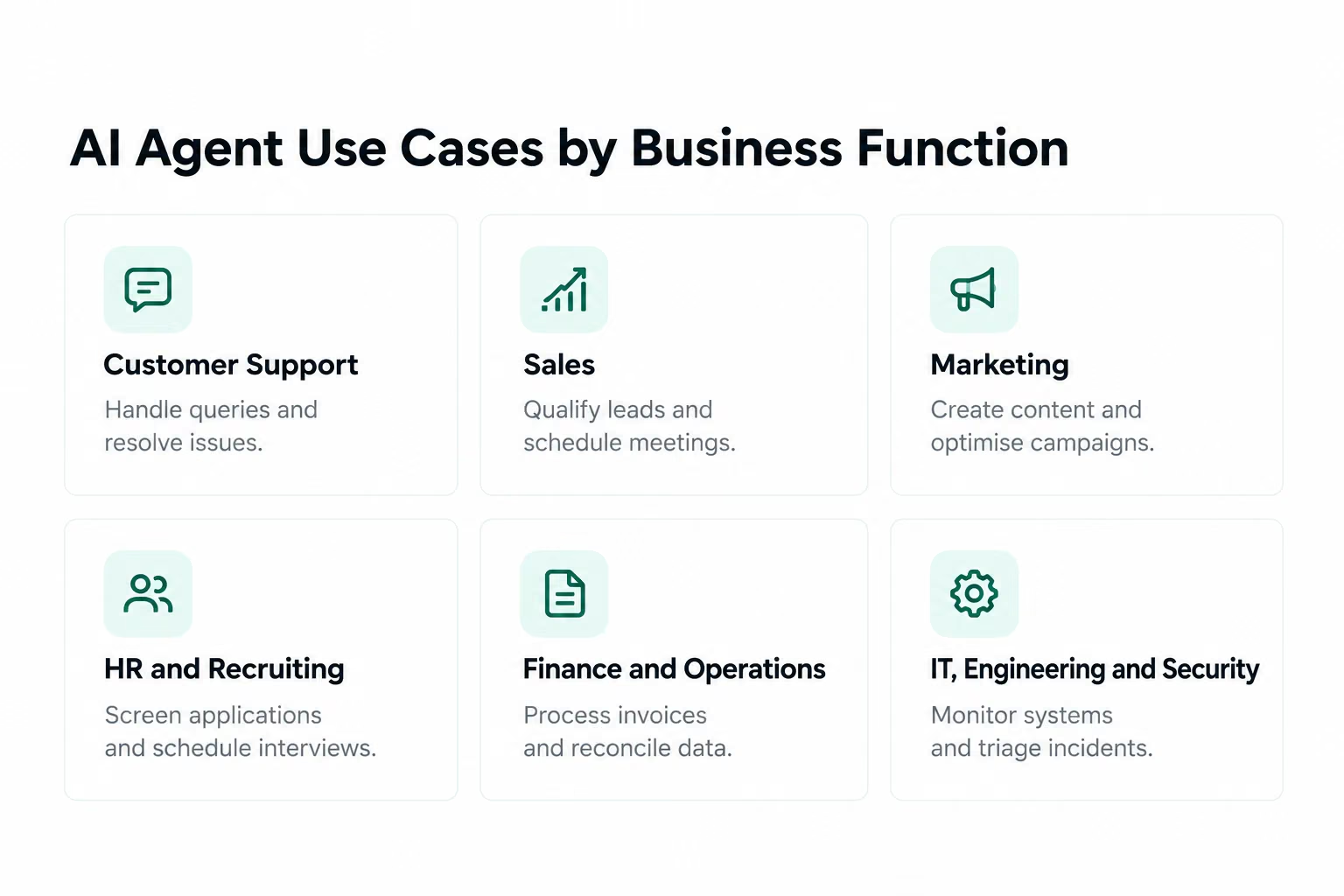
AI agent use cases include resolving customer service requests, qualifying sales leads, coordinating recruitment, analyzing financial records, monitoring IT systems, and managing marketing workflows. These applications are particularly useful where conventional rule-based automation cannot easily process changing information and respond accordingly.
Customer Support and Service
Customer support is one of the most practical use cases for AI agents. Unlike basic chatbots that primarily answer frequently asked questions, AI agents can access customer information, interact with business systems, and take appropriate actions to resolve service requests.
A real-world example is Salesforce, which deployed its Agentforce AI agent on its customer support website. According to Salesforce, the agent handled more than 500,000 customer conversations within its first six months and resolved over 84% of customer questions coming through Agentforce. Complex requests could still be directed to human support teams.
Besides this, AI agents can also assist support teams by providing conversation summaries, categorizing tickets, and flagging urgent requests. This can help reduce repetitive work for the team, and customers can receive better and quicker responses. Human intervention can then be reserved for complex or sensitive issues. To build an agent like this for your own support team, use a customer support agent builder and define its actions and handoff rules yourself.
Sales and Lead Generation
Sales teams often spend a significant amount of time identifying potential customers, analyzing customer demographics, qualifying leads, and updating CRM records. They also need to continuously follow up with prospective leads and, in many cases, work closely with customers to provide after-sales services.
AI agents can help automate several of these activities, allowing sales representatives to focus more on building relationships and closing deals.
For example, an AI sales agent can interact with a prospective customer visiting the company's website. The agent can ask relevant questions, assess their requirements, and record the interaction in a CRM system. The agent can also schedule a meeting with a sales representative and initiate follow-ups, depending on the workflows and permissions configured.
With AI agents, it is possible to analyze existing customer information to identify potential sales opportunities and prioritize leads that need urgent attention. To build this yourself, a sales agent builder lets you describe the questions it asks, how it qualifies a lead, and when it books a meeting. For the narrower jobs, you can start with a lead qualification agent to score and route leads, or a lead generation agent to build the prospect list before anyone fills out a form.
Marketing and Content
Marketing involves much more than creating content or running promotional campaigns. From understanding customer requirements and improving products to managing campaigns and after-sales engagement, marketing teams handle a wide range of activities. AI agents can assist with several of these processes by working across different tools and data sources.
For example, an AI marketing agent can monitor campaign performance through connected analytics platforms, identify changes in engagement or conversions, and prepare recommendations for improving the campaign. Depending on its configured permissions, it may also update campaign reports, create follow-up tasks, or suggest adjustments to the marketing team. To build one around your own campaigns and approval rules, a marketing agent builder lets you describe what it tracks, what it recommends, and what needs sign-off.
For content teams, AI agents can help research topics, analyze customer feedback and survey responses, organize editorial calendars, and coordinate publication workflows. Human review remains important for verifying information, maintaining brand voice, and approving content before publication. If you want to build this around your own editorial process, you can build a content creation agent that researches topics and drafts for review, or build an SEO agent that handles keyword research and page refreshes.
These applications can help marketing teams reduce repetitive coordination work and spend more time on strategy, creativity, and decision-making.
HR and Recruiting
Human Resource Management is another broad business function that involves identifying potential candidates, staffing, recruitment, onboarding, training, and employee development. In many cases, it also includes handling administrative responsibilities and routine HR queries.
These activities require HR personnel to work with large volumes of information, communicate with different people, coordinate discussions, and manage continuous follow-ups. Some processes are repetitive, while others require individual attention and judgment.
AI agents can assist HR teams in reviewing applications against job requirements, preparing and sharing evaluation tests, organising candidate information, scheduling interviews, and sending follow-ups.
A recruitment agent can extract information from numerous applications, identify candidates who appear to meet the stated job requirements, and coordinate further steps based on the availability of recruiters and applicants.
Beyond recruitment, AI agents can also support employee onboarding by sharing joining instructions, tracking document submissions, and responding to routine questions about company policies or leave procedures.
However, decisions involving candidate suitability, hiring, and employee evaluations should remain subject to appropriate human oversight. AI-generated assessments can be incomplete or biased, particularly when the underlying information or evaluation criteria are inadequate. To build one around your own hiring steps, you can build an HR agent that organizes applications, schedules interviews, and sends follow-ups while your team makes the hiring decisions.
Finance and Operations
Finance and operations teams handle a wide range of activities, including processes involving critical and confidential financial information related to an enterprise. From invoice processing, maintaining books of accounts, financial reporting, cash flow management, expense forecasting, and budgeting to day-to-day operational management, the list is quite extensive.
Many of these processes involve collecting information from different systems, checking records, identifying discrepancies, and coordinating with other departments.
AI agents can assist in carrying out these activities with varying levels of human involvement. They can retrieve financial information, compare records, identify unusual transactions, review reports, point out discrepancies, and assist in detecting potential fraud.
A real-world example is Intuit's QuickBooks, which uses AI agents to assist businesses with accounting and financial management. Its Accounting Agent can categorize transactions, automate bookkeeping tasks, and assist with bank reconciliation. Its Finance Agent can analyze financial performance, prepare reports, and support forecasting and scenario planning. These capabilities can help finance teams reduce manual work while retaining oversight of important financial decisions.
These applications can reduce manual effort and improve the visibility of routine business operations. However, financial approvals, payment execution, and other sensitive transactions should remain subject to appropriate controls and human oversight. To build one around your own approval rules and reporting needs, you can build a finance agent that handles reconciliation checks and flags unusual transactions for review.
IT, Engineering, and Security
IT, engineering, and security teams are responsible for maintaining technical infrastructure, developing systems, troubleshooting issues, and protecting business systems from potential threats. These activities often involve monitoring different systems, analyzing technical information, and responding promptly to issues.
AI agents can assist these teams by monitoring system logs, investigating error reports, identifying potential vulnerabilities, and coordinating routine maintenance activities. Within software development, there can be coding agents that can write code, identify bugs, run tests and suggest fixes.
GitHub Copilot's coding agent is a practical example. Developers can assign GitHub issues to the agent, which can examine the repository, make code changes, run tests, and prepare a pull request for human review. This allows developers to delegate certain coding tasks while retaining control over the final changes.
These applications can help technical teams respond to incidents more efficiently and reduce time spent on repetitive investigations. However, critical changes to production systems and security configurations should remain subject to appropriate safeguards and human approval. Teams that want to try this on a smaller scale can build a coding agent for one repeatable task, such as bug fixes, and keep every change behind a review step.
What AI Agent Use Cases Look Like Across Industries
Since we understand how AI agents can help improve organizational efficiency by carrying out numerous business functions, it will be interesting to consider how these capabilities are applied to industry-specific issues.
Healthcare
The healthcare industry has unique requirements because it involves managing large volumes of patient information, maintaining confidentiality, coordinating appointments, maintaining medical records, and ensuring timely communication between patients and healthcare professionals.
A healthcare organization may need to retrieve information from different systems, and the information must be processed accurately. The privacy and security requirements are often quite strict.
AI agents can assist healthcare providers with administrative and operational activities such as appointment scheduling, patient intake, medical documentation, and follow-up coordination.
With an AI healthcare agent, it is possible to manage patient appointments by checking a doctor’s availability, identifying suitable slots, scheduling consultations and sending reminders. If a patient requests a change, an AI agent can check alternative slots and update the appointment through connected systems.
AI agents may also assist medical professionals by summarising patient records or retrieving relevant clinical information. However, clinical recommendations and decisions involving diagnosis or treatment require appropriate validation, safeguards, and oversight from qualified healthcare professionals.
Financial Services
Financial services include banks, insurance companies, and other financial institutions. The industry has very high regulatory and compliance requirements. AI agents can assist with customer onboarding, KYC verification workflows, insurance claims processing, and transaction-related compliance activities.
For example, an insurance company can use an AI agent to assist with claims processing. The agent can retrieve policy information, review submitted documents, identify missing information, and check the claim against predefined requirements. It can then request additional documents or forward the case to a claims officer for further assessment.
Similarly, banks can use AI agents to investigate flagged transactions and prepare reports for compliance teams.
These applications can reduce manual processing and improve operational efficiency. However, sensitive financial decisions and regulatory compliance activities require appropriate controls and human oversight.
Retail and Ecommerce
Retail and ecommerce businesses can use AI agents to manage inventory, analyze customer preferences, coordinate order fulfillment, and provide personalised shopping assistance.
For example, an ecommerce AI agent can monitor inventory levels, analyze recent sales trends, and identify products that may need restocking. Based on predefined inventory policies, it can prepare purchase recommendations, check supplier availability through connected systems, and notify the procurement team for approval.
Similarly, AI shopping agents can help customers find suitable products by understanding their requirements, comparing available options, and providing recommendations based on product information and stated preferences.
These applications can help retailers improve inventory planning, reduce manual coordination, and offer more relevant shopping experiences. However, recommendations and automated purchasing actions depend on the quality of available data and configured permissions.
Logistics and Supply Chain
Logistics and supply chain management involve coordinating suppliers, warehouses, transportation networks, and deliveries. The entire process includes a number of stakeholders and multiple systems. With AI agents, it is possible for a business to track shipments, monitor delivery schedules, identify disruptions, and coordinate information through connected systems.
For example, a logistics AI agent can monitor a shipment's location, check traffic and weather updates, and identify potential delivery delays. If a disruption occurs, the agent can evaluate available alternative routes, notify the logistics team, and update delivery estimates based on the information available.
AI agents can also assist with supplier communications, shipment documentation, and identifying bottlenecks across supply chain operations.
These applications can help businesses respond to disruptions more efficiently, reduce manual coordination, and improve visibility across their supply chains.
Manufacturing
Manufacturing businesses can use AI agents to monitor production processes, identify equipment-related issues, coordinate maintenance activities, and support quality control.
For example, an AI agent connected to factory monitoring systems can use equipment sensor data, maintenance records, and predictive maintenance alerts to identify machinery that may require attention. It can then alert maintenance personnel, retrieve relevant service records, and recommend preventive maintenance based on the available information.
Similarly, AI agents can assist quality control teams by analyzing inspection reports, identifying recurring defects, and highlighting production processes that may require attention.
These applications can help manufacturers reduce manual monitoring, respond to equipment issues earlier, and improve operational efficiency. However, their effectiveness depends on reliable data, appropriate system integrations, and human oversight of critical production decisions.
Single-Agent vs Multi-Agent Use Cases
An AI agent can work independently on a given defined task. It can also collaborate with other agents to complete more complex workflows. You can choose a single- or multi-agent system, and the eventual decision should be based on the task complexity, the number of specialized activities involved, and the level of coordination required.
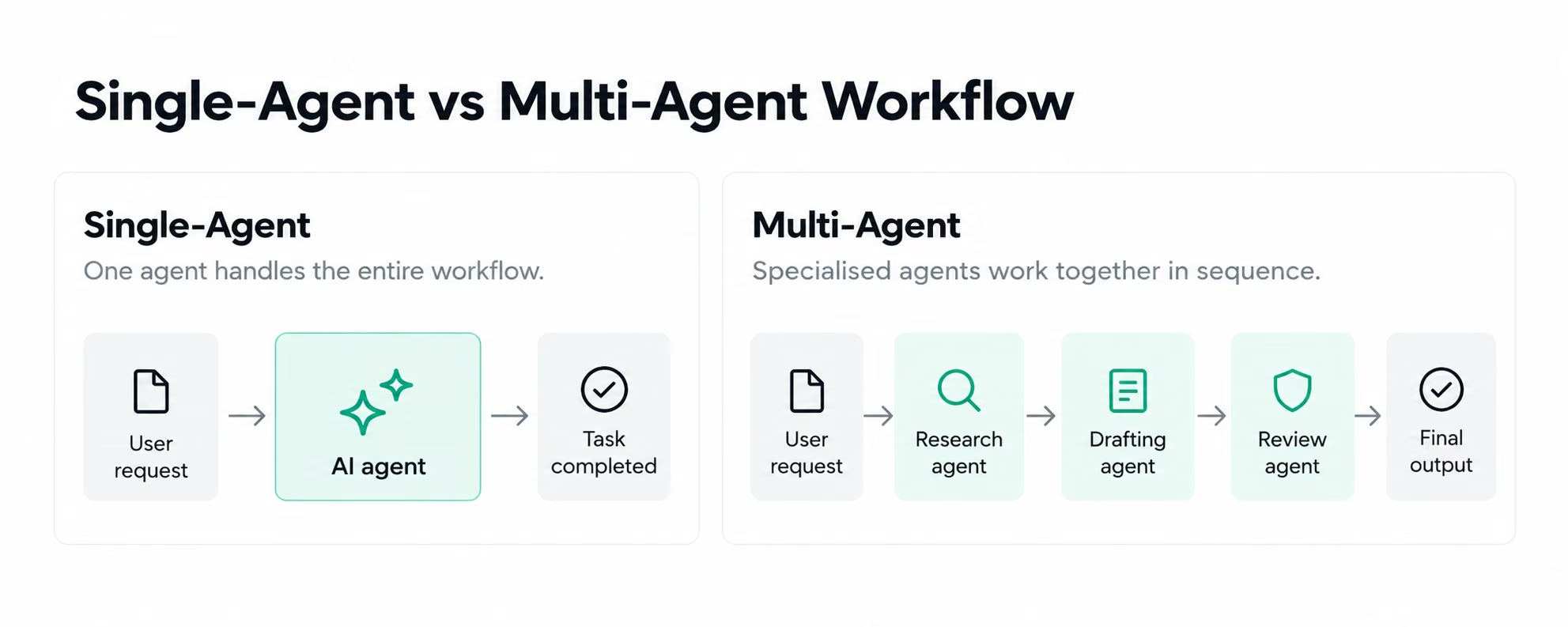
A single-agent system uses one agent to manage a workflow. For example, a customer support agent can retrieve order information, answer queries, and create support tickets using connected tools.
A multi-agent system involves multiple specialized agents working together towards a common goal. For example, in a content marketing workflow, one agent may research topics, another may prepare a draft, and a third may review the content against predefined guidelines before sending it for human approval.
Here is how the two approaches compare:
Build an AI Agent for Your Use Case With Emergent
Identifying a suitable use case is the first step. The next is building an AI agent that can perform the required tasks, access relevant information, and work within defined permissions.

Emergent's AI Agent Builder allows users to describe the AI agent they want to build using natural-language instructions.
With Emergent, you can build custom AI agents by describing your requirements in natural language, without having to write the entire application code yourself. You can define the agent's responsibilities, connect relevant tools and data sources, and configure workflows based on your business requirements.
For example, suppose you want to build a sales agent that qualifies website leads and schedules meetings. You can describe the information it should collect, the criteria for qualifying prospects, and the actions it should take. Emergent can help build the application and its agent workflow, which you can then test and refine.
Start by identifying one specific task, the information your agent needs, and the actions it should be allowed to perform. Test the workflow with realistic scenarios before gradually expanding the agent's responsibilities.
Most AI app builders stop at prototypes. Emergent creates production-ready apps you can actually launch.
- Production-ready apps
- Web & mobile apps
- Deploy in minutes