Picking the wrong Claude model costs you twice. You overpay for simple tasks, or you get weak results on hard ones. Fable 5.1 is priced at $10 per million input tokens, while Sonnet 5.5 is priced at $2.
Claude Fable 5.1 vs Claude Sonnet 5.5 comes down to depth versus speed. Fable 5.1 fits long, hard, multi-hour projects. Sonnet 5.5 fits fast, everyday work. If you are new to it, this explainer on what Claude Sonnet 5.5 is covers the basics.
Many readers ask, Which Claude model should I use? This guide answers it by comparing features, benchmarks, speed, and price, and by showing where each model falls short.
Every spec and price here comes from Anthropic’s own documentation and launch pages, checked on October 30, 2026. Benchmark scores come from Anthropic’s runs unless noted. Prices appear in US dollars.
Fable 5.1 and Sonnet 5.5 at a Glance
Fable 5.1 is designed to handle more complex tasks. Sonnet 5.5 focuses on the work people do most often. The table below compares the two models.
Sonnet 5.5 was released 27 days after Fable 5.1. Fable 5.1 is an updated version of Fable 5, released in June 2026.
What Each Claude Model Is Built For
Claude Fable 5.1 features and best uses
Anthropic built Fable 5.1 for jobs that run for hours and span many apps. The company says it skips shortcuts and fixes root causes, not symptoms. Four uses stand out:
- Long-running agents: It can take a list of pending tasks and work through them using a browser, without needing someone to guide each step. If something fails, it tries to recover and continues. It also sends progress updates on its own.
- Large coding projects: It can work on features that touch different parts of a codebase, review code, and improve performance. It can keep a project going over several days, write tests, and use vision to check whether the result matches the original design.
- Deep research and enterprise work: It handles multi-stage analysis from start to finish and returns deliverables ready for review.
- Document vision: It reads diagrams, charts, and tables nested inside PDFs, which helps in finance, legal, and architecture work.
Version 5.1 costs the same as Fable 5, but uses 75% less for cache reads. Anthropic also says it performs better on longer coding tasks, multi-step research, and work with documents, spreadsheets, and slides. It adds three beta features: you can change the effort level during a conversation, set system messages for individual turns, and see progress updates between tool calls.
Claude Sonnet 5.5 features and best uses
Anthropic describes Sonnet 5.5 as a faster, more affordable option than Opus 5.5. It works best on everyday tasks with clear goals. Its main uses include:
- Everyday coding: Early testers say it understands a codebase quickly. It also batches tool calls, which cuts the number of steps per task.
- Documents, slides, and spreadsheets: In one Anthropic test, it received a company’s earnings materials and a slide template. Two experts judged its 10-slide operating review ready to send as written.
- Design sense: Testers say it polishes user interfaces and follows slide templates with little editing.
- Chart reading: It scores 61.6% on Chartography, a visual chart test, up from 15.6% for Sonnet 5.
- Clearer writing: Testers call it a better collaborator than Sonnet 5.
Specs and Feature Comparison
Anthropic’s Fable 5.1 docs and Sonnet 5.5 docs list the figures below.
The shared numbers mean memory does not separate these models. Both read the same amount of text and write the same length of answer.
Thinking and effort controls
The effort setting controls how long a model thinks, how fast it answers, and how much it costs. Fable 5.1 always thinks, so even a simple request pays for some reasoning. Sonnet 5.5 offers a setting called between_tools that switches off up-front thinking at high effort or below.
Anthropic says Sonnet 5.5 at Low or Medium effort beats Sonnet 5’s best score on several benchmarks for about one-tenth of the cost per task.
Safeguards and fallback
Fable 5.1 sends many cybersecurity and biology queries to other Claude models. Anthropic says rerouted requests do not carry Fable prices. Sonnet 5.5 is the first Sonnet model with cyber safeguards. Higher-risk cyber tasks fall back to Sonnet 5, while routine bug fixing stays on Sonnet 5.5.
Platforms
Both models run on the Claude API, Amazon Bedrock, Google Cloud, and Microsoft Foundry. Sonnet 5.5 also offers zero data retention.
Benchmarks and Real-World Performance
Both models post strong launch scores, but few of them line up. Anthropic published results for Fable 5.1 on September 1 and Sonnet 5.5 on September 28. The two tables use different test versions and different rival models.
Fable 5.1 vs Sonnet 5.5 benchmarks
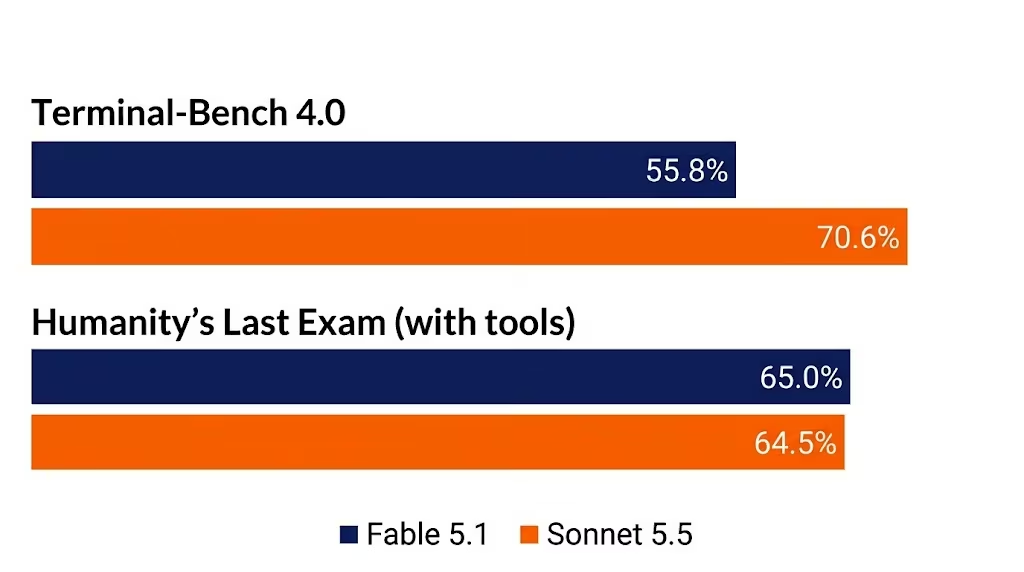
Both launch tables include two tests with the same name and version.
Sonnet 5.5 scores 14.8 points higher than Fable 5.1 on terminal coding. Their expert reasoning scores are much closer, with Fable 5.1 ahead by just 0.5 points.
The terminal coding result needs some context. Anthropic reports a 66.4% score for Opus 5.5 on the same test. However, it says Opus 5.5 is still much stronger at open-ended work that requires careful judgment over time. Terminal-Bench focuses on tasks with clear goals, which suits the way Sonnet works.
The remaining scores do not compare:
- Fable 5.1 only: Terminal-Bench-Science 0.1 at 52.6% (Fable 5 scored 24.7%), AutomationBench at 31.4%, CursorBench 3.2.0 at 73.4%, GDPval-AA v2 at 1,853, and OSWorld 2.0 (partial) at 77.9%.
- Sonnet 5.5 only: CursorBench 4.0 at 55.5%, GDPval-AA v2.1 at 1,844, OSWorld 2.1 (partial) at 80.1%, and FrontierCode 1.1 at 52.1% on Xhigh effort.
CursorBench 3.2.0 and 4.0 are different test versions. The 73.4% and 55.5% scores say nothing about which model wins. The same holds for GDPval-AA and OSWorld. Anthropic also notes that Fable 5.1 scored zero on OSWorld tasks where its safeguards stepped in, which pulls that score down.
What the scores mean in real work
Customers on Anthropic’s launch pages describe the gap in practice. These are company statements, not independent tests.
- MongoDB on Fable 5.1: A staff engineer says the model built a complex prototype in about three days. It ran for hours unattended and left a visual walkthrough of its work.
- Red Hat on Fable 5.1: Its engineers say the model found the root cause of every broken build they tested, at every effort level.
- Epic Games on Sonnet 5.5: The team says it managed tens of thousands of lines of gameplay code and handled multi-hour tasks.
- Box on Sonnet 5.5: The company reports answers 2.4x faster and 12% fewer tokens than the previous model.
- Zendesk on Sonnet 5.5: The company says it processed support tickets 20% faster.
Fable’s examples run for hours or days. Sonnet’s examples measure speed and token use.
Speed, Cost, and Pricing Compared
Speed
Anthropic’s docs label Fable 5.1 “Slower” and Sonnet 5.5 “Fast.” Anthropic also says Sonnet 5.5 generates output more than 30% faster than Sonnet 5.
A slower model hurts most when you wait on every reply, such as in chat, quick edits, or live coding help. It hurts less on overnight agent runs, where nobody watches the clock.
Fable 5.1 vs Sonnet 5.5 pricing
This table shows API prices per million tokens from Anthropic’s pricing page.
Fable 5.1 adds 10% to both rates if you need US-only inference. Here is what the gap means for a sample task with 100,000 input tokens and 10,000 output tokens:
These figures use list prices and equal token counts. Real bills shift because each model uses a different number of tokens per task.
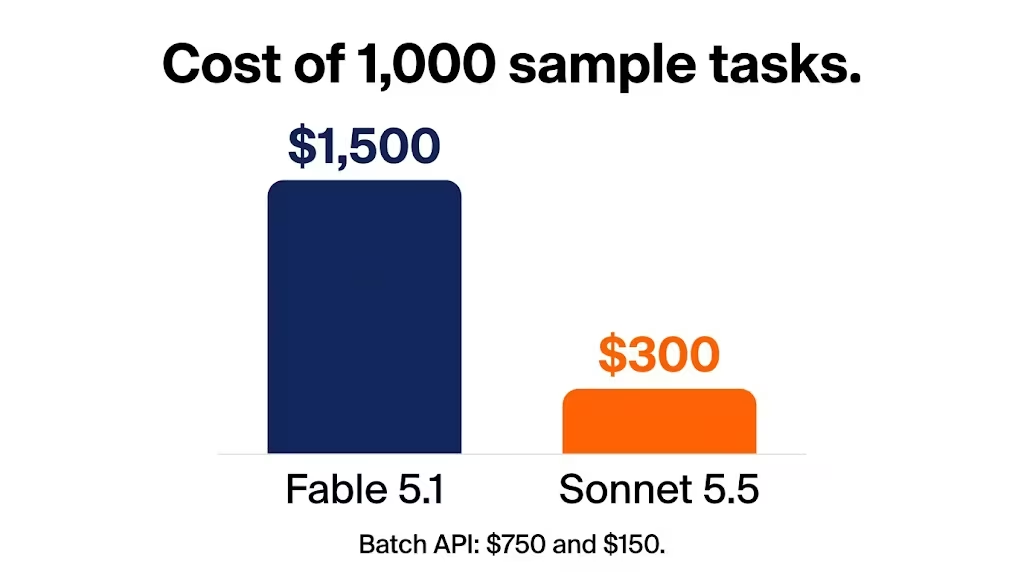
Plan access in the Claude apps
Anthropic’s plans page shows which plans include each model:
- Free: Includes access to Sonnet, but not Fable.
- Pro ($17/month with annual billing or $20/month with monthly billing): Sonnet comes with the plan. Fable requires usage credits.
- Enterprise: Fable is available on this plan.
Cost per task, not per token
The lower cache price affects the overall cost. Anthropic estimates that the 75% cut in cache pricing reduces the cost of typical Fable 5.1 workloads by 25% and agent-heavy workloads by up to 45%. But Artificial Analysis, which helped test the model, disagrees with these savings at the highest effort setting. Its tests show that Fable 5.1 costs 20% more per task than Fable 5 at maximum effort because it generates about 1.7 times more output tokens.
Sonnet 5.5 works the other way. It keeps Sonnet 5’s per-token price but needs fewer tokens, which Anthropic says cuts per-task cost by up to 30%.
Where Each Model Falls Short
Claude Fable 5.1 limits
- Reasoning you cannot switch off. Thinking stays on, so quick questions cost more and take longer.
- Safeguard reroutes. Security and biology teams may see their requests move to another model. Cyber-safeguard interventions fell by about 60% per Claude Code session, and biology safeguards fire 85% less often on benign elementary biology and medical requests. Qualified security teams can apply to the Cyber Verification Program.
- Data retention. Fable 5.1 has data-retention considerations; eligible enterprise customers can use zero data retention until Enterprise Frontier Safeguards is available.
- API changes. Forced tool use returns an error. Editing earlier turns also invalidates thinking blocks, which breaks some workflows built on Fable 5.
Claude Sonnet 5.5 limits
- Anthropic still considers Opus 5.5 the stronger choice for complex tasks that require careful judgment over a long period.
- Sonnet 5.5 doesn't always perform better at higher effort settings. On FrontierCode, its score drops at Max compared with Xhigh.
- At Max, it used the code-review feature more often, spread the work across sub-agents, and ended up with timeouts and changes outside the task's scope.
- Higher-risk security tasks still use Sonnet 5. Anthropic says it plans to offer defenders access through a tiered application process.
- The API also has some restrictions. Attempts to set temperature, top_p, or top_k return a 400 error. Forced tool use does not work either.
- Teams that run Sonnet without thinking enabled will need to switch to the new between_tools setting.
Which Claude Model Should You Choose?
Think about the work you need to do first. The table shows which model best suits each task.
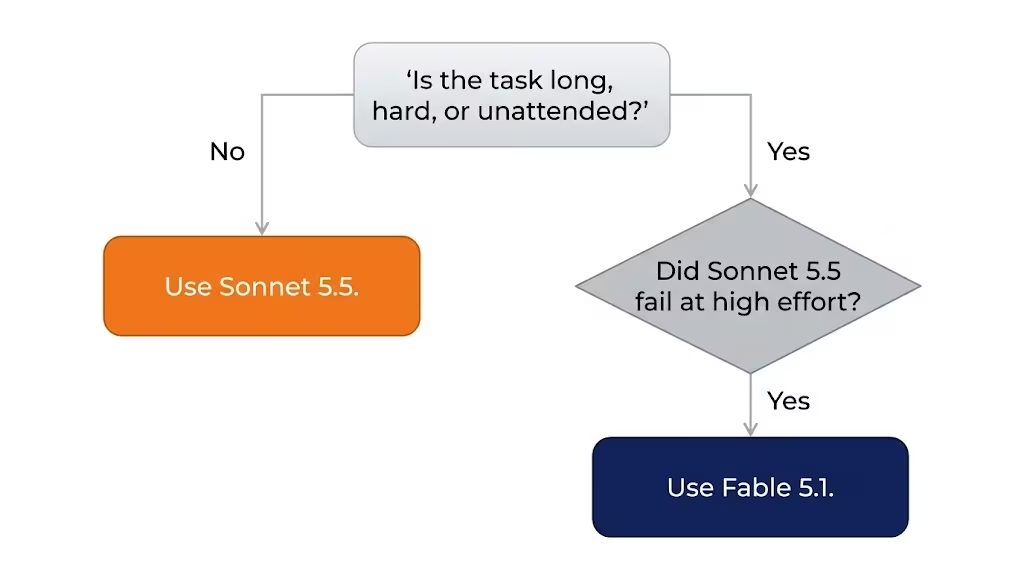
A simple rule: start low, then move up
Run every new task on Sonnet 5.5 first. Raise its effort setting before you switch models, and try Xhigh before Max. Move a task to Fable 5.1 only after Sonnet 5.5 fails on it.
This is our suggested workflow, not an Anthropic rule. It keeps most traffic at $2 and $10 and saves the $10 and $50 rate for tasks that need it.
When neither model fits
Anthropic recommends that most teams start with Opus 5.5, which is priced at $4 per million input tokens and $20 per million output tokens. They should consider Fable 5.1 only if their tests show that Opus falls short, even at higher effort settings.
Haiku 5.5 is a cheaper option for simple, high-volume tasks, starting at $0.10 for input and $0.50 for output per million tokens. Our guide on what Claude Haiku 5.5 is explains what it's best suited for.
If you build agents or products
Founders without a technical background don't need to worry about the API details. The model only does the processing behind the scenes. You can still build software without coding by explaining what you want it to do.
Conclusion
Claude Fable 5.1 or Sonnet 5.5: the choice is purely based on your task. The following points will help you to decide.
Key takeaways:
- Fable 5.1 suits long, complex projects. It is priced at $10 per million input tokens and $50 per million output tokens.
- Sonnet 5.5 suits everyday tasks. It is priced at $2 per million input tokens and $10 per million output tokens.
- Both models have the same context window and maximum output limit.
- When comparing benchmark scores, make sure both models were tested using the same test name and version.
Both models are live on Emergent, an AI app builder, so you can test them on a real project.


Most AI app builders stop at prototypes. Emergent creates production-ready apps you can actually launch.
- Production-ready apps
- Web & mobile apps
- Deploy in minutes