Claude Opus 4.8 may justify its higher cost for demanding coding and multi-step agentic work, while Sonnet 4.6 offers a more economical option for everyday development, writing, and high-volume requests.
Choosing between them requires more than comparing benchmark scores. Response latency, task success, and total operating costs also matter. This article examines their capabilities, independent benchmarks, pricing, and deployment considerations to help you select the right model for your workload.
Claude Opus 4.8 vs. Claude Sonnet 4.6 at a Glance
Opus 4.8 targets complex coding and agentic workflows, while Sonnet 4.6 offers a lower-priced option for everyday tasks. Both support a 1M-token context window and 128K maximum output.
Claude Opus 4.8 vs. Claude Sonnet 4.6: specifications, pricing, and benchmark performance. Sources: Anthropic model documentation and Vals AI. Pricing checked November 16, 2026. Vals Index v1.1 results: May 28, 2026; SWE-bench Verified results: September 1, 2026. Pricing checked November 16, 2026.
*Blended pricing assumes 70% cached input tokens, 20% standard input tokens, and 10% output tokens. These illustrative rates exclude initial cache-write charges, which are billed separately. Actual costs depend on usage patterns and applicable pricing modifiers.
Sources: Anthropic model documentation | Vals Index v1.1 | SWE-bench Verified
What Are Claude Opus 4.8 and Claude Sonnet 4.6?
Claude Opus 4.8
Released on May 28, 2026, Opus 4.8 targets complex coding and multi-step agentic work. Anthropic reports improvements in reliability and collaboration over Opus 4.7. Its adaptive thinking feature adjusts reasoning effort by task complexity, with high effort as the default when enabled.
Claude Sonnet 4.6
Released on February 17, 2026, Sonnet 4.6 balances cost and capability across coding, document analysis, and knowledge work. It supports adaptive thinking, which developers must explicitly enable through Anthropic's API. High is the default reasoning effort when enabled.
Claude Opus 4.8 vs. Claude Sonnet 4.6: model positioning and capabilities. Source: Anthropic's official model documentation, accessed November 16, 2026.
Although Opus 5.5 and Sonnet 5.5 are newer, comparing these legacy models remains relevant to businesses assessing existing deployments and potential upgrades.
Claude Opus 4.8 vs. Claude Sonnet 4.6: Key Differences
Five differences matter when choosing between these models: reasoning performance, response speed, context limits, multimodal capabilities, and deployment options. Understanding these distinctions helps businesses evaluate which model best fits their workloads.
1. Intelligence and Reasoning
On Vals Index v1.1, Opus scored 70.17%, compared with Sonnet's 60.30%. Both support adaptive thinking, although reasoning effort can affect latency and token consumption.
2. Speed and Latency
Artificial Analysis reports higher output throughput for Opus 4.8 (Max), while Sonnet 4.6 (Non-reasoning, High) starts responding sooner. Different reasoning settings limit direct comparisons of overall speed.
3. Context Window
Both offer 1M-token context windows and 128K standard output limits. However, teams should still test retrieval accuracy and reasoning quality when working with lengthy inputs.
4. Multimodal Capabilities
Both models accept text and images and generate text. Neither directly supports native audio or video input through the documented model interface; those workflows require additional tools.
5. Model Weights and Licensing
Both are proprietary, closed-weight models available through APIs and supported cloud platforms. Neither offers publicly downloadable weights for self-hosting.
Claude Opus 4.8 vs. Claude Sonnet 4.6 Benchmarks
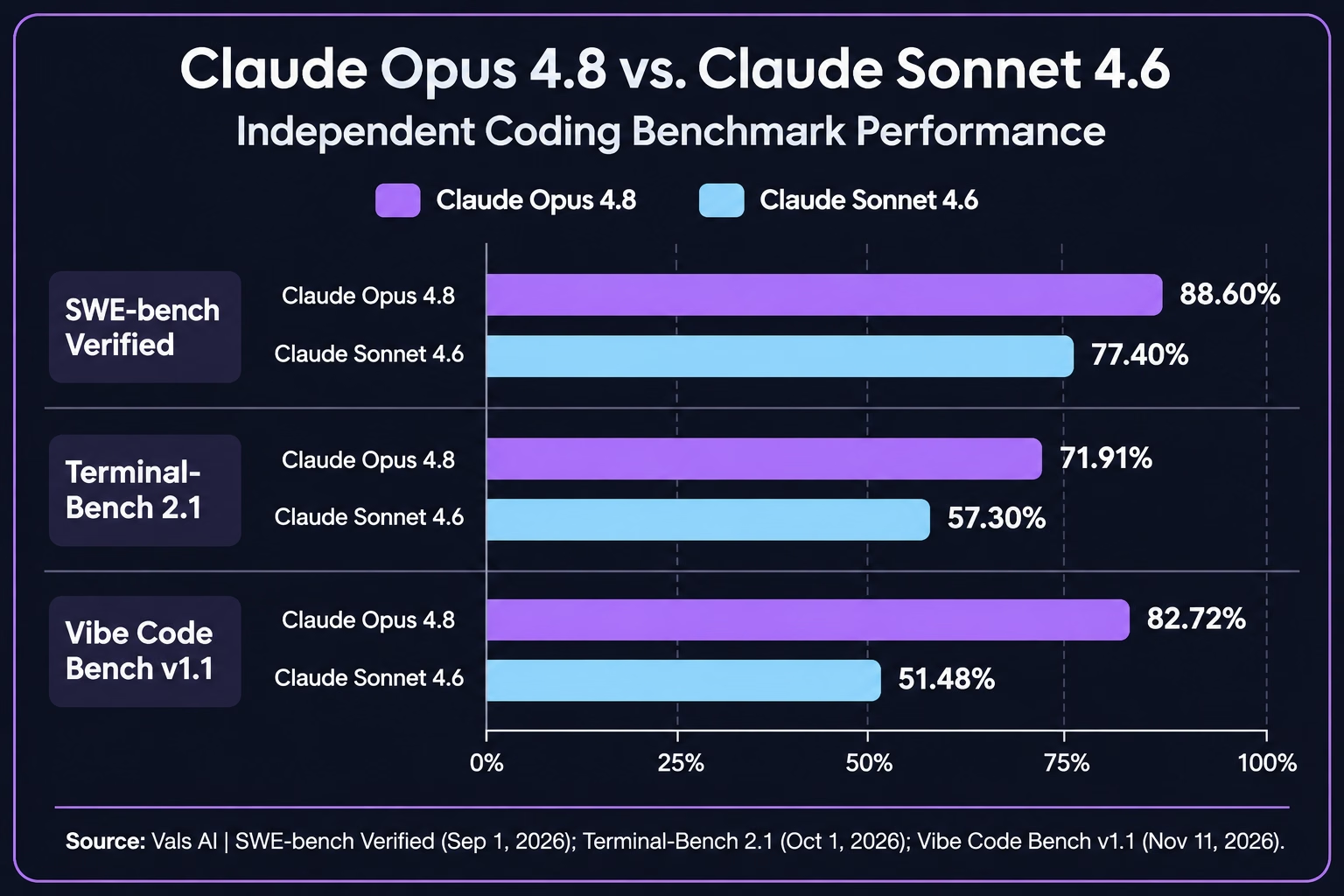
We compare six Vals AI metrics using the same benchmark versions and matching test setups where available. Vals Index v1.1 overlaps with some individual evaluations, so the six metrics are not entirely independent. Their reasoning settings may also differ from those used in our separate Artificial Analysis speed comparison.
Independent Benchmark Performance
Claude Opus 4.8 vs. Claude Sonnet 4.6: independent benchmark performance. Source: Vals AI. Dates indicate when each benchmark leaderboard was last updated, not necessarily when individual models were tested. Higher scores indicate better performance.
What Do These Benchmarks Tell Us?
Vals Index v1.1: Combines coding and finance evaluations; Opus leads by 9.87 percentage points.
SWE-bench Verified: Tests real software fixes. Both results use Mini-SWE-agent.
Terminal-Bench 2.1: Evaluates command-line problem-solving. Both results use Terminus 2.
Vibe Code Bench: Measures application-building ability. Both results use OpenHands, with Opus showing the largest performance gap.
CorpFin v2: Tests comprehension of corporate credit agreements. The models perform relatively closely.
Finance Agent v2: Evaluates multi-step financial analysis, where Opus has a smaller advantage.
Anthropic-Reported Capabilities
Anthropic reports improvements in Opus 4.8's coding reliability and Sonnet 4.6's computer use, reasoning, and knowledge work. These are vendor claims, not independent head-to-head results.
Which Model Performs Better?
Opus leads all six Vals AI metrics, with the largest advantages in terminal-based coding and application development. Its smaller leads on financial tasks suggest that the value of upgrading depends on workload complexity and the cost of errors.
Claude Opus 4.8 vs. Claude Sonnet 4.6 for Coding
Both models can write, debug, and review code. Opus's stronger benchmark results favor complex development, while Sonnet's lower pricing makes it attractive for routine coding tasks.
Coding Performance and Problem-Solving
Opus leads on SWE-bench Verified and Terminal-Bench 2.1 under matching testing setups. These results support evaluating it for difficult debugging, repository-level changes, and multi-step development. However, benchmark advantages do not guarantee identical outcomes in production.
Claude Code and Agentic Development
Both models support Claude Code, subject to availability. Anthropic introduced dynamic workflows alongside Opus 4.8 as a research preview for Enterprise, Team, and Max plans. Anthropic positions Opus for demanding development and Sonnet for everyday coding and agentic tasks. These are vendor-reported capabilities.
Which Model Should Developers Choose?
Consider Opus for difficult debugging, multi-file refactoring, and autonomous agents. Sonnet is more economical for documentation, test creation, and routine coding when its capabilities are sufficient.
For production workloads, compare cost per accepted result, including retries and developer intervention, rather than relying on token prices alone. Cost per accepted result is easiest to measure on your own code. A coding agent builder lets you build an AI coding agent that runs your tests and counts accepted changes for you.
Claude Opus 4.8 vs. Claude Sonnet 4.6 for Writing
Both models support writing, editing, and document analysis. Because comparable independent writing benchmarks are limited, evaluate factual accuracy, tone, instruction following, and editing effort rather than declaring an overall winner.
Claude Opus 4.8 for Complex Writing
Anthropic reports improvements in Opus 4.8's collaboration and consistency across longer sessions, based partly on early-user feedback. These are not independent writing benchmark results. Opus is worth evaluating for research-intensive articles, complex reports, and multi-stage editing.
Claude Sonnet 4.6 for Everyday Writing
Anthropic highlights Sonnet 4.6's instruction following and long-context reasoning. Its lower API pricing makes it a practical candidate for blogs, summaries, emails, and routine business documents, provided the outputs meet editorial standards.
Which Model Should You Choose for Writing?
Test Opus for complex editorial assignments and Sonnet for frequent, well-defined tasks. Use identical briefs and sources, then compare accuracy, tone, editing time, and cost per approved draft.
Claude Opus 4.8 vs. Claude Sonnet 4.6: Pricing, Speed, and Access
Sonnet costs less per token, but the speed trade-off depends on reasoning configuration. Opus has higher measured output throughput, while Sonnet's non-reasoning setting delivers the first answer token sooner.
Pricing and Performance Comparison
Claude Opus 4.8 vs. Claude Sonnet 4.6: API pricing from Anthropic and performance measurements from Artificial Analysis, captured November 17, 2026. Opus 4.8 uses Max reasoning, while Sonnet 4.6 uses the Non-reasoning, High configuration. First-answer-token latency includes reasoning time where applicable. Figures may change as Artificial Analysis updates its measurements.
Which Model Offers Better Value?
Sonnet's token rates are 40% lower, but tokenizer differences, reasoning effort, and retries affect actual costs.
Opus's higher measured output throughput includes reasoning tokens where applicable; it does not necessarily mean faster generation of visible answers. Meanwhile, Sonnet's lower first-answer-token latency reflects a non-reasoning configuration.
These results do not establish which model completes a task faster. Teams should test representative workloads under comparable configurations and measure cost per successful result. Both models have newer successors. For the 5.5 generation's rates, see our Claude Opus 5.5 pricing and Claude Sonnet 5.5 pricing guides.
Availability and Access
Both models are available through Anthropic's API and supported providers, including Amazon Bedrock, Google Cloud, and Microsoft Foundry. Availability varies by product and configuration.
Anthropic lists both as active legacy models, with retirement commitments no earlier than May 28, 2027 (Opus) and February 17, 2027 (Sonnet). US-only inference on Anthropic's API carries a 1.1× pricing multiplier; partner pricing may differ.
Privacy, Data Residency, and Enterprise Controls
Both are closed-weight, API-hosted models. For businesses handling sensitive data, retention, training-use policies, regional processing, and access controls depend primarily on the deployment platform and commercial agreement.
Data Retention and Model Training
Under Anthropic's commercial data policy, customer inputs and outputs are not used for model training by default unless the customer explicitly permits it.
Anthropic's retention documentation states that conversation content is not retained by default for eligible API models. However, retention varies by feature, with some services storing data for longer periods.
Zero Data Retention
Anthropic offers Zero Data Retention (ZDR) arrangements for eligible commercial API usage. Under ZDR, customer prompts and responses are not stored at rest after the API response is returned.
However, ZDR requires separate enablement and does not cover every feature. Businesses using file storage, batch processing, or third-party integrations should review the applicable exceptions.
Data Residency and Regional Deployment
According to Anthropic's data residency documentation, both models support US-only inference and global routing through the Claude API. US-only inference costs 1.1 times the standard token rates, while global routing uses standard pricing. Regional pricing may differ on partner-operated cloud platforms.
Importantly, inference location and data storage location are separate controls. Organizations should verify both when evaluating residency requirements.
Enterprise Security and Access Controls
Anthropic provides workspace permissions, API key controls, and spending limits. Partner platforms may apply different data-handling terms. Regulated businesses should verify contracts, retention policies, regional processing, and security controls before deployment.
Which Should You Choose? Claude Opus 4.8 or Claude Sonnet 4.6 by Use Case
Start with Sonnet for frequent, straightforward tasks and evaluate Opus for demanding coding or multi-step agents. Confirm your choice with representative workload tests.
Recommended Claude models by workload, based on independent benchmark results, published API pricing, and Anthropic's documented capabilities. Performance varies with configuration and deployment.
For teams building applications without coding, Emergent uses AI agents to develop, test, and publish apps from natural-language instructions. Its Universal LLM Key also supports Claude models, allowing builders to integrate supported versions into their applications.
Conclusion
Choosing between Claude Opus 4.8 and Sonnet 4.6 comes down to workload complexity, responsiveness, and cost.
Opus 4.8 is better suited to demanding coding and agentic workflows where stronger benchmark performance may justify higher API costs. Sonnet 4.6 offers a more economical alternative for routine development, writing, and latency-sensitive applications.
However, both are now legacy models. Businesses starting new projects should also evaluate Claude Opus 5.5 and Sonnet 5.5, which Anthropic recommends as their respective successors. Claude Fable 5.2 is another option for particularly demanding workloads, provided its additional capabilities justify the premium.
Ultimately, the best model is the one that completes your tasks reliably at an acceptable cost.
Ready to turn your idea into a working application? Start Building with Emergent.

Describe it. Build it. Launch it.
- End-to-End Creation
- No Code Needed
- Live in Minutes
Most AI app builders stop at prototypes. Emergent creates production-ready apps you can actually launch.
- Production-ready apps
- Web & mobile apps
- Deploy in minutes