Choosing between Claude Opus 5.5 and GPT-6 Astra becomes more complicated when both models operate at High reasoning effort. At this setting, the focus shifts beyond generating quick answers to handling demanding tasks that require deeper analysis, complex coding, research, and multi-step problem-solving.
However, higher reasoning effort does not automatically translate into better results across every task. A model that performs well in coding may not offer the same advantages in research, agentic workflows, or cost efficiency. Response time and token consumption also matter, particularly when AI becomes part of a recurring business workflow.
This comparison examines Claude Opus 5.5 (High) and GPT-6 Astra (High) across benchmark performance, coding, AI agents, research, speed, and cost per task. The goal is to help you understand where each model offers practical advantages and which one makes more sense for your workload.
Two Frontier Models, Two Different Bargains
Claude Opus 5.5 and GPT-6 Astra are both designed for demanding AI workloads, but they're positioned differently.
Anthropic positions Claude Opus 5.5 around long-running coding, AI agents, and professional knowledge work. OpenAI positions GPT-6 Astra as its most capable model for complex reasoning, software engineering, research, and computer-based tasks.
Both support High reasoning effort, allowing the models to spend more effort working through complicated problems. However, High is a model-specific setting, not a guarantee that both models use the same amount of computation.
Here is how they compare at a glance.
Sources: Anthropic's Claude Opus 5.5 documentation and OpenAI's GPT-6 Astra model documentation. Prices reflect standard API token rates, excluding caching, additional tool charges, and other pricing adjustments.
The clearest difference is pricing. GPT-6 Astra costs 2.5 times as much per input and output token at standard API rates. However, that doesn't necessarily make every Astra-powered task 2.5 times more expensive. Actual costs also depend on reasoning tokens, tool calls, and how many attempts a model needs to complete a task successfully.
For users, the choice therefore goes beyond selecting the model with the lower price or stronger benchmark score. It comes down to which model can complete their particular work accurately, efficiently, and with the least intervention.
Each rate card is broken out in our Claude Opus 5.5 pricing and GPT-6 Astra pricing guides.
Intelligence and Benchmark Results
Benchmark results help assess how well AI models handle unfamiliar problems, expert-level questions, and complex reasoning. However, no single benchmark can determine which model performs better across every task.
Claude Opus 5.5 and GPT-6 Astra both demonstrate strong reasoning capabilities, although their relative performance varies across evaluations.
How Do Their Benchmark Results Compare?
Source: Artificial Analysis – Claude Opus 5.5 vs. GPT-6 Astra. Results reflect Intelligence Index v5.0.1, comparing Claude Opus 5.5 (High with fallback) and GPT-6 Astra (High). Higher scores indicate better performance.
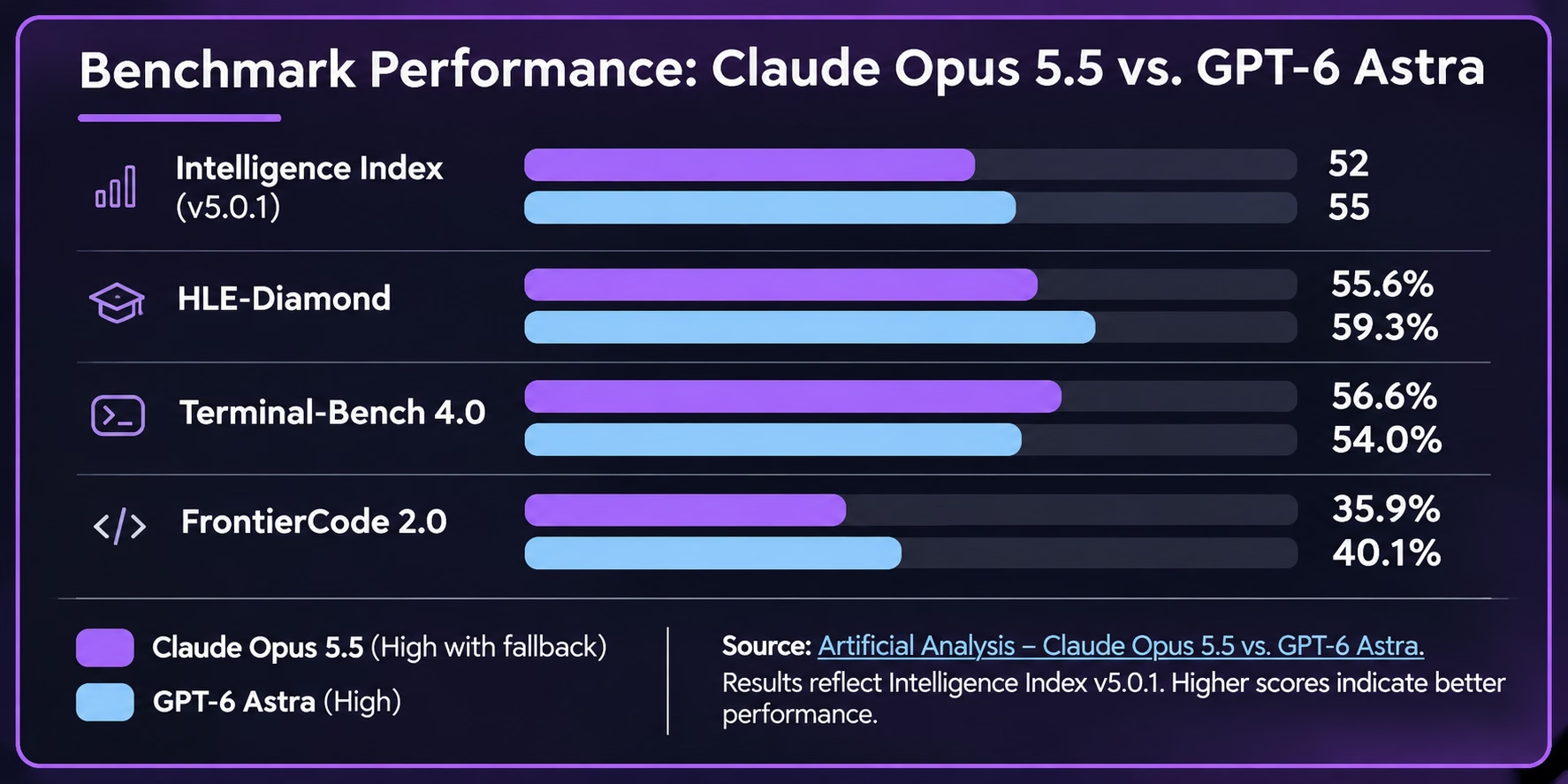
The benchmark results highlight three important differences:
- Overall intelligence: GPT-6 Astra leads on the Intelligence Index, suggesting stronger aggregate performance across the evaluated reasoning and knowledge tasks.
- Advanced reasoning: Astra also scores higher on HLE-Diamond, indicating an advantage on this particular set of challenging expert-level questions.
- Coding performance: Results are mixed. Claude Opus 5.5 leads on Terminal-Bench 4.0, while GPT-6 Astra performs better on FrontierCode 2.0. This suggests that their relative strengths depend on the type of software development task.
These findings do not establish an overall winner. Benchmark scores reflect specific evaluation conditions, and actual performance may differ depending on the task, tools, and reasoning configuration.
For each model's wider score set, see our Claude Opus 5.5 benchmarks and GPT-6 Astra benchmarks guides.
What Do These Results Mean for Users?
For everyday users and businesses, benchmark differences matter most when they translate into better completed work.
A model that performs well on advanced reasoning evaluations may be useful for analyzing complicated documents, interpreting technical information, or solving unfamiliar problems. However, those scores do not necessarily indicate how reliably it can build an application, navigate software, or complete a multi-step business process.
That is why benchmark performance should be considered alongside practical task completion, accuracy, response time, and cost. These differences become particularly important when AI models are used for coding, research, and autonomous workflows.
Coding, Agents, and Research Performance
Beyond general intelligence, the real test of an AI model is whether it can complete demanding tasks with minimal errors and human intervention. This becomes particularly important when using AI to develop software, automate business processes, or conduct technical research.
Coding and Software Development
Claude Opus 5.5 and GPT-6 Astra demonstrate different strengths across software engineering benchmarks. Terminal-Bench 4.0 evaluates how effectively AI agents complete tasks in a command-line environment, while FrontierCode 2.0 assesses software engineering capabilities.
Claude Opus 5.5 performs slightly better on Terminal-Bench 4.0, while GPT-6 Astra leads on FrontierCode 2.0. These mixed results suggest that neither model has a consistent advantage across all coding tasks.
For users developing applications, the more relevant considerations are whether the model can understand requirements, generate functional code, identify errors, and make corrections without introducing new problems.
AI Agents and Business Automation
AI agents go beyond generating responses. They can use tools, work across applications, and complete a sequence of actions to achieve a defined objective.
Both models support these workflows, but their relative performance depends on the tasks involved.
For example, the AutomationBench results published in Anthropic's comparison show:
Source: Anthropic's published comparison, using results from Zapier's AutomationBench evaluations.
The small difference favors GPT-6 Astra on this evaluation, although it is not sufficient to establish an overall advantage in business automation.
Consider an AI agent responsible for processing customer enquiries. It might need to extract information from messages, update a database, assign enquiries to the appropriate employee, and generate follow-up reminders. If you want an agent that handles those enquiry steps, you can build one with an AI agent builder.
Successful execution depends on more than reasoning ability. The agent must use the correct tools, follow instructions, maintain context, and avoid making incorrect changes.
For business users, these practical considerations are often more important than a small difference in benchmark scores.
Research and Technical Problem-Solving
Both models can support complex research workflows, including analyzing documents, investigating technical questions, and working with specialized tools.
However, research performance depends heavily on the nature of the task.
In Vals AI's Terminal-Bench-Science evaluation, GPT-6 Astra scored 62.86%, compared with 47.14% for Claude Opus 5.5. The benchmark tests research workflows involving scientific tools and software.
This gives Astra a meaningful advantage in that particular evaluation, although it does not establish that Astra is better at every form of research.
For example, analyzing a company's financial reports, reviewing academic papers, and executing scientific software workflows require different capabilities.
Users should therefore evaluate the models against their actual research requirements, particularly source accuracy, completeness, tool reliability, and the ability to explain findings clearly.
Which Model Performs Better in Practice?
The available evidence does not establish a universal winner.
Claude Opus 5.5 leads in the cited Terminal-Bench coding evaluation, while GPT-6 Astra performs slightly better on AutomationBench and substantially better in the cited scientific workflow evaluation.
For users building software or automating business operations, the better choice is the model that completes their specific tasks accurately, with fewer corrections and a reasonable overall cost.
Speed, Latency, and Token Use
When using AI for complex tasks, speed is not simply about how quickly text appears on the screen. A model may generate responses rapidly but spend considerable time reasoning before answering. Another may generate fewer tokens and complete the overall task sooner.
This distinction becomes particularly important at High reasoning effort.
How Fast Are Claude Opus 5.5 and GPT-6 Astra?
Artificial Analysis reports the following performance figures for the two models at their respective High settings.
Artificial Analysis model comparison. Claude uses High with default fallback. Time per task is an estimated Intelligence Index inference metric; latency and output speed are measured separately.
Does Higher Reasoning Effort Mean More Tokens?
Higher reasoning effort generally allows models to devote more computation to solving difficult problems. However, it does not guarantee better answers or shorter completion times.
Artificial Analysis reports the following average token consumption across its Intelligence Index tasks:
These figures reflect the benchmark's weighted task averages, not the number of tokens consumed by a typical chat response. GPT-6 Astra uses considerably fewer tokens in these evaluations. This helps explain how it can complete tasks faster despite its lower measured output speed.
For businesses using AI repeatedly, token consumption also affects operating costs. A model with higher per-token pricing may still be competitive if it completes a task using substantially fewer tokens.
What Matters for Everyday Users?
The practical difference depends on how AI is being used.
For interactive tasks such as asking questions, reviewing documents, or refining content, faster initial responses can make the experience feel more responsive. For longer workflows, such as analyzing multiple files, generating software, or completing several connected actions, total completion time matters more.
The best approach is to evaluate how long each model takes to deliver a usable result, rather than judging performance solely by how quickly it starts responding.
Pricing and Cost per Task
Claude Opus 5.5 is considerably cheaper than GPT-6 Astra when comparing their standard API token rates. However, token pricing alone does not reveal how much a completed AI task will cost.
A model that uses fewer tokens or requires fewer attempts may deliver a better cost per task, even with higher token prices.
Source: Anthropic API Pricing and OpenAI API Pricing. Standard rates in USD; additional charges and pricing adjustments may apply.
For example, consider a task requiring 100,000 input tokens and 20,000 output tokens, with no caching or additional tool charges.
- Claude Opus 5.5: $0.40 for input and $0.40 for output, totaling $0.80.
- GPT-6 Astra: $1.00 for input and $1.00 for output, totaling $2.00.
Under identical token usage, Claude Opus 5.5 is 60% cheaper.
However, reasoning-intensive tasks rarely consume exactly the same number of tokens across different models.
Cost per Task: Which Model Is More Economical?
Artificial Analysis measures the average cost of completing tasks across its Intelligence Index evaluations. Unlike a simple token-price comparison, this accounts for differences in token consumption and the evaluation's pricing methodology.
Source: Artificial Analysis: Claude Opus 5.5 (High) vs. GPT-6 Astra (High). Claude uses High with default fallback. Figures are evaluation averages, not estimates for every business task.
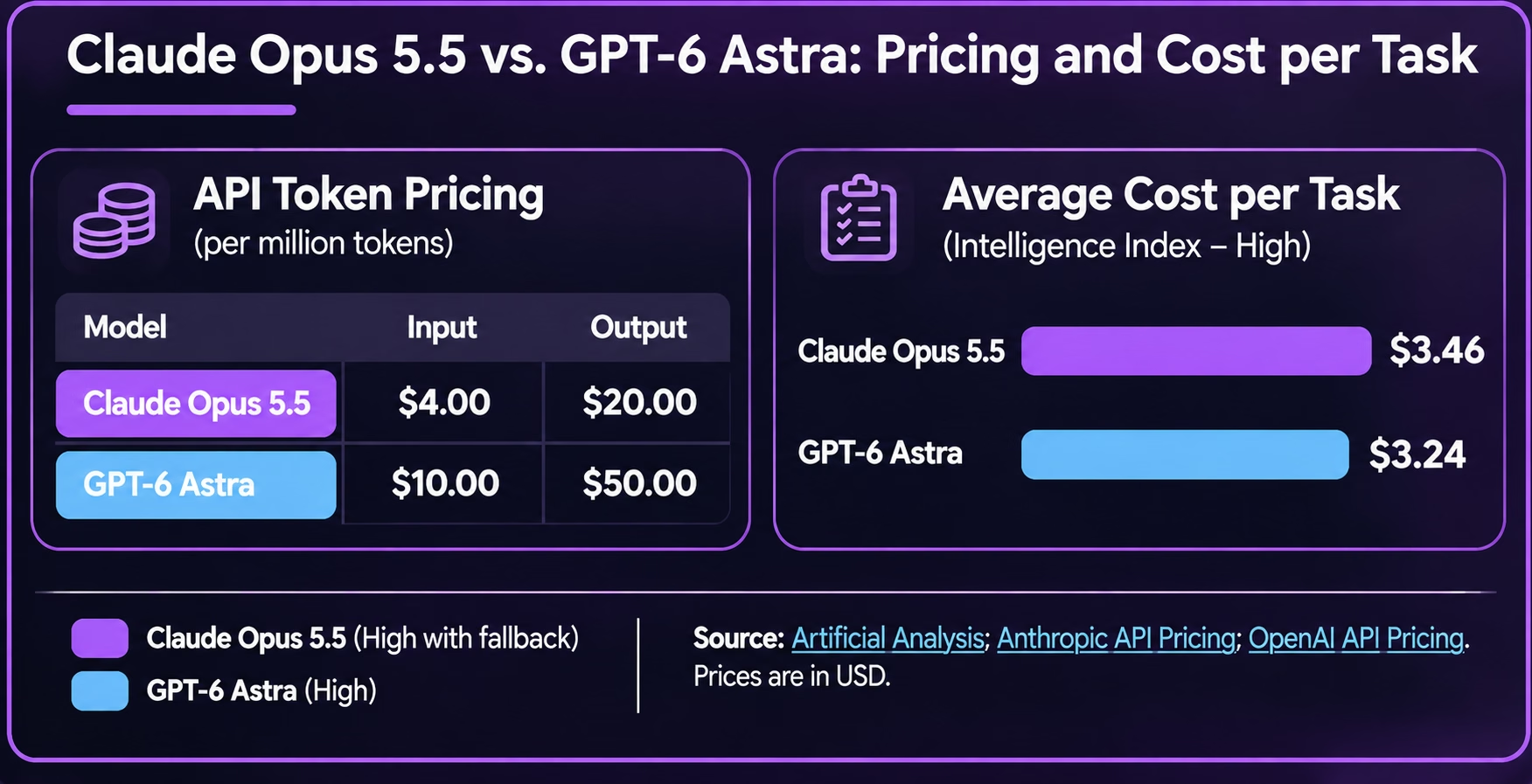
Despite its higher API rates, GPT-6 Astra has an approximately 6.4% lower average cost per task in this evaluation.
The difference is largely associated with token consumption. Astra uses substantially fewer output and reasoning tokens across the evaluated tasks, helping offset its higher per-token pricing.
However, these results should not be interpreted as proof that Astra is always cheaper. Actual costs depend on the complexity of the work, input length, caching, reasoning effort, tool usage, and the number of attempts required.
Which Offers Better Value?
Claude Opus 5.5 is the more economical choice when both models process comparable token volumes, particularly for workloads involving substantial input and output.
GPT-6 Astra becomes competitive when its lower token consumption offsets its higher API rates.
For businesses building AI-powered applications or running recurring workflows, the most useful metric is therefore the cost of completing a task successfully, rather than the cost of generating a fixed number of tokens.
A practical evaluation should consider the total cost of generating, testing, correcting, and completing the required work.
When to Choose Opus and When to Choose Astra
Claude Opus 5.5 and GPT-6 Astra are both capable of handling complex professional tasks. However, their strengths differ depending on the nature of the work, the tools involved, and the importance of speed, accuracy, and cost.
The following comparison can help you identify which model may be better suited to your requirements.
The right choice depends on the type of work you need to complete. Claude Opus 5.5 may be more suitable for interactive coding workflows and cost-sensitive applications, while GPT-6 Astra may be worth considering for demanding reasoning and complex software engineering tasks.
However, benchmark advantages do not guarantee better results in every situation. Testing both models on representative tasks remains the most reliable way to determine which one meets your requirements.
What If You Are Not a Developer?
You do not necessarily need to select and configure a frontier AI model to build useful business software.
For example, a business owner might want an employee attendance dashboard, a customer enquiry tracker, or an internal reporting application. The challenge is not simply choosing the model with the highest benchmark score. It is translating business requirements into functional software.
Platforms such as Emergent allow users to build applications through natural-language instructions rather than writing the underlying code manually.
For nontechnical users, the more relevant considerations are whether the resulting application works as intended, supports the required workflows, and can be maintained without extensive technical intervention.
Ultimately, the better model is the one that delivers reliable results for your specific workload, at an acceptable cost and with minimal additional effort.
A Practical Decision Framework
Benchmark scores provide a useful starting point, but the best way to choose between Claude Opus 5.5 (High) and GPT-6 Astra (High) is to test them against the work you actually need to complete.
Here is a four-step approach.
Step 1: Identify Your Most Important Tasks
Start by identifying two or three tasks you regularly perform, such as analyzing financial reports, debugging code, conducting research, or automating business processes.
Choose tasks that represent your actual workload rather than relying on generic AI prompts.
Step 2: Test Both Models Under Similar Conditions
Use identical instructions, input files, and expected outcomes wherever possible. Select High reasoning effort for both models and record any differences in configuration.
For example, if you want to build a reporting dashboard, provide both models with the same dataset and requirements. Compare calculation accuracy, functionality, and the number of corrections needed.
Step 3: Measure Quality, Time, and Cost
Evaluate each model against three practical criteria:
- Quality: Did it complete the task correctly and follow all requirements?
- Time: How long did it take to produce a usable result?
- Cost: How much did the completed task cost, including retries and corrections?
A model that delivers a correct result on the first attempt may offer better value than one requiring several revisions.
Step 4: Choose Based on Consistent Results
Repeat the evaluation across several representative tasks rather than making a decision based on a single response.
If one model consistently delivers better results for your most important workflows, prioritize it. If the results are similar, consider cost, responsiveness, and ease of integration.
For businesses using AI to build applications or automate processes, the ultimate measure of success is not the model's benchmark ranking. It is whether the resulting workflow performs reliably and solves the intended problem.
Conclusion
Claude Opus 5.5 (High) and GPT-6 Astra (High) offer different advantages, but benchmark leadership alone does not determine which model is right for you.
The more important consideration is how reliably each model handles your actual work. Whether you're developing software, conducting research, or automating business processes, evaluate result quality alongside completion time, operating costs, and the effort required to correct errors.
Ultimately, the better choice is the model that helps you achieve your goals with fewer complications and more predictable results.

Describe it. Build it. Launch it.
- End-to-End Creation
- No Code Needed
- Live in Minutes

Most AI app builders stop at prototypes. Emergent creates production-ready apps you can actually launch.
- Production-ready apps
- Web & mobile apps
- Deploy in minutes