Choosing between Claude Opus 5 and Sonnet 5 isn't simply about picking the more powerful AI model. It's about deciding how much performance your workload needs and whether the additional cost delivers enough value.
Both models can handle coding, agentic workflows, and complex business tasks. However, they serve different priorities. Claude Opus 5 focuses on difficult, multi-step work where accuracy and successful task completion matter most. Claude Sonnet 5 offers a more economical option for teams that need capable AI across frequent, repeatable tasks.
The differences become particularly important when you're building AI applications. A model that costs less per token may be suitable for thousands of routine requests, while a more capable model could justify its premium if it completes difficult tasks with fewer failed attempts.
In this Claude Opus 5 vs Sonnet 5 comparison, we'll examine pricing, coding benchmarks, agentic performance, speed, and practical use cases to help you decide which model fits your needs.
Two Anthropic Models, Two Different Bargains
Anthropic released Claude Sonnet 5 on June 30, 2026, followed by Claude Opus 5 on July 24, 2026. Both belong to the Claude 5 generation, but their value propositions differ.
Claude Opus 5 prioritizes demanding work. Anthropic positions it for complex software engineering, long-running agents, and professional tasks that require sustained reasoning. Its stronger performance on several challenging evaluations makes it worth considering when unsuccessful attempts can be expensive.
Claude Sonnet 5 prioritizes cost-efficient execution. It brings advanced coding, tool use, and agentic capabilities to a lower-priced model. This makes it attractive for everyday development, business automation, and applications processing large volumes of requests.
The distinction isn't that Opus handles complex tasks while Sonnet handles only simple ones. Both can perform sophisticated work. The question is whether Opus's additional capability produces a meaningful improvement for your specific workload.
We'll examine that trade-off using independent performance measurements, published pricing, and practical deployment considerations.
Anthropic has since released the 5.5 generation. For its scores, see our Claude Opus 5.5 benchmarks guide, and for the mid-tier model, our Claude Sonnet 5.5 overview.
Pricing and Running Costs
Claude Sonnet 5 has a clear pricing advantage. At standard API rates, it costs $2 per million input tokens and $10 per million output tokens. Claude Opus 5 costs $5 and $25, respectively, making it 2.5 times more expensive for both.
Standard global Claude API pricing in USD, November 2026. Source: Anthropic's published API pricing.
What Does This Mean for Actual Workloads?
Consider an application processing 10 million input tokens and generating 2 million output tokens monthly.
Under these assumptions, Sonnet 5 saves $60 monthly, or 60%. The calculation excludes caching, batch discounts, and additional tool-related charges.
However, token pricing doesn't tell the entire story. If Opus 5 completes a difficult coding or automation task more reliably, it could reduce retries, debugging, and human intervention.
The practical question is whether those improvements outweigh its higher API cost. For routine, high-volume workloads, Sonnet 5 has an immediate cost advantage. For demanding tasks, Opus 5's value depends on its actual completion rate and total cost per successful task.
For the current rate cards, see our Claude Opus 5.5 pricing and Claude Sonnet 5.5 pricing guides.
Intelligence and Task Quality
Claude Opus 5 demonstrates stronger performance than Sonnet 5 across several independently measured knowledge-work and automation benchmarks. However, the size of the advantage varies by task.
Artificial Analysis reports the following results for Claude Opus 5 at maximum effort and Sonnet 5 at high effort. These are model-specific configurations rather than a like-for-like effort comparison. We use the available results to assess task performance and identify effort settings wherever they differ.
Independent knowledge-work and automation benchmark results. Source: Artificial Analysis, accessed November 18, 2026. Effort settings differ.
Opus 5 leads on all three evaluations. Its advantage is particularly noticeable on AutomationBench-AA, which assesses the ability to complete automation tasks, and GDP.pdf, which tests complex document-based knowledge work.
These results suggest that Opus 5 is worth considering for demanding workflows involving multiple steps, tools, and decisions. For example, teams developing research agents or document-processing applications may benefit from its stronger measured task performance.
However, benchmark results don't guarantee equivalent improvements in every application. Sonnet 5 may still deliver satisfactory results for less demanding workloads at a substantially lower token cost.
The practical approach is to evaluate both models on representative tasks and compare successful completions, retries, and total processing costs rather than choosing solely by benchmark rankings.
Claude Opus 5 vs Sonnet 5: Coding Performance
Claude Opus 5 has a substantial advantage over Sonnet 5 on independently measured terminal-based coding tasks. However, both models can support software development, and the better choice depends on the complexity of the work.
Artificial Analysis reports the following Terminal-Bench 4.0 results:
Terminal-Bench 4.0 coding performance. Source: Artificial Analysis, accessed November 18, 2026. Higher scores indicate better benchmark performance.
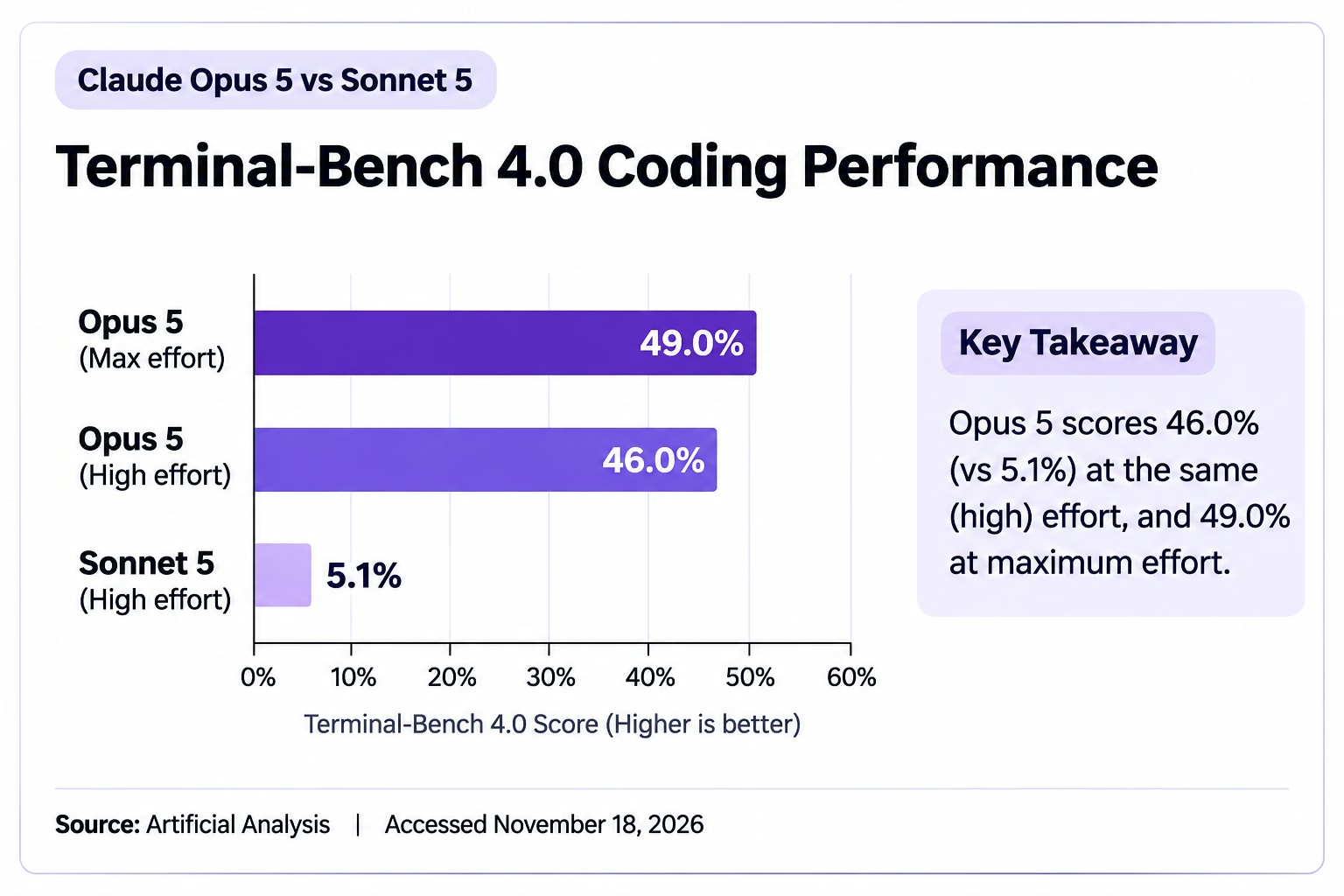
Terminal-Bench 4.0 coding performance for Claude Opus 5 (maximum and high effort) and Sonnet 5 (high effort). Source: Artificial Analysis, accessed November 18, 2026.
Terminal-Bench evaluates AI agents working through terminal-based tasks. These require more than generating code snippets: models must interact with development environments and complete tasks under benchmark-defined conditions.
At high effort, Opus 5 scores 46.0%, compared with Sonnet 5's 5.1%. Increasing Opus to maximum effort raises its score to 49.0%.
This gap suggests that Opus 5 is better suited to demanding coding-agent workflows, particularly when successful execution matters more than minimizing individual API calls.
However, the benchmark doesn't establish that Sonnet 5 will perform poorly on everyday programming tasks. Code explanation, documentation, straightforward functions, and routine development assistance may not require the same level of autonomous problem-solving.
For teams building coding agents, the decision should depend on actual task success rates, debugging requirements, and cost per completed task. Opus 5 is the stronger candidate for difficult autonomous workflows, while Sonnet 5 remains worth evaluating for predictable, lower-cost development tasks.
A 46.0% against 5.1% gap on one benchmark won't tell you how either model handles your codebase. You can build an AI agent for coding around your own repo and tests with a coding agent builder, then see which model completes your real tasks.
Agents and Business Workflows
AI agents do more than respond to prompts. They can retrieve information, use tools, process documents, and execute multi-step workflows. Choosing between Claude Opus 5 and Sonnet 5 depends on how demanding these tasks are.
Opus 5 is the stronger candidate for complex agentic workflows. Its performance on independent automation and knowledge-work evaluations suggests an advantage when tasks involve multiple decisions, tool interactions, and sustained reasoning.
Sonnet 5 remains a practical option for structured, repeatable workflows where costs matter and tasks can be completed with limited intervention.
Which Model Fits Your Workflow?
These are starting recommendations, not guarantees of performance.
For businesses deploying AI agents, the most useful metric is often cost per successfully completed task rather than cost per token.
A practical approach is to use Sonnet 5 for routine requests and route difficult or unsuccessful tasks to Opus 5. This hybrid strategy could help control costs while retaining access to stronger reasoning capabilities when needed. To build that routing setup yourself, see how to build AI agents from scratch.
Speed and Responsiveness
Claude Sonnet 5 has an advantage in measured response speed. This matters for applications where users expect quick answers, including interactive assistants, customer support, and everyday development tools.
Artificial Analysis reports the following results with both models configured at high effort:
Output speed and time to first answer token for Claude Opus 5 and Sonnet 5. Source: Artificial Analysis Performance Leaderboard, accessed November 18, 2026. Figures reflect the selected model configurations and may change over time.
Sonnet 5 generates output approximately 30% faster than Opus 5 in these measurements. However, Opus 5 delivers its first answer token sooner, at 13.29 seconds compared with Sonnet 5's 16.49 seconds. This means Sonnet 5 has the throughput advantage, while Opus 5 has the lower initial answer latency in the measured configurations.
However, faster responses don't necessarily mean faster task completion. Complex coding or automation workflows may involve multiple attempts, tool calls, and corrections.
Opus 5's stronger performance on demanding task benchmarks could offset some of its slower response speed if it completes a workflow with fewer retries. Whether that happens depends on the application.
For applications generating lengthy responses, Sonnet 5's higher output throughput may be advantageous. For complex autonomous tasks, teams should compare total completion time, successful outcomes, and operating costs rather than relying on a single speed metric.
Features and Integration
Claude Opus 5 and Sonnet 5 share much of the same developer ecosystem. Both support text and image inputs, tool-driven workflows, and integration through Anthropic's API and supported cloud platforms.
Claude Opus 5 and Sonnet 5 capabilities and integration options. Sources: Anthropic's official Claude Opus 5 and Claude Sonnet 5 model specifications (accessed November 18, 2026). Platform availability and usage limits may vary.
Developers can use the API identifiers claude-opus-5 and claude-sonnet-5 to select the appropriate model. This makes it possible to evaluate both within a common application architecture.
The main differences lie in performance, cost, and response speed rather than access to entirely separate development ecosystems.
Opus 5 also offers an optional Fast mode for developers prioritizing lower latency, although it carries an additional cost. Teams should therefore evaluate the model configuration alongside the underlying model when comparing performance and pricing.
Choosing the Right Model
The choice between Claude Opus 5 and Sonnet 5 comes down to task complexity, response speed, and total operating costs.
Choose Claude Opus 5 when:
- You're building autonomous coding agents or complex research workflows.
- Tasks require sustained reasoning and multiple tool interactions.
- Failed attempts, debugging, or human intervention are expensive.
Choose Claude Sonnet 5 when:
- You're developing high-volume, cost-sensitive applications.
- Fast responses are important for the user experience.
- Your workflows are predictable and Sonnet meets your quality requirements.
Can You Use Both Models Together?
Yes. A hybrid approach can route routine requests to Sonnet 5 and escalate more demanding tasks to Opus 5.
However, test both models individually and adjust their effort settings before introducing additional routing complexity. A hybrid setup makes sense only when it improves task success, latency, or overall costs.
Ultimately, the best choice is the model that meets your quality requirements at the lowest acceptable cost per successful task.
Conclusion: Claude Opus 5 or Sonnet 5?
Claude Opus 5 is the stronger choice for demanding coding, complex agents, and knowledge-work tasks where successful completion matters more than token costs. Sonnet 5 offers a more economical, faster alternative for routine development and high-volume applications.
For developers and businesses, the deciding factor is how reliably each model handles the tasks that matter most, not simply which one leads a benchmark.
If you're ready to turn AI capabilities into working software, Emergent is an App builders that lets you describe an application in plain language, then builds and deploys it for you, without managing the whole development process yourself.The goal isn't simply to choose a powerful model. It's to build an application that reliably delivers results.

Describe it. Build it. Launch it.
- End-to-End Creation
- No Code Needed
- Live in Minutes
Most AI app builders stop at prototypes. Emergent creates production-ready apps you can actually launch.
- Production-ready apps
- Web & mobile apps
- Deploy in minutes