DeepSeek V4.1 Flash and DeepSeek V4 Pro are two large-scale mixture-of-experts (MoE) models designed for different performance and efficiency requirements. V4.1 Flash has 552B parameters and a new encoder-decoder architecture. It has 8B active parameters for input and 16B active parameters for output, according to DeepSeek's official documentation.
In contrast, DeepSeek V4 Pro has an architecture of 1.6 trillion parameters, of which 49B are active parameters. DeepSeek V4.1 Flash supports both text and image inputs and replaced the earlier V4 Flash model in September 2026. The current Flash 1017 snapshot, used in this comparison, was released on October 17, 2026. DeepSeek V4 Pro, meanwhile, remains available as a separate, text-only model.
Both models are open-weight, with a 1 million-token context window and up to 384K output tokens. Both DeepSeek V4.1 Flash and V4 Pro support reasoning and non-reasoning configurations. Their performance, response latency, and cost per task vary depending on the selected reasoning effort.
In a mixture-of-experts (MoE) model, only a subset of the model's parameters is activated during token processing. This can improve computational efficiency compared with activating every parameter, although actual inference speed and cost also depend on the model architecture, hardware, and deployment configuration.
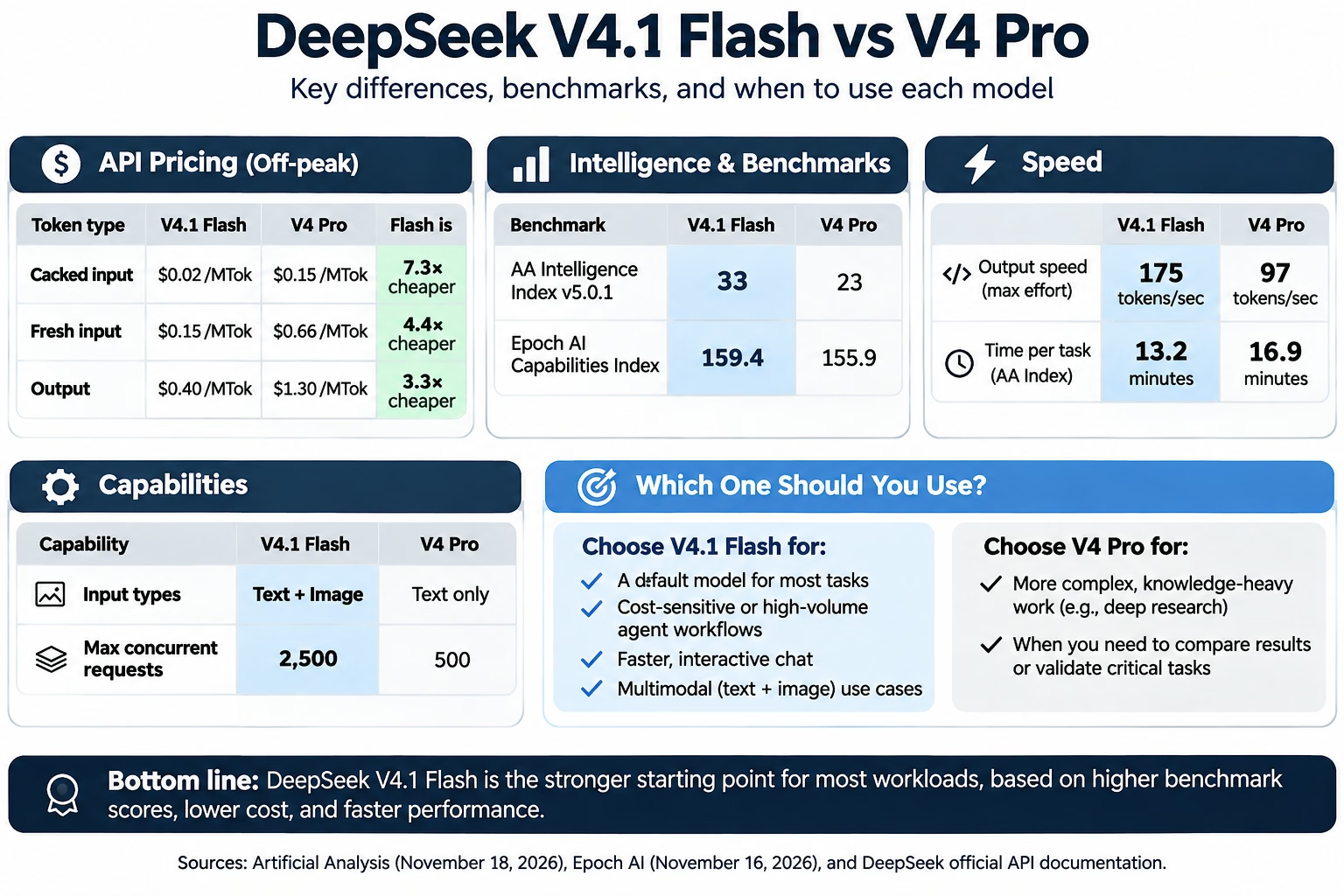
DeepSeek V4 Pro has approximately 2.9 times as many total parameters as V4.1 Flash, but the difference in API cost varies by token type and workload. At off-peak rates, Pro costs 4.4 times as much for fresh input tokens and 3.3 times as much for output tokens. Therefore, model size alone should not be used to estimate the cost of running either model.
A token is a unit of text processing used for API billing. In English, one token is roughly three-quarters of a word on average, although the actual ratio varies by language and content type.
DeepSeek V4.1 Flash vs. V4 Pro: Feature Comparison
In this table, we compare the two MoE models based on context window, architecture, active parameters, model maker, maximum output, output speed, price, Artificial Analysis Intelligence Index version 5.0.1, cost, and weights and license.
Intelligence Index scores, cost per task, and output speed are based on Artificial Analysis measurements accessed on November 18, 2026, using maximum reasoning effort. These figures may change as API performance and provider conditions evolve.
Two DeepSeek Models, Two Different Bargains
DeepSeek V4 launched on April 24, 2026 as two models: V4 Pro for heavy work and V4 Flash for volume. At launch, Flash's output token price was approximately 12 times lower than Pro's ($0.28 versus $3.48 per million output tokens, based on launch pricing).
Since then, the two have diverged. DeepSeek rebuilt Flash on July 31, refreshed Pro on August 13, retired the original V4 Flash on September 10 in favor of V4.1 Flash, and shipped a new Flash snapshot on October 17. Pro has not been rebuilt since August, so Flash is now the newer model.
DeepSeek V4.1 Flash is the successor to the original V4 Flash model, while V4 Pro remains a separate model. Developers using the earlier Flash version should check their API model identifier and provider documentation to confirm which version their applications access. Model aliases and pinned snapshots may behave differently depending on the provider.
The two models offer different trade-offs. DeepSeek V4.1 Flash delivers faster token generation, lower API costs, and higher scores on several Artificial Analysis benchmarks. It also supports both text and image inputs. V4 Pro has a larger architecture and more active parameters, but these characteristics do not automatically translate into better performance. For specialized or knowledge-intensive workloads, teams should evaluate both models against their specific requirements.
Pricing: Flash Is Cheaper per Token
DeepSeek uses peak and off-peak API pricing, with separate rates for cached input, uncached input, and output tokens. Off-peak rates are 50% lower than peak rates. According to DeepSeek's official documentation, peak hours run from 01:00–04:00 UTC and 06:00–10:00 UTC, Monday through Friday, excluding Chinese public holidays. All remaining hours, including weekends and Chinese public holidays, qualify for off-peak pricing.
Source: DeepSeek — Official API Pricing.
A cache hit occurs when DeepSeek reuses previously processed input tokens, such as a repeated system prompt or an unchanged section of a codebase. These cached tokens are billed at a lower rate than fresh input tokens. This makes prompt caching particularly useful for agentic workflows that repeatedly send the same instructions or context. Newly generated output tokens are billed separately at the applicable output rate.
Source: DeepSeek — Context Caching Documentation.
What It Costs In Practice
Consider a request with 100,000 uncached input tokens and 10,000 output tokens at the models' off-peak rates. Flash costs approximately $0.021, and Pro costs $0.086. Now, an agent cycle re-reads 200,000 cached tokens, adds 20,000 fresh tokens, and writes 10,000 tokens, costing about $0.010 and $0.037 on Flash and Pro, respectively.
In these examples, Flash costs approximately 4.1 times less than Pro for the first workload and 3.7 times less for the second. Under DeepSeek's published pricing schedule, the corresponding API costs would double during peak hours, while the relative cost advantage would remain unchanged.
Using a 7:2:1 ratio of cached input, fresh input, and output tokens, the blended API cost at peak rates is approximately $0.18 per million tokens for DeepSeek V4.1 Flash and $0.69 for V4 Pro. At off-peak rates, these costs fall to approximately $0.09 and $0.35, respectively. Under either pricing window, Flash is about 3.8 times cheaper for this token mix. Actual costs depend on caching patterns and token usage. Our guide to AI agent cost shows how to estimate spend across a whole agent workflow.
Artificial Analysis also reports the average cost per Intelligence Index task, including reasoning tokens. At maximum reasoning effort, Flash costs $0.60 per task compared with $1.77 for Pro, making Flash approximately 3.0 times cheaper. With reasoning disabled, Flash costs $0.43 per task versus $0.98 for Pro, a 2.3-fold difference. Because Flash can consume and generate more tokens per task, its cost advantage per completed task is smaller than its advantage per token.
Intelligence and Benchmark Results
Artificial Analysis Intelligence Index version 5.0.1 combines the nine tests of science, knowledge, coding, and agentic work to derive DeepSeek configuration scores.
Artificial Analysis, Intelligence Index v5.0.1. Checked November 18, 2026. Performance times are dynamic. N/A indicates no currently reported measurement for that configuration.
Flash leads Pro by ten points at maximum reasoning effort, eight points at high effort, and six points with reasoning disabled. It also costs less per Intelligence Index task across all three configurations. Flash completes tasks faster in the configurations with reported timing data, although Pro's high-effort completion time is currently unavailable.
Epoch AI's Capabilities Index assigns DeepSeek V4.1 Flash 1017 a score of 159.4, compared with 155.9 for V4 Pro 0813 (November 16, 2026 snapshot). Although Flash has a higher point estimate, the models' uncertainty intervals overlap, suggesting that their overall capabilities remain broadly comparable on this measure.
Why Flash Can Outscore a Larger Model
Differences in architecture, training, and optimization can influence how effectively a model handles coding, reasoning, and agentic tasks. For knowledge-intensive workloads, teams should compare both models on factual accuracy and task completion rather than assuming the larger model will perform better. For a more consistent head-to-head comparison, Artificial Analysis Intelligence Index v5.0.1 reports higher scores for Flash than Pro at maximum, high, and non-reasoning effort settings.
Coding and Agentic Performance
DeepSeek V4.1 Flash and V4 Pro support developer workflows involving tool calling and structured outputs. Both models can be integrated into applications through DeepSeek's API, although the available endpoints, request formats, and compatibility options should be checked against the current API documentation before implementation.
For coding and agentic workflows, DeepSeek V4.1 Flash performs better than V4 Pro on several Artificial Analysis evaluations. Terminal-Bench 4.0 measures how effectively models complete multi-step tasks in a terminal environment, while FrontierCode-AA 2.0 evaluates software engineering performance on real-world open-source repositories.
AutomationBench-AA focuses on agentic SaaS workflows. These benchmarks assess different capabilities, so their results should be interpreted individually rather than as a single measure of coding ability.
Source: Artificial Analysis, DeepSeek V4.1 Flash 1017 and DeepSeek V4 Pro 0813 model evaluations. Results are reported for the benchmark versions and model configurations shown on the respective model pages.
On Terminal-Bench 4.0, DeepSeek V4.1 Flash scores 33.8%, compared with approximately 14% for V4 Pro. Flash also leads on the reported FrontierCode-AA 2.0 and AutomationBench-AA evaluations, indicating stronger performance across these specific coding and agentic benchmarks. However, benchmark results may not reflect performance on every development workflow.
We did not run an original side-by-side test. To find which model is better for you, choose one task with at least eight to ten checkable requirements. Then, prepare a prompt and give the same prompt to both models at similar effort settings and record pass or fail for every requirement mentioned. Though leaderboard scores matter, a small test in your own environment gives you an edge.
To make that pass-or-fail check repeatable, you can build an AI agent for coding that scores each model's output against your own requirements with a coding agent builder.
Speed, Latency, and Token Use
Speed involves two important measures: how quickly a model generates output tokens and how long it takes to complete a task.
According to Artificial Analysis measurements accessed on November 18, 2026, DeepSeek V4.1 Flash generates approximately 175 tokens per second at maximum reasoning effort, compared with 97 tokens per second for V4 Pro. This makes Flash approximately 1.8 times faster in output generation.
Flash also completes an Intelligence Index task in 13.2 minutes, compared with 16.9 minutes for Pro, reducing completion time by approximately 22%.
However, output speed and task completion time measure different aspects of performance. Faster token generation does not guarantee proportionately faster completion of every request. Actual results depend on reasoning effort, token usage, task complexity, and API conditions.
When to Choose Flash, and When to Choose Pro
Choosing between DeepSeek V4.1 Flash and V4 Pro depends on your workload, performance requirements, and budget. The following table outlines where each model may be a better fit and why.
If neither DeepSeek model fits, our DeepSeek alternatives and competitors guide covers other models worth testing.
Conclusion
DeepSeek V4.1 Flash challenges the assumption that a larger model necessarily performs better. On the Artificial Analysis Intelligence Index v5.0.1, Flash scores 33 at maximum reasoning effort, compared with 23 for V4 Pro. However, benchmark results do not guarantee that Flash will outperform Pro on every workload.
Teams working on specialized research, security analysis, or complex coding tasks should test both models against their own requirements before making a final choice.
But choosing an AI model is only one part of building an application. A model can write code, answer questions, or help debug problems, but will that alone give you a working product? You still need an interface, a database, a backend, and somewhere to deploy it.
That's where Emergent comes in. Have a SaaS product, dashboard, or web application in mind? Describe what you want to build in plain English, and Emergent can help you create, test, and deploy the application without managing every technical step yourself.
Emergent also supports AI-powered features through its Universal LLM Key, allowing you to integrate supported language models into applications without managing separate API integrations for each provider.
Get started with Emergent, a full-stack App Builder.
Describe it. Build it. Launch it.
- End-to-End Creation
- No Code Needed
- Live in Minutes
Most AI app builders stop at prototypes. Emergent creates production-ready apps you can actually launch.
- Production-ready apps
- Web & mobile apps
- Deploy in minutes