TL;DR
- Gemini 4 Argon and Claude Opus 5.5 are flagship AI models designed for advanced reasoning, coding, and agentic workflows.
- Gemini 4 Argon supports text, image, audio, and video inputs, while Claude Opus 5.5 supports text and images.
- Published benchmarks show mixed results: Gemini leads in certain scientific and long-context tests, while Claude performs better in some software engineering evaluations.
- Both models offer approximately one-million-token context windows, with different reasoning and output capabilities.
- Gemini's reported introductory API pricing is 50% lower than Claude's for equivalent input and output token volumes, subject to verification of the promotional terms.
- Neither model is universally better. The right choice depends on workload, performance, integration requirements, and total cost.
Google introduced the Gemini 4 Argon on October 13, 2026. It is a direct competitor to Anthropic’s Claude Opus 5.5. Both models are designed to serve similar purposes: handle demanding tasks such as complex reasoning, software development and multi-step workflows. However, they differ in capabilities, pricing, and performance.
The version enters the market with a considerable improvement in coding, long-text processing, and agentic tasks. It also has introductory API pricing that undercuts Opus 5.5. Benchmark results, though, show neither model leads in every category.
This comparison examines Gemini 4 Argon vs Claude Opus 5.5 across benchmarks, features, context windows, API pricing, and practical use cases to help businesses and individuals choose the model that best suits their requirements.
Gemini 4 Argon vs Claude Opus 5.5: At a Glance
Both are flagship reasoning models designed for complex coding and research, along with multi-step AI workflows. Here is a table showing key specifications:
| Feature | Gemini 4 Argon | Claude Opus 5.5 |
|---|---|---|
| Developer | Google DeepMind | Anthropic |
| Release date | October 13, 2026 (public release) | September 22, 2026 |
| Model ID | gemini-4-argon | claude-opus-5-5 |
| Context window | 1,048,576 tokens (unified) | 1 million tokens |
| Maximum output | Up to 1M tokens with long decode; 65,536 default synchronous limit | 128K tokens; up to 300K via Batch API beta |
| Input modalities | Text, images, audio, video, PDF | Text and images |
| Output modality | Text | Text |
| Reasoning | Configurable thinking levels: low, medium, high | Adaptive thinking with configurable effort |
| Input pricing | $2 per million tokens (introductory) | $4 per million tokens |
| Output pricing | $10 per million tokens (introductory) | $20 per million tokens |
| Cached input pricing | $0.10 per million tokens (implicit cache hits) | $0.20 per million tokens (cache reads) |
| API availability | Gemini API, Google AI Studio | Claude API and supported cloud platforms |
| Primary focus | Complex coding, agentic workflows, scientific reasoning, multimodal tasks | Agentic coding, complex reasoning, long-running knowledge work |
Sources: Google Gemini 4 Argon model specifications, Gemini API pricing and capabilities, and Anthropic Claude Opus 5.5 documentation
What Is Gemini 4 Argon?
Gemini 4 Argon is Google's latest flagship AI model, launched on October 13, 2026, for tasks such as coding, advanced reasoning, and processing large amounts of information. The model is developed by Google DeepMind, and it can process different types of content, including text, images, audio, video, and documents, within a single model.
The capabilities of this model make it particularly relevant for building AI agents and applications that involve complex, multi-step tasks. In addition, it is expected to analyze complex datasets, have a higher ability to work with large codebases, and create applications that combine multiple types of data and information.
Rather than relying only on text-based instructions, users can provide additional context through multimodal inputs, including images, audio, and video.
Unlike earlier Gemini releases, Argon also supports extended output generation of up to one million tokens through its long-decode capability, subject to a shared context limit. Developers can configure its reasoning effort using low, medium, or high thinking levels, depending on task complexity.
What Is Claude Opus 5.5?
This is Anthropic’s flagship AI model, which was also introduced quite recently (September 22, 2026). Opus 5.5 is designed for complex reasoning, software development and long-running tasks.
It is designed for developers and businesses that need an AI model capable of handling multi-step instructions, analyzing large amounts of information, and working with external tools.
The model supports a context window of up to one million tokens, making it suitable for tasks involving extensive documents, large codebases, and lengthy conversations. It also supports text and image inputs, allowing developers to combine written instructions with visual information.
One of the distinguishing features of Opus 5.5 is its adaptive thinking system, which adjusts reasoning effort as per the task at hand. Developers can control this effort, but thinking cannot be disabled entirely. The model is available through the Claude API and major cloud platforms, including Google Cloud, Microsoft Foundry and Amazon Bedrock.
Gemini 4 Argon vs Claude Opus 5.5: Benchmark Performance
Benchmark results will help us understand how the two AI models have performed across different tasks, from writing and debugging code to analysis of complex information. As per the published evaluations by Google, Gemini 4 Argon leads in several areas, including knowledge work, scientific reasoning and longer context tests. On the other hand, Opus 5.5 works better in certain coding and terminal-based tasks.
For Opus 5.5’s full benchmark set rather than the overlapping rows, read our Opus 5.5 benchmarks breakdown.
The following results come from Google's October 2026 model card. Higher scores indicate better performance within each benchmark:
| Benchmark | Gemini 4 Argon | Claude Opus 5.5 | Higher score |
|---|---|---|---|
| Vals Index (knowledge work) | 68.90% | 67.00% | Gemini |
| DeepSWE v1.1 (agentic coding) | 77.90% | 74.20% | Gemini |
| FrontierSWE v2 (software engineering) | 55.00% | 62.30% | Claude |
| Terminal-Bench 4.0 (terminal tasks) | 57.40% | 66.40% | Claude |
| LABBench 2 (scientific reasoning) | 88.80% | 73.10% | Gemini |
| GraphWalks, 256K–1M tokens (long context) | 84.20% | 66.80% | Gemini |
Source: Google DeepMind: Gemini 4 Argon Model Card.
Note: These are published evaluation results, not independent tests conducted by Emergent
Here is a detailed assessment of the results:
Coding and Software Development
For coding, the results can be best described as mixed. Gemini 4 Argon scores 77.9% on DeepSWE v1.1, ahead of Opus 5.5's 74.2%.
However, Claude leads on FrontierSWE v2 and Terminal-Bench 4.0, which assess different aspects of software engineering and terminal-based problem-solving.
The results largely imply that neither model has a universal coding advantage over the other. The choice should depend on the types of tasks an application needs to perform, including modifying existing codebases, executing commands, or completing multi-step development workflows.
Reasoning, Knowledge Work, and Long Context
As per the Vals Index, Gemini 4 Argon scored 68.9%, which was 67.0% for Opus 5.5. The difference is not considerably large, so it cannot be interpreted as proof of a substantial advantage across all professional tasks.
The gap is more pronounced on LABBench 2, where Gemini scores 88.8% against Claude's 73.1%. Gemini also leads on the GraphWalks long-context evaluation, which tests the ability to follow relationships across large amounts of information.
The results show that there are some potential benefits for Gemini in a few scientific and long-text workloads. On the other hand, it is worth noting that benchmark performance does not guarantee similar or identical results in production applications.
What do the benchmarks tell us?
Gemini 4 Argon performs better on several published knowledge-work, scientific, and long-context evaluations, while Claude Opus 5.5 leads on important software engineering benchmarks. The better choice depends on the workload rather than a single overall score.
Key Differences Between Gemini 4 Argon and Claude Opus 5.5
Both models target demanding AI workloads. The differences matter more when users and developers consider the kind of information their applications process. Also, how reasoning is controlled and how models interact with external tools are critical factors.
Here are the key differences between the two models:
1. Multimodal Capabilities
Gemini 4 Argon supports text, images, audio, video, and document inputs. This lets developers build applications that analyze different types of information in the same workflow. For example, an application could examine a recorded product demonstration alongside technical documentation and generate a written analysis.
Claude Opus 5.5 supports text and image inputs. Though it has the capability to analyze screenshots, diagrams, and documents, any applications requiring audio or video require additional processing or supporting services.
While both the models can be used for text-based and image-assisted workflows, Gemini has a slight edge as far as broader native input support is concerned.
2. Context Handling and Long Outputs
Both models support context windows of approximately one million tokens, making them suitable for working with lengthy documents, extensive conversations, and large codebases.
The distinction lies partly in output generation. Gemini 4 Argon offers an extended long-decode capability, whereas Claude Opus 5.5 supports a smaller standard maximum output.
However, a larger context window or output limit does not automatically translate into better accuracy. Developers should also consider retrieval quality, context utilization, latency, and token costs when processing large inputs.
3. Reasoning and Thinking Controls
Gemini 4 Argon gives the choice to the developers to choose between three thinking levels: low, medium and high. With lower settings, faster responses and reduced token consumption are attained. On the other hand, with higher settings, more reasoning effort will be allocated to complex problems, including mathematical analysis and advanced coding.
Claude Opus 5.5 uses adaptive thinking, which adjusts reasoning effort according to the task. Unlike models that allow thinking to be switched off, Opus 5.5 keeps adaptive thinking enabled. Developers can still configure the effort level to balance response quality, latency, and cost.
The most critical difference is how they manage reasoning. Gemini offers three explicit thinking levels. On the other hand, Claude combines adaptive reasoning with developer-defined effort controls. However, neither of the two approaches guarantees better results across diverse workloads.
4. Tool Use and Agentic Workflows
Both models can support AI agents that interact with external tools, execute multi-step instructions, and perform tasks beyond generating text.
Gemini 4 Argon supports function calling, code execution, and search grounding through Google's API ecosystem. Computer use is also supported, although the feature is currently in preview. It can also be configured within Google's Antigravity managed agent for complex software engineering workflows.
Similarly, Claude Opus 5.5 can also support tool-driven workflows. It includes document analysis, coding assistants and applications that interact with external systems. However, the availability of tools in practice depends on API configuration and the environment of model deployment.
For example, consider an AI assistant designed to review code, identify errors, and suggest fixes. The assistant may need to read multiple files, execute commands, and verify whether the changes work. In such a workflow, successful task completion and reliable tool use matter more than a model's performance on a single coding benchmark.
Gemini 4 Argon vs Claude Opus 5.5: Pricing and API Availability
The current API price of Gemini 4 Argon is lower than Claude Opus 5.5. It is worth noting that the introductory rates are temporary. Both models charge separately for input and output tokens, with additional pricing provisions for cached inputs and batch processing.
API Price Comparison
| Pricing component | Gemini 4 Argon | Claude Opus 5.5 |
|---|---|---|
| Input tokens (per 1M) | $2.00 | $4.00 |
| Output tokens (per 1M) | $10.00 | $20.00 |
| Cached input (per 1M) | $0.10 | $0.20 |
| Batch API | Supported; rates depend on processing tier | 50% discount |
Sources: Google Gemini API documentation and Anthropic Opus 5.5 pricing. Prices in USD, as of October 14, 2026
How Much Does Each Model Cost in Practice?
We can take the example of an application processing 10 million input tokens and generating 2 million output tokens. Due to the introductory pricing, Gemini 4 Argon might appear to be low-cost at the moment:
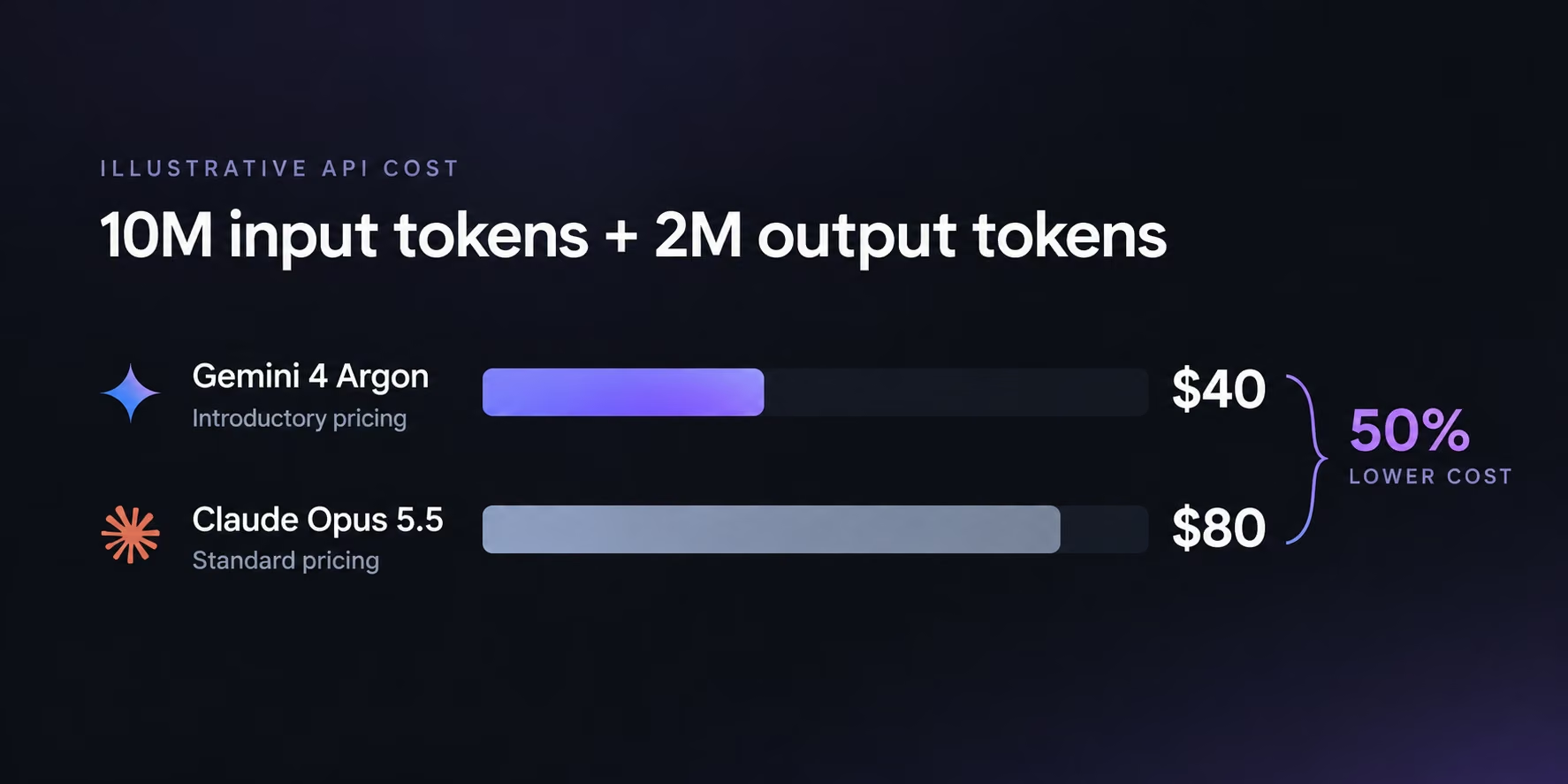
Figure: Gemini 4 Argon vs Claude Opus 5.5 – Illustrative API Cost Comparison.
Note: The pricing is tentative and based on the illustrated 10 million input tokens and 2 million output tokens. The costs are calculated using published API rates as of October 14, 2026. Actual costs might be different as they depend on usage, caching and reasoning efforts. The introductory pricing is valid through November 30, 2026.
API Availability
Gemini 4 Argon is available through Google’s Gemini API (paid) and Google AI Studio. Claude Opus 5.5 is available through Anthropic's Claude API, Amazon Bedrock, Google Cloud, and Microsoft Foundry.
Which Model Should You Choose: Gemini 4 Argon or Claude Opus 5.5?
The eventual choice should depend on the application requirements, budget, and the kind of task you wish to automate. Both models are capable of handling complex tasks, but the relative strengths might differ across use cases.
Choose Gemini 4 Argon if you:
- If you require native multimodal processing that involves text, images, audio or video
- If you need to work with extensive documents or datasets that need long-context reasoning
- If you wish to benefit from Google’s introductory pricing to lower your API costs for the time being
- If you want to build AI-powered applications involving scientific analysis or knowledge-intensive tasks.
Choose Claude Opus 5.5 if you:
- Prioritize software engineering tasks involving terminal operations and complex codebase modifications.
- Need adaptive reasoning for multi-step coding and agentic workflows.
- Already use Anthropic's API or supported cloud deployment environments.
- Want to build coding assistants or tools that handle lengthy development tasks.
Neither model is an automatic selection over the other. Pricing cannot be the sole decision Benchmark scores provide a useful starting point, but the models should be evaluated against actual workloads, considering response quality, latency, reliability, and total API costs.
Build AI-Powered Applications With Emergent
Choosing the right AI model is only one part of building an application. Turning an idea into a functional product also requires a user interface, backend infrastructure, database management, and integrations that work together.
With Emergent, you can build AI-powered web and mobile applications by describing your requirements in natural language. Its AI agents handle coding, testing, and deployment, allowing you to focus on the application's functionality rather than building everything from scratch.
Emergent also allows users to incorporate AI-powered features into their applications, depending on the integrations and services available for their projects.
Most AI app builders stop at prototypes. Emergent creates production-ready apps you can actually launch.
- Production-ready apps
- Web & mobile apps
- Deploy in minutes