TL;DR
- Pick one type and validate it: Curation, replenishment, or access. Get paying customers before you build anything else.
- Price with real data: A Van Westendorp survey of your target customers gives you a defensible range. Expect tiers to surprise you: the priciest tier often outsells the cheapest.
- Cover the four-piece minimum tech stack: A recurring payment processor, subscription billing software, a self-serve customer portal, and automatic payment-retry logic. Failed payments alone cause roughly a third of all churn.
- Write clear auto-renewal and cancellation terms upfront: "Clear and conspicuous" is a defined legal standard under the FTC's Negative Option Rule.
- Launch to a small group first: Match your acquisition channel to your subscription type.
- Track four numbers from week one: Monthly recurring revenue, churn rate, customer lifetime value, and customer acquisition cost. Aim for CLTV at three times CAC or higher.
- Budget two to four weeks to launch: Model choice, pricing, and billing setup eat most of it.
Charging people every month is the easy part to describe. The decisions start the moment you commit: which pricing strategy to use, which billing software to trust, and what happens when a card gets declined on renewal day.
This guide walks through how to build a subscription business step by step, using real case studies from companies that got it right and those that got it wrong.
Adobe spent a decade validating demand before it moved to Creative Cloud. That patience paid off. MoviePass skipped that step, and its collapse shows what happens when you do.
Slack ties its pricing to actual usage instead of seat counts. That builds a subscription business that lasts. BattlBox, a subscriber-funded outdoor gear brand, shows what real pricing surprises and real community look like in practice.
By the end, you’ll know what to build first. You’ll also see where most subscription businesses, SaaS included, quietly lose revenue.
What Is a Subscription Business Model?
A subscription business model charges customers a recurring price, weekly, monthly, or annually, for ongoing access to a product or service. It only works if the customer gets ongoing value that justifies staying subscribed.
Subscription business ideas generally fall into three types:
- Curation: A new, personalized selection each period. This is the model behind most subscription box business ideas, like a beauty or snack box. For example, Birchbox sends subscribers a curated selection of beauty products each month.
- Replenishment: Recurring delivery of products customers regularly need to replace, like razors, coffee, or supplements. For example, Dollar Shave Club’s customers receive replacement razor blades on a recurring schedule.
- Access: Ongoing access to content or a service rather than a physical product, like software, streaming, or a premium community. Examples include software like Adobe Creative Cloud and streaming services like Netflix.
A successful subscription business commits fully to one type rather than blending all three.
What You'll Need Before You Start
Prerequisites:
- A product or service that gets better, or at least retains its value, the longer someone stays subscribed
- A payment processor account that supports recurring charges
- A rough price point, even if it changes later
- Basic terms of service covering auto-renewal and cancellation
Time required: A working version can realistically launch in two to four weeks, with most of the time going to choosing a model, making pricing decisions, drawing up legal terms, and setting up billing software.
What it costs to start: Most subscription billing software has a free starter tier, so software cost isn't usually the barrier. Card processing runs about 3% per transaction on top of whatever platform fee you pay.
The real upfront cost is the first batch of inventory for curation or replenishment models, typically a few hundred to a few thousand dollars depending on your product and order size. Access-based subscriptions (software, content, streaming) carry no physical inventory cost at all.
How to Build a Subscription Business: Step-by-Step
Step 1: Choose Your Subscription Type and Validate Demand
What to do: Commit to one subscription type: curation, replenishment, or access, based on what your product naturally supports. Then validate that people will pay regularly.
Validation begins when people open their wallets. Until someone has paid you, you have interest, not demand.
Why it matters: The subscription type dictates almost every decision after this: how often you bill, what churn looks like, and what value means to a subscriber. A pet treat curation box and a streaming platform subscription solve completely different problems and have different sets of requirements.
Case Study: How Adobe Validated Demand Before Betting the Company on It
Adobe took a full year to move Photoshop and Illustrator to subscription-only.
Starting in 2012, it sold Creative Cloud subscriptions alongside the traditional perpetual-license Creative Suite for about a year, watching adoption and retention data. Then, after Creative Suite 6, Adobe stopped developing new perpetual licenses and made Creative Cloud subscription-only in 2013.
The transition cost Adobe in the short term. Adobe's investor filings show that revenue dipped during this period as a lot of customers delayed switching, and investors grew concerned as the stock dropped.
The drop was smaller than leadership expected: Adobe's CFO put it at 6%, recovering fully within three months. Adobe's informed bet paid off.
Now the company receives predictable monthly or annual recurring revenue, replacing the occasional big purchases it relied on before. The switch benefited customers too; they gained continuous updates, cloud storage, and easier access to the full suite of applications rather than waiting years for major releases.
Adobe's Digital Media business grew from about $3 billion in 2012 to more than $14 billion in 2023, fueled by its transition from perpetual licenses to Creative Cloud subscriptions.
The lesson for a founder starting smaller: expect a revenue dip while the subscriber base ramps up, and read it against your retention numbers rather than your monthly total.
Adobe removed the perpetual license option only after a full year of subscriber data gave it confidence.
Pro Tip
If you're unsure which type fits, ask what happens if a customer does nothing for three months. If the product depletes, that's replenishment.
If the customer would forget you exist without new content, that's curation. If they'd simply lose access, that's an access model.
Need a complete list of things to put in place before full launch? Check out our eight-step guide on how to start a digital business.
Step 2: Design Your Subscription Pricing Strategy
What to do: Choose a pricing model that matches how customers perceive value. A flat rate works when the offer is simple and consistent.
A tiered pricing model works when different customers get different value from the features or product. Usage-based pricing works when consumption varies a lot between customers.
The Van Westendorp Price Sensitivity Meter
Guessing a price based on what competitors charge is the most common pricing mistake at this stage. The Van Westendorp Price Sensitivity Meter is a decades-old market research method that is still used by subscription pricing consultancies today. It replaces guessing with four questions put to your actual target customers:
- At what price would this be so expensive you wouldn't consider it?
- At what price would this be expensive, but you'd still consider it?
- At what price would this be a bargain, good value for the money?
- At what price would this be so cheap you'd question the quality?

A Van Westendorp chart plots all four responses against price. The shaded overlap is your defensible price range.
Plot the responses from a representative sample of your target customers, and you get a defensible price range, bounded by a point of marginal cheapness and a point of marginal expensiveness, with an optimal point somewhere in between.
It takes a day to run, and you finish with willingness-to-pay numbers from actual buyers.
Case Study: Adobe's Concession Pricing Tier
When Adobe's initial all-inclusive Creative Cloud subscription drew backlash from photographers who only needed two of the 20+ included applications, Adobe introduced a $9.99 per month Photography Plan bundling Photoshop and Lightroom.
The $9.99 plan was a deliberate second price point built for a distinct, vocal value segment, and it became one of Adobe's most popular plans. In January 2025 Adobe raised the monthly price to $14.99, and existing subscribers could only hold the old $9.99 rate by moving to the prepaid annual plan at $119.88 a year. A rigid, one-size-fits-all price often just means you haven't segmented your audience yet.
Case Study: BattlBox's Tiered Pricing Surprise
BattlBox, the outdoor and survival gear subscription that grew into a business doing over $20 million a year, launched in February 2015 with four pricing tiers. Like many new subscription businesses, it assumed the lowest-priced plan would attract the most customers, with demand declining as prices increased.
According to CEO John Roman, that assumption was wrong from day one. The top tier, priced at roughly four times the basic box, was the most popular option from launch, starting around 30 to 35% of subscribers and close to half the entire customer base a decade later.
The driver was simple unit economics: cost of goods doesn't scale linearly with box size, so the higher tiers, which bundle in a single premium item rather than several smaller ones, deliver more perceived value per dollar than the entry tier.
The lesson for anyone assuming the cheapest tier will dominate: test the assumption before you build around it, and design tiers so value compounds at the top with each step up.
Why it matters: A subscription pricing strategy misaligned with how people use the product creates two problems: customers on the wrong tier either feel overcharged or underserved, both of which increase churn rate.
The MoviePass case study later in this guide shows what happens when a price is set without testing it against heavy users.
Pro Tip
A freemium model, where a limited version is free and full access requires payment, works well for access-based subscriptions but rarely for curation or replenishment. Free samples don't map the same way physical recurring shipments do.
Looking beyond freemium and subscriptions? Our guide explains the different revenue models apps use to make money.
Step 3: Assemble a Minimum Viable Subscription Tech Stack
What to do: Skip the instinct to build custom subscription infrastructure from scratch, and skip over-provisioning for scale you don't have yet. A minimum viable stack has four key components:
- A payment processor that supports recurring charges, like Stripe or Square
- Subscription billing software that handles scheduling, proration, and plan changes
- A customer self-serve portal where subscribers can update payment details or cancel without emailing you
- An automated email or notification trigger for renewal reminders and failed-payment alerts
For SaaS specifically: If you sell internationally, check whether you need a merchant of record (a platform that handles global sales tax and VAT compliance on your behalf, like Paddle or Lemon Squeezy) or a direct processor like Stripe Billing, where you handle tax compliance yourself. This decision is worth making deliberately once you have international customers.
Why it matters: Those four pieces cover what a new subscription business actually needs on day one. Everything past them, custom dashboards, backup gateways, analytics, is a stage-two problem.
Pro Tip
Pro tip: Most subscription management software bundles the first three pieces. Buying beats building here almost every time.
For curation and replenishment models: the tech stack above only covers billing. You'll also need to prepare inventory, build a prototype box to test packaging and unit costs, and pick a shipper who can handle recurring monthly volume rather than one-off orders.
Get a landed cost per box (product plus packaging plus shipping) before you set a price, since that number determines whether your tiers are actually profitable.
If you still need the sign-up and account pages this stack connects to, see our roundup of website builders that actually work for subscription services.
Step 4: Set Up Failed-Payment Recovery Before You Launch
What to do: Set up automatic retry logic for declined renewal payments and a way to notify the customer that their card needs updating before you launch.
Why it matters: Failed payments are one of the most common causes of subscription churn. When a card expires, a bank flags an unfamiliar recurring charge, or a customer's balance is temporarily low, the subscription silently lapses.
That's involuntary churn: the subscriber still wants the product, so you only have to fix the charge, which makes it the cheapest kind of churn to fix.
The Numbers Behind Involuntary Churn
Subscription benchmark research from billing platforms, including Recurly, consistently finds that involuntary churn accounts for roughly a third of total churn across subscription businesses.
Recurly's July 2026 network data puts average involuntary churn at 1.25% against 3.60% total churn, and the effect is sharpest on cheaper plans: 1.30% involuntary churn on subscriptions in the $10 to $25 a month band, against 0.18% above $250.
In other words, for every 10 subscribers a typical business loses in a month, about 3 of them didn't choose to leave; their card failed.
Recurly points to the same three fixes: intelligent retry logic that times attempts by decline code, automated prompts asking subscribers to update their billing details, and a card-updater service. It reported recovering $1.2 billion in failed-payment revenue for its customers in 2023 alone, up 20% from the year before.
A basic recovery sequence looks like this:
- Retry the charge automatically after one to three days, timed for when balances typically refresh
- Send an email the same day the payment fails, with a direct link to update the card
- Retry again after a week if the first attempt fails
- Only cancel the subscription after two or three failed attempts
Pro Tip
Most subscription billing software includes this retry logic out of the box. If yours doesn't, this is worth building before anything else since it protects earned revenue.
Step 5: Set Your Terms, Auto-Renewal, and Cancellation Policy
What to do: Write clear terms covering how the subscription renews, how a customer cancels, and what happens to unused time if they do. Require active, visible agreement to these terms at signup.
What that looks like in practice: an unticked checkbox at signup reading "I understand this subscription renews automatically at $X/month until I cancel," a renewal reminder email three days before each charge, a cancel button inside account settings that takes two clicks, and a stated policy on unused time (most consumer subscriptions run to the end of the paid period rather than refunding).
Why it matters: "Clear and conspicuous" is a defined legal standard under the FTC's Negative Option Rule, which governs how auto-renewals must be disclosed and cancelled. A cancellation process that's harder to complete than signup is both a legal risk and a fast way to generate unfavorable reviews.
Pro Tip
Make cancellation self-serve through the customer portal. A simple, transparent cancellation process reduces friction and helps preserve goodwill with customers who may choose to return later.
Step 6: Launch in Stages
What to do: Release the subscription to a small group first. Observe what works, what breaks, what confuses people, and what increases churn.
Why it matters: A soft launch catches pricing confusion, onboarding friction, and billing edge cases while the stakes are low. Scaling marketing spend behind an untested subscription flow multiplies whatever is broken.
This is the same underlying logic behind Adobe running two pricing models in parallel for a year: subscriber behavior beats internal projections every time.
Pro Tip
Treat your first 20 to 50 subscribers primarily as a feedback source. Their cancellation reasons matter more than their payments at this stage.
Step 7: Market and Acquire Your First Subscribers
What to do: Match your acquisition channel and trial offer to your subscription type. A curation box, a replenishment service, and a software access subscription earn trust through completely different signals, so the same acquisition playbook doesn't work for all three.
For curation subscriptions: Unboxing content does the selling for you. Curation subscription boxes have largely grown through user-generated unboxing videos and photos on social platforms because the surprise element is inherently shareable.
Seed the first cohort of boxes to a small group of engaged customers or micro-influencers specifically willing to post their unboxing, and treat that content as your primary channel before spending on ads.
For replenishment subscriptions: The acquisition hook is convenience. Customers already know they need razors, coffee, or supplements. Your job is to catch them at the moment they're already buying the one-time version and offer the subscription as the easier default.
Place the subscription option prominently at checkout and lead with a modest first-order discount. Replenishment subscribers convert on price and convenience more than on trying something new.
For access subscriptions and SaaS specifically: A free trial or freemium tier does the acquisition work, but trial length and the point where you ask for a credit card matter more than most founders assume.
A trial that's too short doesn't give someone time to build the habit that justifies paying. A trial that's too long trains people to expect the free version indefinitely. Start with seven to 14 days for anything used daily, and 30 days for anything used weekly, then adjust based on where trial users convert.
Asking for a card upfront filters for higher-intent signups and produces a smaller but higher-converting trial pool; skipping the card requirement produces more signups but a lower percentage who ever convert. Your choice should be based on whether you're optimizing for trial volume or trial quality.
For creator and community-platform subscriptions (Patreon, Ko-fi, or OnlyFans-style products): Acquisition works backward from a typical direct-to-consumer motion.
The faster path is recruiting a small number of creators or niche opinion leaders who already have an audience, and giving them a reason to bring that audience onto your platform, according to Dennis Babych, founder of software development studio DB2.
Landing two or three recognized creators in a specific niche can make your new platform the default choice for that entire niche, since the creators are effectively doing your cold-start acquisition for you.
Cautionary Tale: Don't Build on a Single Acquisition Channel
BattlBox ran on Facebook ads almost exclusively for its first six or seven months, since the team hadn't yet learned other channels were necessary.
Then its Facebook ad account was suspended, cutting off close to 99% of its traffic overnight. The business only recovered because a customer happened to work at Facebook and could personally escalate the review internally, a resolution BattlBox CEO John Roman describes as pure luck rather than anything the business did right.
BattlBox now treats content, email, and community as channels independent of paid social specifically because of that scare.
Whatever channel is working best for you right now, treat single-channel dependency as an operational risk to plan around and work to include other acquisition channels.
Two acquisition levers apply regardless of subscription type:
- Annual pricing doubles as an acquisition tool: Offering an annual plan at a discount up front, commonly in the 15 to 20% range for SaaS products, pulls in customers who were on the fence about a monthly commitment and locks in a full year of revenue before the churn clock starts.
- Set referral rewards based on customer lifetime value (CLTV): A $10 credit makes sense for a customer worth $500 over their lifetime. The same $10 on a $15 one-time purchase wipes out the margin.
Common early mistake: Treating subscriber acquisition like one-time product marketing, chasing raw sign-up volume, when what matters is how many of those sign-ups are still paying in month three.
A channel that brings in subscribers who cancel within 30 days is more expensive than it looks once churn is factored in, even if the cost per sign-up is low.
Step 8: Track the Metrics That Predict Churn
What to do: Track four numbers from week one: monthly recurring revenue, churn rate, customer lifetime value, and customer acquisition cost.
- Monthly recurring revenue (MRR): Total predictable monthly revenue from active subscribers, the core health metric of a recurring revenue model.
- Churn rate: The percentage of subscribers who cancel in a given period. Separate voluntary churn from involuntary churn, since they need different fixes.
- Customer lifetime value (CLTV): Total revenue a customer is expected to generate over their whole relationship with your business. The quick version: average monthly revenue per customer divided by your monthly churn rate. A $30/month customer at 5% monthly churn is worth about $600.
- Customer acquisition cost (CAC): Total acquisition cost divided by customers acquired in that period.
Cohort Retention Curves
A single churn percentage hides more than it reveals. The fix is a cohort retention curve: group subscribers by the month they signed up, then plot what percentage of each cohort is still active at month one, month two, month three, and so on.
Healthy subscription businesses see the curve drop initially, then flatten into a long, nearly horizontal tail, meaning the subscribers who make it past the first few months tend to stay for a long time. A curve that keeps sloping downward with no flattening point is a warning sign that no single churn percentage would show you.
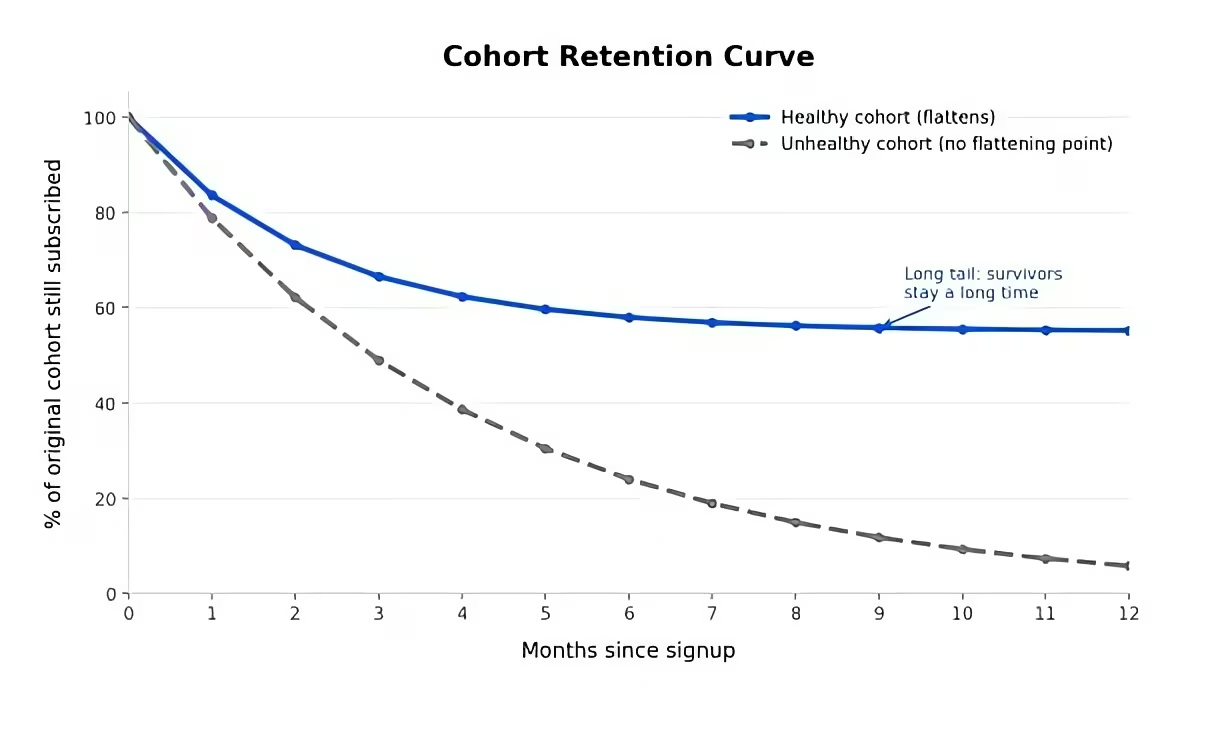
The gap between these two curves is the difference between a subscription business with a durable core and one that's replacing its entire customer base every year.
Why it matters: A healthy subscription business generally keeps CLTV at three times CAC or higher. Tracking these from the start, even roughly, tells you whether growth is sustainable before you've spent enough to find out the hard way.
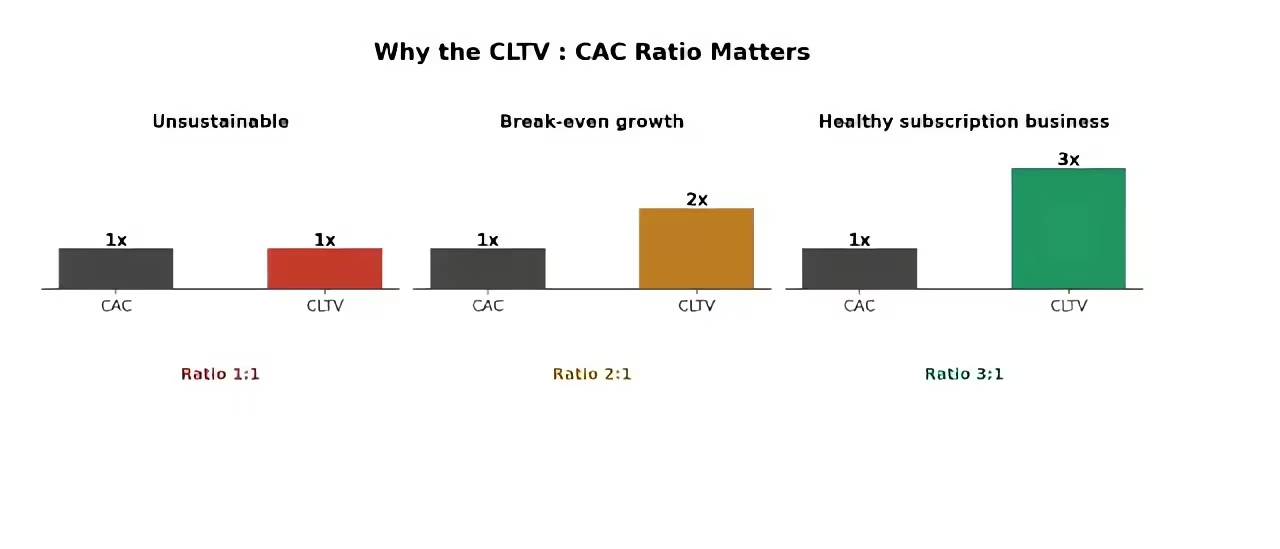
A 1:1 ratio means you're spending everything a customer will ever be worth just to acquire them, with nothing left for margin.
Pro Tip
Recalculate these monthly. Subscription businesses can look healthy on revenue alone for months while churn quietly erodes the base underneath it.
SaaS-Specific Considerations for Subscription Founders
Everything above applies to any subscription business. SaaS founders specifically should also think through three things that consumer subscription guides often skip.
There are other factors to consider when building a SaaS business; we cover them in our guide on how to start a SaaS business in 2026.
Net Revenue Retention: The Metric SaaS Investors Weigh Most
Net revenue retention (NRR) measures how much revenue you retain from your existing customers over a year after accounting for upgrades, downgrades, and cancellations.
A business with 100 customers churning at a non-zero rate can still show NRR above 100% if the customers who stay are upgrading fast enough to outpace the ones who leave.
This is why SaaS investors and operators place more emphasis on NRR than raw churn rate alone: a business can have real churn and still grow its existing revenue base without adding a single new customer, purely through expansion.
If your product has a natural upgrade path, make it easy for customers to expand through additional seats, higher usage, or premium plans.
Seat-Based vs. Usage-Based Pricing
Seat-based pricing is simpler to forecast and easier to sell to a finance team, which is why it still dominates B2B software. Usage-based pricing tracks value more closely but makes revenue lumpier. The rough rule: charge per seat when roughly everyone with access uses the product, and charge on usage when consumption swings hard between accounts.
Case Study: Slack's Fair Billing Policy
Most enterprise software of the 2010s charged per purchased seat, whether or not that seat was ever used. Slack's Fair Billing Policy took a different approach from early on: customers are billed only for members active within a rolling 28-day window, and Slack automatically issues a prorated credit when a paid seat goes dormant.
The effect went beyond customer goodwill. It tied Slack's own revenue directly to whether customers were getting ongoing value, which pushed the company to keep investing in onboarding and daily engagement rather than treating the sale as done once a contract was signed.
You don't have to copy fair billing. The principle underneath it travels: pricing that only earns when the customer is using the product keeps your incentives pointed at retention.
Expansion Revenue Can Come From Usage You Already Have
Case Study: Netflix's Paid-Sharing Rollout
Netflix's password-sharing crackdown turned usage it already had inside the product into paying accounts.
The company added roughly 9 million paying members in the first quarter after the rollout, and cancellations came in well below what analysts had predicted. Netflix told investors the cancel reaction "continues to be low, exceeding our expectations."
For a SaaS founder, the parallel is worth thinking through directly. Before you spend on new customer acquisition, check whether your free tier, trial users, or under-licensed accounts already hold usage you could convert with the right nudge.
What Makes Subscribers Stay: Retention Levers Beyond the Product Itself
Pricing and product value get most of the attention in subscription strategy. Eight other forces decide whether someone actually stays.
Alex Hormozi, founder of Acquisition.com, outlines eight distinct levers, independent of product quality, that make recurring revenue stickier.
- Consumption: The more of the product a subscriber uses, the stickier the subscription. This is an argument for investing in onboarding and usage habits specifically.
- Collateral: Subscribers stay when the service holds something of theirs: files, contacts, and historical data that would be costly to lose or move. It's why CRM and cloud storage products retain so well: switching means abandoning your own data.
- Cost of switching: The time, effort, or money required to leave. The healthy version of this is deep product integration into a customer's workflow. The unhealthy version is a deliberately difficult cancellation flow, which is exactly what Step 5 above warns against on legal grounds. Same lever, very different risk depending on which one you build.
- Choice: Fewer credible alternatives make a subscription stickier. The legitimate version of this is genuine differentiation and a real competitive advantage.
- Control of money flow: Customers are less likely to cancel subscriptions they barely notice, which is why automatic billing can reduce churn. But that advantage comes with a trade-off: hiding or obscuring recurring charges clashes with transparent pricing and can expose a business to legal and reputational risks.
- Cause: Subscribers who feel aligned with what a company stands for renew for reasons beyond the product itself.
- Community: Subscribers embedded in a community around the product resist canceling because leaving means leaving people, not just software.
- Contracts: Structuring a subscription around a stated commitment, for example, a six-month term billed monthly, tends to increase realized tenure more than a pure month-to-month plan, since people tend to honor a stated commitment even when nothing legally binds them to it.
Case Study: How BattlBox Turned Community Into a Retention Engine
Brandon Currin was a paying BattlBox subscriber posting his own unboxing videos. No partnership, no payment. BattlBox noticed his content was resonating with other subscribers and hired him to lead content full-time.
The company now runs a private, members-only Facebook group of roughly 11,000 active subscribers, largely moderated by paying customers rather than staff.
CEO John Roman says the real test of a community is whether it would still function if the company stepped back from it entirely. By that standard, BattlBox's group passes: conversations and shared experiences happen there constantly without staff involvement.
The company also maintains a members-only discounted marketplace, giving subscribers a reason to stay that has nothing to do with the core box itself.
For SaaS founders, the test is simple: would the community keep going if your team stopped showing up? If it wouldn't, what you have is a support channel, and support channels rarely keep anyone subscribed.
Why Subscription Businesses Fail (and How to Avoid It)
MoviePass skipped almost every step above. Here's what it cost them.
Case Study: MoviePass
In August 2017, MoviePass dropped its price to $9.95 a month for unlimited movie tickets, at a time when the average U.S. movie ticket cost $8.97, per the National Association of Theatre Owners. The company added more than 150,000 subscribers within two days of the announcement and passed 3 million within a year.
The pricing had never been stress-tested against actual usage patterns. MoviePass paid full retail price for every ticket a subscriber redeemed, and subscribers on an unlimited plan naturally used it more than an average moviegoer.
By mid-2018, the company was losing more than $40 million in a single month. Its parent company's stock collapsed to effectively worthless, and the business shut down about two years after the price cut that made it famous.
Subscription movie tickets still work today. AMC Stubs A-List launched in June 2018 as a direct answer to MoviePass, and Regal Unlimited followed a year later, both priced with unit economics in mind from day one.
The pattern to watch for in your own business: Rapid subscriber growth driven by a price that looks aggressive against competitors, without a clear answer for what your top 10% of heaviest users will cost you at that price. Growth that outpaces your unit economics is exactly what killed MoviePass.
Common Mistakes to Avoid
- Pricing before understanding true costs: Setting a price based on competitor pricing alone, without first knowing your own production, fulfillment, and acquisition costs, is a fast way to run a subscription business at a loss.
- Ignoring failed-payment recovery until it's already costing revenue: By the time involuntary churn shows up as a problem, it's usually been quietly happening for months.
- Auto-renewal terms that aren't clear enough to be compliant: Vague or buried renewal terms create real legal exposure.
- Overbuilding the tech stack before launch: Custom analytics dashboards and multi-gateway redundancy are stage-two problems. Solving them before you have subscribers shifts priority from what really needs testing: the offer itself.
Emergent Makes It Faster to Launch and Test Your Subscription Offer
Building a subscription business usually stalls at Step 3, the minimum viable tech stack. Each piece is straightforward on its own. Wiring the sign-up flow to the billing system is what eats the development time.
Emergent builds a working subscription sign-up flow, plan selection, and customer portal from a plain-language description of what you want, then connects it directly to Stripe, so recurring billing, proration, and renewal work the same way they will for your first paying subscriber.
While not a subscription management platform itself, Emergent speeds up the path from validating a subscription idea, such as pricing tiers informed by a Van Westendorp survey, to launching a fully functional version that customers can use.
Describe the sign-up flow and plan structure you have in mind, and try Emergent free to see a working version before you write a line of code.

Describe what you want and Emergent builds it. A real, production-ready app you can launch the same day.
- One prompt to build
- Zero code required
- Deploy in minutes