If you've built anything agentic, you know what happens next: the thing that looked solid in the demo starts making the same mistake once it's running on its own. Mine did it three times in the first four runs, flagging the same change like it had never seen it before.
I built Scoutline, a small content-change-monitoring agent, inside Emergent in one working session, then ran it a few more times to confirm the fixes held. The first working version took 14 credits and nine minutes.
Fixing it took a lot longer than building it. Scoutline needed a memory that outlived the session.
This guide walks through the nine principles of building AI agents, the specific, checkable decisions that separate an agent that holds up from one that slowly drifts.
What Are the Principles of Building AI Agents? The 30-Second Answer
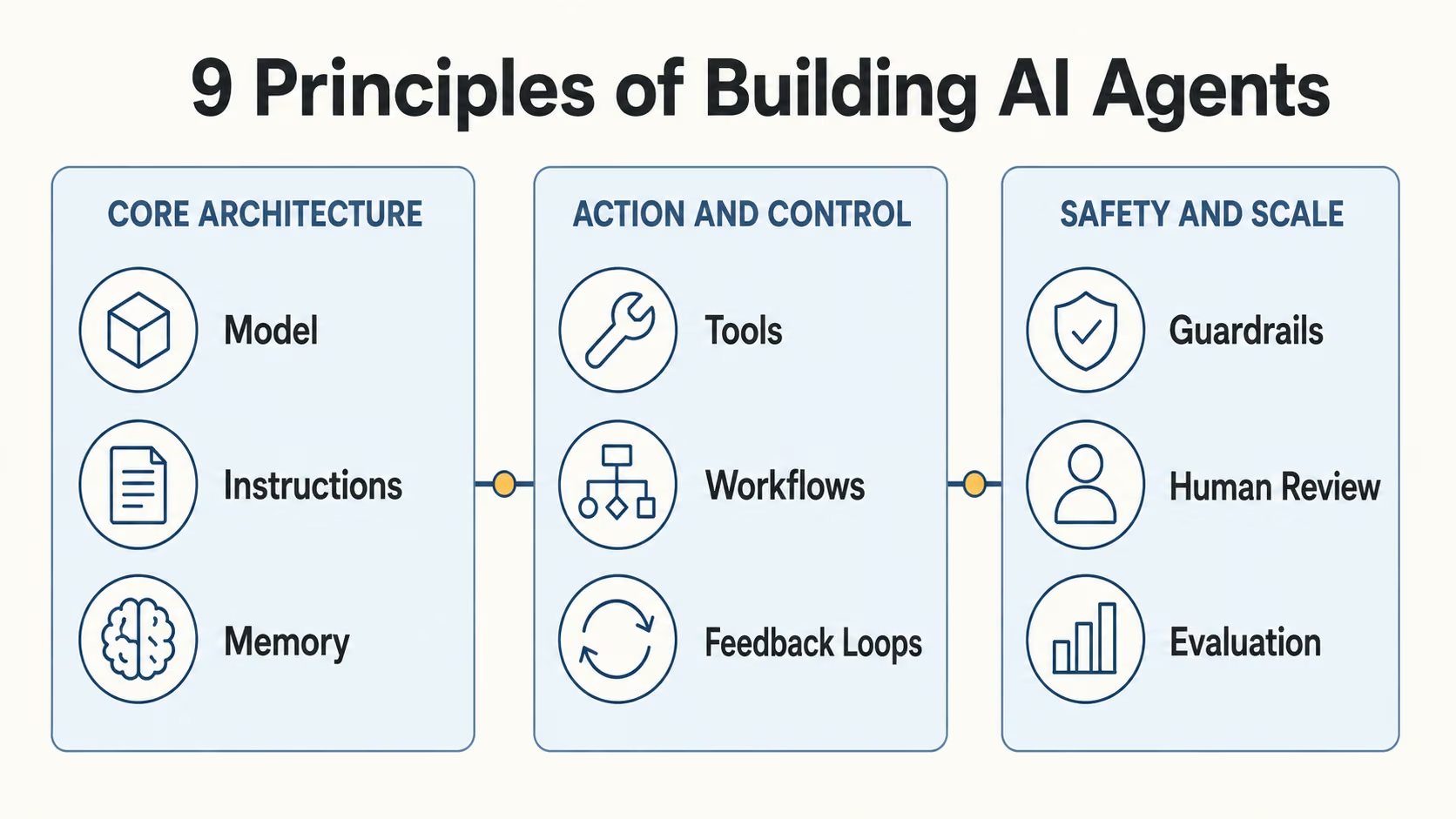
A well-built AI agent comes down to nine specific design decisions across three categories. Get those nine right, and an agent holds up under messy, unpredictable conditions.
How Does Principle-Driven Design Work?
Nine decisions, three buckets.
Core Architecture: The Model, Instructions, and Memory
The model gets the credit when an agent works and the blame when it doesn't, even though a capable model still produces an unreliable agent when the instructions and memory around it are weak. It's the reasoning engine deciding what happens next, and this comparison of the best LLMs shows how differently models handle long context, coding, and research.
Clear instructions are where that weakness shows up first. The best vibe coding prompt techniques specify the objective, inputs, outputs, and success conditions so the model has less room to guess.
But a rule written only as a prompt suggestion still holds up fine in a demo, then gets routed around the moment an edge case hits. What worked was moving the rule somewhere the model can't talk its way past.
Memory is where I felt that weakness hardest. Scoutline's first version had no memory outside the chat window it ran in. It checked a topic and compared it against what it "remembered," then drafted a note. But nothing about that comparison survived between runs, so it kept flagging the same change as new.
The fix was straightforward: I had Scoutline, through Emergent, write every confirmed note to a plain structured log, then read that log first on every new run, no longer trusting session memory. The duplicate flags stopped right away
Action and Control: Tools, Workflows, and Feedback Loops
A good tool sounds simple to design, until you build one badly. Scoutline's first "check this topic" tool returned a wall of raw, unformatted page text, and the agent had to guess which part of that blob held the real change. Once, it guessed wrong, summarizing a change to the wrong part of a test page entirely.
I described a narrower version to Emergent instead, one that names the change, states how confident the agent was, and cites the exact source line in a single structured response. The vagueness mostly cleared up in the same afternoon. A narrow, typed tool beats a flexible one almost every time.
Combining checking, comparing, drafting, and logging into one opaque step makes failures hard to trace to a bad prompt, a bad tool call, or stale memory. Narrower, single-responsibility steps make each failure easier to locate.
Feedback loops catch errors that tools and workflows miss. A feedback loop is a self-check: the agent validates its own draft against the source before handoff. That's the same kind of check that would have caught Scoutline summarizing the wrong part of that test page. It gives you a cheaper first pass, not a stand-in for a person's judgment.
Safety and Oversight: Guardrails, Human-in-the-Loop, and Evaluation
Instructions tell the model what to do. Guardrails are the boundaries it isn't allowed to cross. One enforced outside the prompt holds under pressure. One that only lives inside the prompt eventually gets talked around.
Scoutline's guardrail was structural, not a prompt suggestion: Draft a note, but never append it to the shared log without a human approving it first. If a rule can't be broken, it shouldn't be optional for the model to follow.
Human review is the piece a self-check can't replace, and it's where Scoutline earned its keep.
On the third run, Scoutline drafted a note based on data that turned out to be a day-old snapshot cached by the source itself. The checkpoint caught it before the note ever reached the log. Without that approval step, a day-old snapshot would have become a permanent entry.
Evaluation is the easiest piece to skip and the most expensive to skip later. Anthropic's own guidance on building effective agents makes the same point about measuring before iterating. A useful version has three layers:
- Checks whether a change helps before you ship it.
- Catches regressions before production.
- Monitors what live runs turn up that testing never did.
Skipping straight to production means finding out only after something breaks.
Scoutline itself never got that far. It only had two of the three layers running. The first stayed informal: re-running against known topics after a fix, not a scored test. The second, a regression suite, never applied, since there was no shipped version yet to regress against.
The third is what actually worked: the same day-old-snapshot catch from the human-review checkpoint, seen from a different angle. That catch only happened because Scoutline was pulling from the real, live source instead of a fixed test case, so it hit a problem no pre-written test would have included: the source itself quietly serving stale data.
That's exactly the kind of thing an isolated pre-ship check, built on known inputs, would never surface.
Most of what looks like a reasoning failure across all three buckets is a system-design failure wearing a disguise. The model did its job correctly on input that was already wrong.
Principle-Driven Design vs. Surface-Level Fixes: What's the Difference?
The alternative to principle-driven design is the instinct to fix a flaky agent with a longer prompt or a "smarter" model, without naming the specific thing that broke.
Where the two approaches diverge:
The change that held was almost always a specific, named decision.
What Works and What's Harder About Principle-Driven Design
What Works
- Writing confirmed state to a durable log stopped Scoutline from flagging the same change again.
- A boundary that isn't just a line in the prompt survives an edge case that a suggestion alone doesn't.
- A checkpoint built in from the start catches a bad output before it reaches the next step, the same way Scoutline's did with a stale-data note.
Where It Falls Short
- Naming a boundary, typing a tool, and deciding a checkpoint all take design time up front, before the first working version ships.
- The agent is never fully hands-off. When no rule can settle a case, it needs a human, and if no one's available to answer, nothing ships until someone is.
Should You Apply All of This? My Take
How much rigor a build needs scales with how much unsupervised control you give it. A low-stakes experiment can skip the evaluation layers and the approval checkpoint. Anything touching money or user data can't.
Prioritize This If the Stakes Are High
- Handle user data or money, or take an action you can't undo.
- Need more than one person to trust what it outputs.
- Run it unattended for stretches, well beyond a single prompt at a time.
You Can Move Faster When the Stakes Are Low
- Have a personal, low-stakes experiment with little on the line.
- Have a human reviewing every output anyway, a habit that can catch a missing guardrail.
How to Start Applying These Principles in Your Own Build
Four steps cover most of it:
- Write the outcome and the one boundary down before you open a tool.
- Design one tool at a time, narrow and typed, skipping the catch-all.
- Decide the autonomy level and the checkpoint upfront, before anything breaks.
- Build the evaluation loop before the first run ever happens.
If you're weighing which platform to build on, here are Eleven agent builders tested side by side.
Principles I Wish I Knew Earlier
The single sharpest thing this process taught me: Blame the environment before you blame the model. Check what the agent could see and store before you reach for a better one.
Common mistakes to avoid:
- Carrying memory over between runs instead of checking the durable log, the mistake that caused Scoutline's duplicate flags.
- Leaving a guardrail as nothing more than a prompt instruction, which a model can eventually route around.
See how seven business AI agents measure up against these nine principles.
My Verdict on Principle-Driven Design
Reliability is a design decision. The principles of building AI agents above trace back to what Scoutline's build got wrong, then fixed.
If you're starting from scratch, don't try to perfect all nine at once. Pick the two or three principles your current build is weakest on, fix those first, and let the rest follow as the build grows.
How Emergent Helps You Apply These Principles Without Hand-Coding Every Guardrail
These nine decisions are one thing to know. The scaffolding for each one (a memory layer, a typed tool, a reliable checkpoint) usually takes engineering support to build.
That's the gap Emergent closes with its AI agent builder. Say what you want the agent to do, which tool it should call, and where the checkpoint sits. Emergent's agents then wire the pieces together and verify the build before handoff.
That's how Scoutline's memory fix and tool return got built, in plain language, never hand-coded. If you want to try it yourself, Emergent's tutorial for building custom agents is a good place to start.
Here's what building it with Emergent looks like:

You write the rules and constraints into the agent's system prompt, and add the Ask Human Tool wherever the agent should stop and request your input before continuing.
Most AI app builders stop at prototypes. Emergent creates production-ready apps you can actually launch.
- Production-ready apps
- Web & mobile apps
- Deploy in minutes