
Choosing a Claude model isn’t just about picking the most powerful option. The amount of reasoning a model applies to a task matters, too. A model running at low effort may respond faster and use fewer tokens, while a higher effort setting gives it more room to work through difficult problems.
That’s what makes the comparison between Claude Fable 5.1 at low effort and Claude Opus 5.5 at high effort interesting.
Fable 5.1 is Anthropic’s model for demanding reasoning and long-running agentic work. Opus 5.5 is designed for complex coding, knowledge work, and extended agentic workflows. Both support adaptive thinking and configurable effort levels, but they have different default settings, pricing, and performance characteristics.
The question is whether Fable 5.1’s underlying capabilities remain compelling when it runs at low effort, or whether Opus 5.5 can close the gap by spending more tokens on reasoning.
The answer depends on the task. A quick coding request, a large software refactor, and a research project involving several tools place very different demands on a model. The configuration that works best for one may not be the right choice for another.
This guide compares the two configurations across reasoning, coding, agentic performance, speed, and cost. It also explains how Claude’s effort settings work and when each configuration makes sense.
Fable 5.1 Low Effort and Opus 5.5 High Effort at a Glance
The first thing to understand is that these are not two completely different versions of Claude. They are configurations that combine a model with a particular effort setting.
Claude Fable 5.1 is designed for demanding reasoning, long-running agentic work, and complex knowledge tasks. Claude Opus 5.5 focuses on long-running agentic coding and knowledge work. Both have adaptive thinking, which means the model can adjust its reasoning rather than following a fixed thinking budget for every request.
Here’s how their published specifications compare.
MTok = 1M Toks. The price is the normal USD list price per API, not including any discounts for caching, batching, etc. The latency is based on Anthropic’s published comparison between models, not the latency measurements of these particular effort levels.
A few details stand out.
First, Fable 5.1 is more expensive per token. Its input price is 2.5 times Opus 5.5’s, and its output price is also 2.5 times higher.
Second, the effort settings are different. Fable 5.1 is being evaluated at low effort, below its high-effort default. Opus 5.5 is being evaluated at high effort, above its medium-effort default.
Third, both models have the same published context window and maximum output. That doesn’t mean they will produce equally good results on long documents or complex tasks. Context capacity describes how much information a model can process, not how accurately it reasons about every piece of it.
The comparison is therefore about more than raw model capability. It involves the trade-off between model choice, reasoning depth, token consumption, and task requirements.
What Effort Changes and What It Does Not
Claude’s effort setting controls how much reasoning the model applies when generating a response. It influences how much work the model can spend on a request, which can affect response quality, token consumption, and latency.
Anthropic offers several effort levels:
Availability and recommendations vary by model. Both Fable 5.1 and Opus 5.5 support all five levels.
For this comparison, low effort means Fable 5.1 is being asked to work with a more limited reasoning budget. High effort gives Opus 5.5 more room to work through a request.
That distinction matters because a higher effort setting does not change the underlying model into a different model. Opus 5.5 at high effort remains Opus 5.5. Likewise, Fable 5.1 at low effort retains the underlying capabilities of Fable 5.1, even though it has less room to reason through a task.
Does high effort always produce better answers?
Not necessarily. A higher effort setting can help with problems that involve several steps, competing constraints, or decisions that need careful examination. It gives the model more room to consider the task before producing its answer.
But not every request needs that much work. If someone asks Claude to rewrite a short paragraph, extract a date from a document, or explain a simple programming concept, using high effort may not make the result noticeably better. It may simply increase the number of tokens used and the time required.
Consider a request to calculate the total cost of five products. A low-effort configuration may be perfectly adequate. Now consider a request to investigate a large codebase, identify a performance issue, modify several files, and run tests. That task has more dependencies and more opportunities for mistakes. A higher effort setting may be worthwhile.
The useful question isn’t whether high effort is better in general. It’s whether the additional reasoning improves the result enough to justify its cost.
Adaptive thinking and effort are not the same thing
One point that can cause confusion is the difference between adaptive thinking and effort.
Adaptive thinking allows Claude to adjust its reasoning as it works through a request. Effort controls how much reasoning the model is encouraged to apply.
Both Fable 5.1 and Opus 5.5 have adaptive thinking enabled by default, and Anthropic does not allow it to be disabled on these models. Effort is therefore the main control developers can use to influence reasoning depth, token consumption, and the amount of work spent on a request.
This is particularly relevant when comparing Fable 5.1 at low effort with Opus 5.5 at high effort. The comparison isn’t between a model that thinks and one that doesn’t. Both use adaptive thinking; they simply have different effort settings.
Why model defaults matter
A model’s default effort setting is a useful starting point, but it shouldn’t be treated as a universal recommendation.
Fable 5.1 defaults to high effort in the API, while Opus 5.5 defaults to medium. Anthropic’s recommendations also distinguish between different environments, including Claude Code, Claude Cowork, and Claude.ai.
For developers, this means an API request that doesn’t specify an effort setting may behave differently from a request made through another Claude product.
If you’re evaluating the two configurations, specify the effort level explicitly. Otherwise, you may end up comparing different settings from the ones intended.
Reasoning and Long-Horizon Work Compared
Reasoning is where the difference between these configurations becomes particularly important.
Some requests have a straightforward answer. Others require the model to understand a large amount of context, identify dependencies, evaluate several possibilities, and keep track of decisions over multiple steps.
The second category is where effort settings can have a greater impact.
Claude Fable 5.1 is positioned for demanding reasoning and long-horizon agentic work. Opus 5.5 is positioned for long-running agentic coding and knowledge work. Both can handle complex requests, but their positioning suggests different strengths to evaluate.
Claude Fable 5.1 at low effort
Fable 5.1 is Anthropic’s higher-capability model for demanding reasoning and extended agentic tasks. Running it at low effort is a way to explore how much of that capability can be retained with a smaller reasoning budget.
This could prove useful for cases where a particular job needs an able model without having to spend much on each request.
In the case at hand, consider a process where Claude is asked to review different documents, come up with recurring topics, and summarize the information. Here, Claude must be aware of the context and how information relates, but he does not have to dig deeply into the subject matter.
Low effort can be a reasonable starting point for this type of work, provided the output is checked for omissions and unsupported conclusions.
However, there is a trade-off. A smaller reasoning budget can leave less room for examining competing explanations, checking assumptions, and recovering from an incorrect intermediate step.
For work where a missed dependency could affect the entire result, the low-effort configuration should be evaluated carefully.
Claude Opus 5.5 at high effort
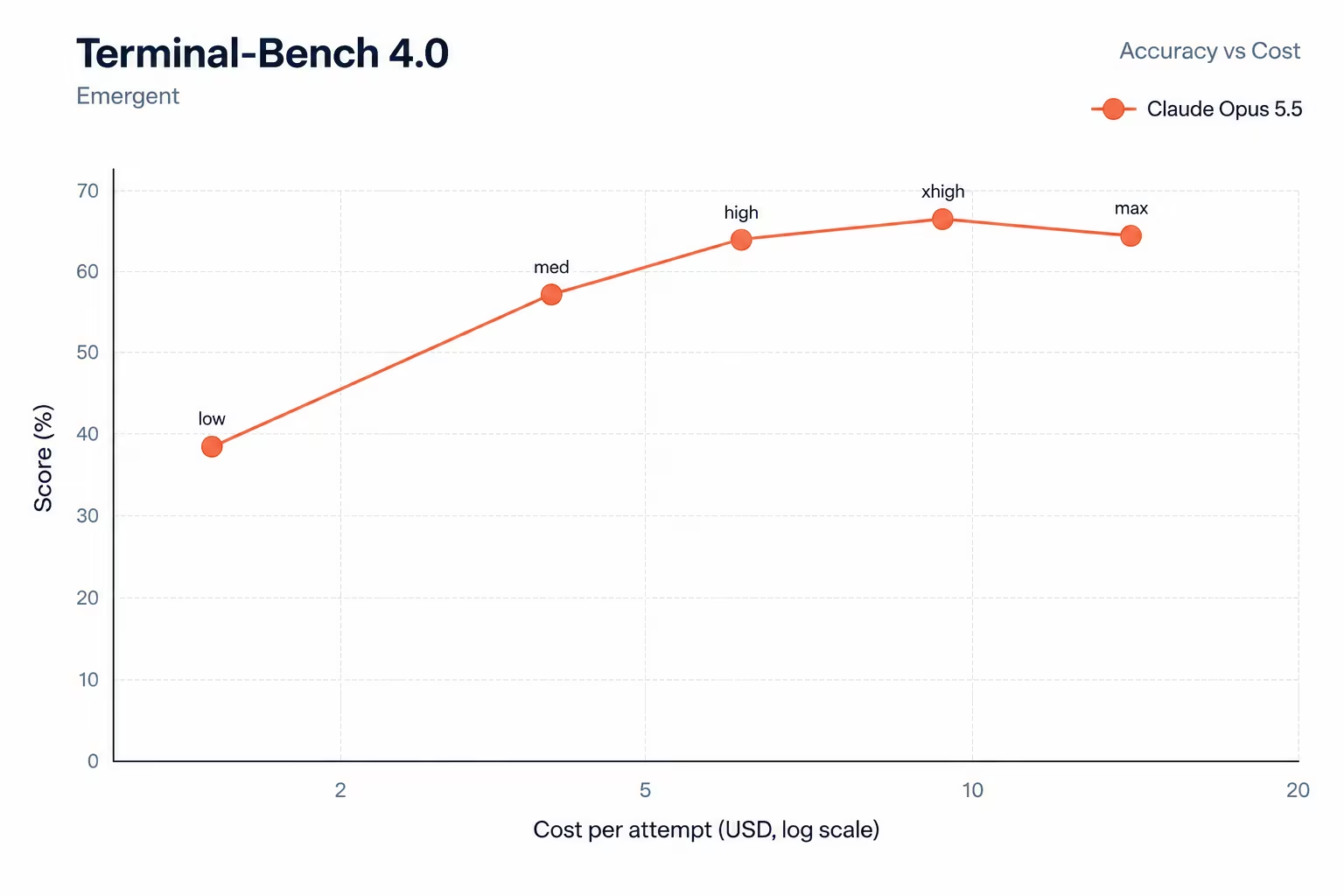
Opus 5.5 is designed for long-running agentic coding and knowledge work. Setting it to high effort gives it more room to work through complex requests.
This can be useful when a task involves several connected decisions. For example, an analyst might ask Claude to review a set of financial documents, compare figures across reports, identify inconsistencies, and explain the possible causes.
The model needs to do more than summarise each document. It must connect information, recognise contradictions, and produce an answer that accounts for the evidence.
High effort gives Opus 5.5 more room to reason through that process. It doesn’t guarantee that every conclusion will be correct, though. The result still depends on the quality of the source material, instructions, and tools available.
What about long-horizon tasks?
Long-horizon work involves more than answering a complicated question in one response. It may require maintaining context across multiple actions, using tools, handling unexpected results, and adjusting a plan as new information becomes available.
Examples include:
- Researching a technical subject using multiple sources.
- Reviewing a large software project and identifying connected issues.
- Building an application through several development and testing stages.
- Analyzing a collection of documents and preparing a consolidated report.
- Completing a workflow that involves several tools and external systems.
Fable 5.1 is explicitly positioned for demanding reasoning and long-horizon agentic work. Opus 5.5 is also designed for long-running agentic coding and knowledge work.
The effort setting adds another variable. Low effort may reduce the reasoning budget available to Fable 5.1, while high effort gives Opus 5.5 more room to work through a task.
It would be misleading to assume that one configuration must win every long-horizon task. A reliable comparison needs to use the same instructions, tools, context, and success criteria for both models.
What Anthropic’s published evaluations tell us
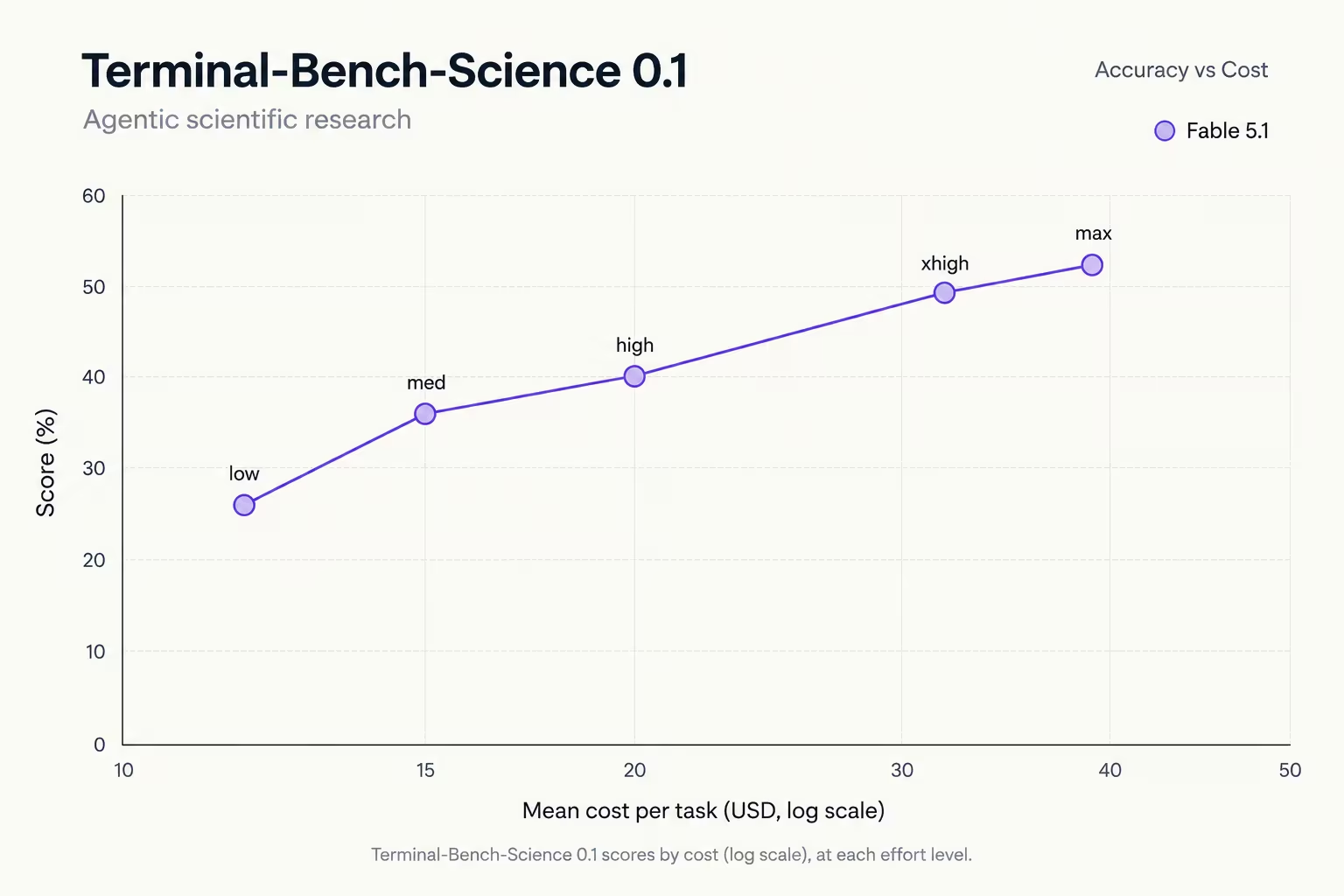
Anthropic’s Fable 5.1 announcement includes performance-versus-cost evaluations across several demanding tasks, including agentic scientific research, terminal coding, multidisciplinary reasoning, and agentic coding.
The important point is that performance changes with effort and cost. Anthropic reports that Fable 5.1 at low or medium effort can achieve results similar to or better than Fable 5 at a substantially lower cost.
These evaluations help explain why running a powerful model at lower effort can be useful. They do not, however, establish that Fable 5.1 at low effort beats Opus 5.5 at high effort on every benchmark.
For this comparison, the fairest approach is to treat Anthropic’s published charts as evidence about Fable 5.1’s effort-cost trade-off, not as a direct head-to-head result for the two configurations. For the Opus side of that picture, the Claude Opus 5.5 benchmarks show where it leads and where it trails, so you can set them beside Fable’s effort-cost charts.
If the decision is important to your workflow, run both configurations against the same representative tasks. Measure completion quality, accuracy, tool-use success, token consumption, and time to completion.
A model that produces a better answer but takes substantially more time and costs more may not be the best choice for a high-volume workflow. Equally, saving tokens is not useful if the model misses important details and requires repeated corrections.
Take a deeper look at the differences in our blog Claude Fable 5.1 vs Opus 5.5: Benchmarks, Cost & Verdict
Coding and Agentic Performance Compared
Coding performance entails much more than writing the code. Difficult jobs will entail debugging, knowledge about the existing architecture, testing modifications, and multiple steps.
Claude Fable 5.1 at low effort may be considered to perform code generation, straightforward debugging, and well-defined development tasks.
Claude Opus 5.5 at high effort is a better configuration to be used to test difficult debugging, making choices concerning architecture, modifying multiple files, and processes involving deeper reasoning.
Agentic work is possible with both configurations. Claude Fable 5.1 is geared up for difficult reasoning and long-horizon tasks, and Opus 5.5 is geared toward agentic coding and knowledge work. But there is no proven direct benchmark to say which configuration wins this competition. To test both on your own coding task, you can build a coding agent and set the model and effort level yourself.
Speed, Token Use, and Cost Compared
The biggest measurable difference is API pricing.
Opus 5.5 costs 60% less per token at standard rates. For one million input tokens and 100,000 output tokens, the estimated costs are $15 for Fable 5.1 and $6 for Opus 5.5.
Effort has an effect on cost and latency as well. Large effort values may consume more reasoning tokens, and small effort values may eliminate unnecessary processing.
There is no evidence to support that there is a definite configuration that will produce faster responses. Latency is based on reasoning needs, output size, and use of tools.
Also Read: Claude Opus 5.5 pricing, a breakdown of its token rates, caching, and batch discounts.
Conclusion
Claude Fable 5.1 at low effort and Claude Opus 5.5 at high effort serve different priorities. Fable 5.1 is worth evaluating for demanding reasoning tasks with a tighter reasoning budget, while Opus 5.5 offers a lower per-token cost and additional reasoning capacity at high effort.
For teams looking to turn these AI capabilities into working products, choosing the right model is only the first step. The next challenge is putting it to practical use. Emergent helps teams build AI-powered applications, internal tools, and automated workflows using natural-language prompts. Users can describe an idea, generate an initial application, refine its functionality, and turn the result into a working product without building everything from scratch.
For example, teams exploring AI-powered business workflows can use Emergent to build custom applications around their requirements, test different approaches, and develop solutions that address actual operational needs.
Ultimately, the right Claude configuration depends on the complexity of the task, expected output quality, and available budget. Test both configurations against real workloads before making a long-term decision. Both Claude Opus 5.5 and Claude Fable 5.1 are live and available on Emergent.


Most AI app builders stop at prototypes. Emergent creates production-ready apps you can actually launch.
- Production-ready apps
- Web & mobile apps
- Deploy in minutes