TL;DR
- Claude Fable 5.2 leads GPT-6 Astra across several reasoning, coding, and automation benchmarks.
- GPT-6 Astra costs approximately 76.5% less per evaluated Intelligence Index task at maximum reasoning effort.
- Fable 5.2 offers 20% lower standard API token prices, but Astra completes the evaluated tasks faster.
- Choose Fable 5.2 for demanding reasoning and agentic tasks; consider Astra when execution cost and speed matter more.
Anthropic released Claude Fable 5.2 on November 9, 2026, bringing stronger capabilities for complex reasoning, coding, and long-running AI agents. The launch also introduced a 20% reduction in API token prices, making the model a more competitive alternative to OpenAI's GPT-6 Astra.
But does better benchmark performance necessarily mean better value?
Early independent evaluations favor Fable 5.2 on overall intelligence, while GPT-6 Astra presents a compelling case for cost efficiency on demanding tasks. The difference matters for developers building AI applications and businesses evaluating models for research, automation, and everyday workflows.
In this Claude Fable 5.2 vs. GPT-6 Astra comparison, we'll examine their capabilities, benchmark performance, coding abilities, speed, pricing, and practical use cases to help you decide which model better fits your needs.
Claude Fable 5.2 vs. GPT-6 Astra: At a Glance
Claude Fable 5.2 and GPT-6 Astra are flagship AI models designed for demanding tasks, including complex reasoning, coding, research, and multi-step workflows. Both support large context windows and extended output generation, but they differ in pricing, reasoning controls, and deployment options.
| Feature | Claude Fable 5.2 | GPT-6 Astra |
|---|---|---|
| Developer | Anthropic | OpenAI |
| Release | November 9, 2026 | September 2026 |
| Model ID | claude-fable-5-2 | gpt-6-astra |
| Context window | 1 million tokens | 1.05 million tokens |
| Maximum output | 128,000 tokens | 128,000 tokens |
| Input price (per 1M tokens) | $8 | $10 |
| Output price (per 1M tokens) | $40 | $50 |
| Reasoning | Adaptive thinking, always on | Configurable reasoning effort |
| Image input | Supported | Supported |
| Text output | Supported | Supported |
| Primary strengths | Complex reasoning, long-running agents, multi-step research | Complex reasoning, coding, computer use, research, and document creation |
| API availability | Claude API and supported cloud platforms | OpenAI API and supported cloud platforms |
Claude Fable 5.2 vs. GPT-6 Astra specifications and standard API pricing. Sources: Anthropic Claude Platform documentation and OpenAI API model documentation. Prices are in USD and exclude applicable taxes, additional tool charges, and special pricing conditions.
At standard API rates, Claude Fable 5.2 costs 20% less per input and output token than GPT-6 Astra. However, lower token prices do not necessarily mean lower costs per completed task. The total expense also depends on reasoning token consumption, execution time, and the number of attempts required.
GPT-6 Astra offers a slightly larger context window, while both models support up to 128,000 output tokens. The more meaningful differences emerge when comparing their performance, efficiency, and reliability across specific workloads.
What Is Claude Fable 5.2?
Claude Fable 5.2 is Anthropic's advanced AI model for complex reasoning, software development, scientific research, and long-running AI tasks. It is designed for projects that require multiple steps, extensive analysis, and sustained problem-solving.
Unlike models optimized for everyday conversations or simple content generation, Fable 5.2 focuses on demanding workflows, such as debugging complex software, coordinating AI agents, and analyzing technical information.
What's New in Claude Fable 5.2?
The latest release introduces several improvements over Fable 5.1:
- Faster responses: Anthropic reports up to 30% faster output generation compared with the previous version.
- Lower API pricing: Standard input and output token prices have decreased by 20%.
- Improved coding and reasoning: Stronger performance on challenging programming, scientific reasoning, and multi-step problem-solving benchmarks.
- More efficient task execution: Improved performance at lower reasoning-effort settings can reduce the cost of completing certain complex tasks.
- Optional fast mode: Developers can prioritize response speed, with output generation up to 2.5 times faster at higher API rates.
Fable 5.2 also supports a 1-million-token context window, allowing it to process extensive documents, codebases, and other large inputs.
However, greater capability does not make it the best choice for every task. Anthropic recommends Claude Opus 5.5 for most everyday coding and knowledge work, positioning Fable 5.2 for more demanding projects where additional reasoning capabilities justify the cost.
Also Read: Fable 5.2 vs Fable 5.1 for the price, speed, and benchmark gaps side by side.
What Is GPT-6 Astra?
GPT-6 Astra is OpenAI's flagship AI model, introduced in September 2026 for complex reasoning, software engineering, research, and professional workflows. It is designed to handle demanding tasks that involve planning, analyzing information, using tools, and completing multiple connected steps.
Astra goes beyond generating text or code. It can support workflows that involve researching information, working with documents, navigating software interfaces, and executing tasks across applications.
What Makes GPT-6 Astra Different?
Its key capabilities include:
- Advanced reasoning: Handles complex problems requiring extensive analysis, logical reasoning, and multiple stages of decision-making.
- Software engineering: Supports code generation, debugging, testing, and modifications across large codebases.
- Computer use: Can interact with supported software interfaces to complete tasks involving multiple applications and tools.
- Research and analysis: Helps analyze extensive documents, evaluate information, and produce structured research outputs.
- Multi-step task execution: Supports workflows that combine planning, tool use, execution, and verification.
Astra also offers configurable reasoning effort, allowing developers to balance response quality, speed, and computational cost according to the task.
However, Astra's advanced capabilities come with relatively high API pricing. For simpler tasks such as summarization, routine writing, and basic coding, smaller models may provide better value.
The key question is whether Astra's reasoning, reliability, and task execution capabilities justify its cost compared with Claude Fable 5.2.
Claude Fable 5.2 vs. GPT-6 Astra: Benchmark Performance
Claude Fable 5.2 leads GPT-6 Astra on several independent intelligence, reasoning, and coding evaluations. However, benchmark results vary by task, and stronger performance does not automatically translate into better cost efficiency.
Artificial Analysis reports an Intelligence Index score of 65 for Claude Fable 5.2 (Max, Default Fallback), compared with 57 for GPT-6 Astra (Max).
Independent Benchmark Comparison
| Benchmark | Fable 5.2 (Max) | GPT-6 Astra (Max) |
|---|---|---|
| Intelligence Index | 65 | 57 |
| AA-Briefcase v1.1 | 1,785 | 1,569 |
| AutomationBench-AA | 76.40% | 68.50% |
| FrontierCode 2.0 | 48.80% | 42.40% |
| HLE-Diamond | 80.20% | 63.80% |
| Terminal-Bench 4.0 | 59.60% | 59.10% |
| GDP.pdf | 24.20% | 31.00% |
Independent benchmark comparison of Claude Fable 5.2 (Max, Default Fallback) and GPT-6 Astra (Max). Higher scores indicate better performance within each benchmark. Source: Artificial Analysis, accessed November 10, 2026.
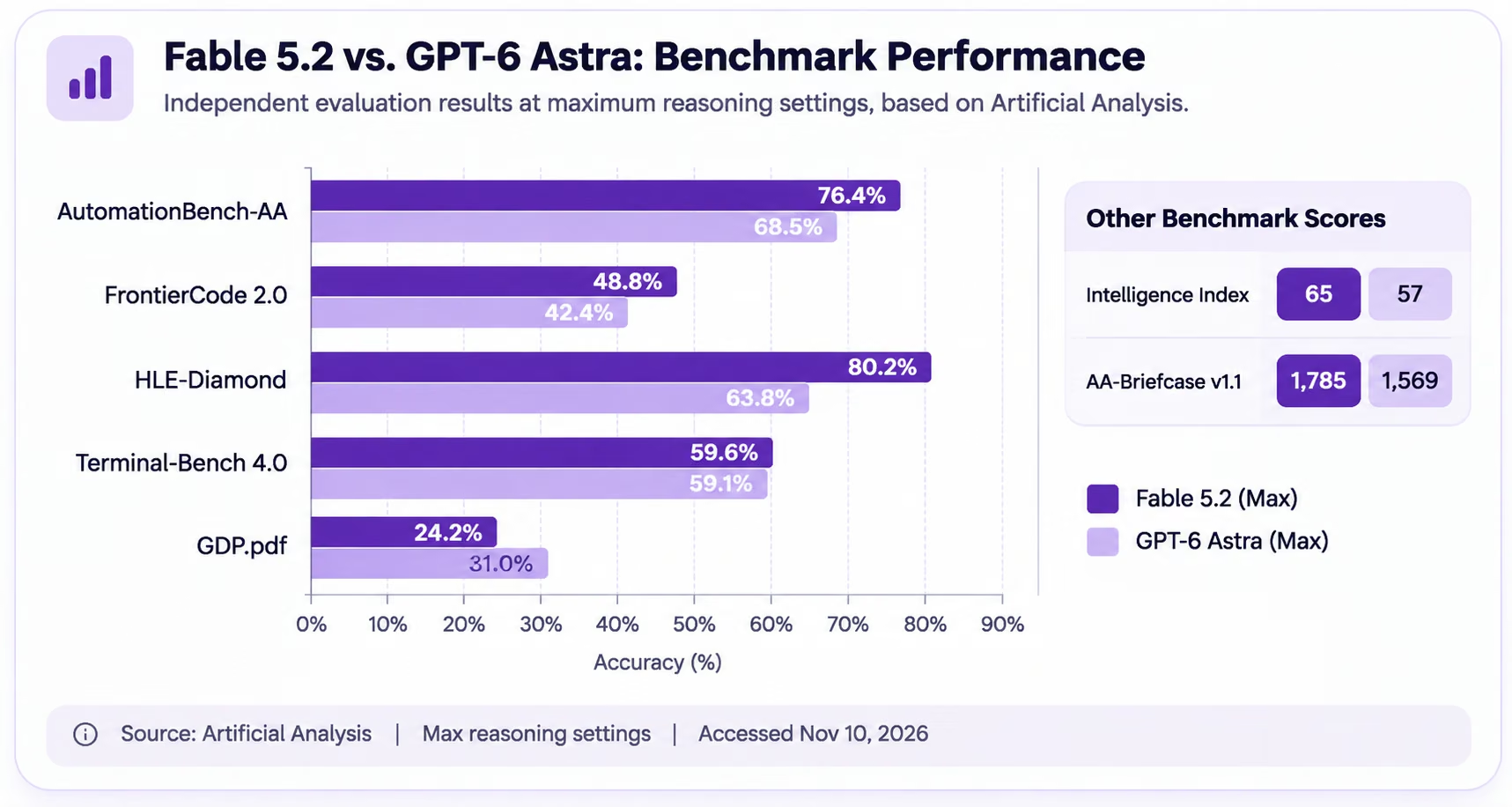
Claude Fable 5.2 vs. GPT-6 Astra across seven independent benchmarks at maximum reasoning settings. Percentage-based results are displayed as bars, while Intelligence Index and AA-Briefcase scores are shown separately. Source: Artificial Analysis, accessed November 10, 2026.
The results highlight three important differences:
- Reasoning and knowledge work: Fable 5.2 leads on the Intelligence Index, AA-Briefcase, and HLE-Diamond evaluations, indicating stronger performance across several demanding reasoning and professional tasks.
- Coding and automation: Fable 5.2 performs better on FrontierCode 2.0 and AutomationBench-AA, although the Terminal-Bench 4.0 results are nearly identical.
- Professional document tasks: GPT-6 Astra leads on GDP.pdf, demonstrating why overall intelligence rankings should not be treated as universal measures of performance.
These results favor Fable 5.2 across most of the selected evaluations. However, they represent specific model configurations tested under standardized conditions, not guaranteed outcomes for every real-world task.
The next consideration is efficiency: how much time and money each model requires to achieve its results.
Also Read: Fable 5.2 benchmarks for what each test measures.
Claude Fable 5.2 vs. GPT-6 Astra: Coding and Agentic Capabilities
Both Claude Fable 5.2 and GPT-6 Astra can assist with software development and multi-step automation. Their capabilities extend beyond writing individual functions to understanding existing code, identifying problems, using development tools, and working through complex tasks.
Coding and Software Development
Claude Fable 5.2 shows an advantage in several agentic coding evaluations. Anthropic's November 2026 testing reports higher scores for Fable 5.2 on FrontierCode 2.0 and FrontierSWE v2, which evaluate aspects of real-world software engineering.
For developers, these results suggest that Fable 5.2 may be particularly useful for:
- Investigating bugs across multiple files
- Making changes to existing applications
- Refactoring complex code
- Working through multi-step development tasks
GPT-6 Astra remains a capable alternative for code generation, debugging, and software engineering workflows. Its effectiveness will also depend on the development tools, repository access, and testing environment available to the model.
Neither model guarantees production-ready code. Generated changes still require testing, security checks, and appropriate review.
AI Agents and Business Automation
Agentic AI systems go beyond answering prompts. They can plan tasks, use tools, process information, and take actions across multiple steps.
Fable 5.2 performs strongly on business workflow evaluations. Anthropic reports an AutomationBench score of 51.4%, compared with 41.4% for GPT-6 Astra.
These capabilities support workflows such as processing customer requests, extracting information from documents, preparing reports, and coordinating tasks across applications.
However, benchmark performance alone does not determine how reliably an AI agent will work in a business environment. Tool integrations, permissions, error handling, and human approval mechanisms remain essential.
To build those controls into the workflow, an AI agent builder lets you define the tools, permissions, and where a person approves.
Which Model Is Better for Coding and Automation?
Fable 5.2 currently shows stronger performance across several published agentic coding and workflow benchmarks. It is worth considering for demanding development tasks and multi-step automation.
GPT-6 Astra remains a competitive choice, particularly for teams already using OpenAI's development tools and infrastructure.
For businesses, the practical decision should also consider implementation complexity, reliability, and the total cost of completing tasks, not just the model's benchmark ranking.
Claude Fable 5.2 vs. GPT-6 Astra: Reasoning and Knowledge Work
Both Claude Fable 5.2 and GPT-6 Astra are designed to handle problems that require more than a straightforward answer. They can analyze complex information, evaluate alternatives, and work through tasks involving multiple reasoning steps.
However, their relative strengths become clearer when we consider the type of work involved.
Complex Reasoning and Research
Claude Fable 5.2 has an advantage in several demanding reasoning evaluations, including Humanity's Last Exam and the Artificial Analysis Intelligence Index.
This makes Fable 5.2 worth considering for tasks such as:
- Analyzing complex technical or scientific information
- Investigating problems with multiple possible solutions
- Conducting multi-step research
- Evaluating competing explanations and evidence
GPT-6 Astra also supports advanced reasoning and research workflows. Its capabilities remain relevant for tasks requiring structured analysis, information synthesis, and decisions based on extensive documentation.
The distinction is not that one model can reason while the other cannot. Rather, Fable 5.2 has demonstrated stronger results across several selected evaluations of difficult reasoning tasks.
Document Analysis and Professional Work
Both models can work with lengthy documents, including research papers, financial reports, technical specifications, and business records.
Fable 5.2 performs strongly on AA-Briefcase v1.1, which evaluates professional knowledge-work tasks. However, GPT-6 Astra outperforms Fable 5.2 on the GDP.pdf evaluation.
This difference is important for businesses. A model that performs better on abstract reasoning tests may not necessarily produce better results when preparing reports, analyzing financial documents, or completing structured deliverables.
For document-heavy workflows, accuracy, formatting, source reliability, and the ability to follow detailed instructions should be evaluated alongside benchmark performance.
Which Model Is Better for Knowledge Work?
Claude Fable 5.2 has the stronger overall showing across several demanding reasoning and knowledge-work benchmarks. It may be preferable when solving difficult, open-ended problems is the primary requirement.
GPT-6 Astra remains a competitive option for structured research, document analysis, and professional workflows, particularly where its tool integrations and task-specific performance are valuable.
For either model, important factual claims and business-critical outputs should be checked against reliable sources before use.
Claude Fable 5.2 vs. GPT-6 Astra: Speed and Efficiency
A model's speed is not determined solely by how quickly it generates tokens. For complex reasoning tasks, the total time required to complete an answer can be more important than raw output speed.
Artificial Analysis measures both models across standardized intelligence evaluations. At maximum reasoning effort, GPT-6 Astra completes the evaluated tasks in substantially less time than Claude Fable 5.2.
Speed Comparison
| Metric | Claude Fable 5.2 (Max) | GPT-6 Astra (Max) |
|---|---|---|
| Time per evaluated task | 46.4 minutes | 23.0 minutes |
| Time to first answer token | 219.85 seconds | 221.85 seconds |
Independent performance measurements for Claude Fable 5.2 (Max, Default Fallback) and GPT-6 Astra (Max). Lower values are preferable. Source: Artificial Analysis, November 10, 2026.
What Do These Results Mean?
GPT-6 Astra takes approximately half as long as Fable 5.2 per evaluated Intelligence Index task. This gives Astra an advantage when completing complex workloads within a limited time.
However, Fable 5.2 has a marginally shorter time to first answer token: 219.85 seconds versus 221.85 seconds for GPT-6 Astra. This two-second difference is relatively small and does not establish a meaningful overall speed advantage for Fable 5.2.
The difference reflects an important distinction between individual response latency and the estimated time required to complete benchmark tasks. A model can respond quickly to an individual request while still taking longer to finish a demanding reasoning task.
Which Model Is More Efficient?
For the evaluated Intelligence Index workloads, GPT-6 Astra has a clear advantage in time per task.
Claude Fable 5.2 may still justify its longer execution time when its stronger reasoning performance produces results that a less capable model cannot achieve.
For businesses, the most useful measure is often the time required to obtain an accurate, usable result, including retries and corrections. Neither model's benchmark timings should be interpreted as guaranteed completion times for real projects.
Claude Fable 5.2 vs. GPT-6 Astra: Pricing Comparison
Claude Fable 5.2 has lower standard API token prices than GPT-6 Astra. However, token pricing tells only part of the story. For complex reasoning workloads, computation and token usage can significantly affect the final cost.
API Pricing Comparison
| Pricing metric | Claude Fable 5.2 | GPT-6 Astra |
|---|---|---|
| Input tokens (per 1M) | $8 | $10 |
| Output tokens (per 1M) | $40 | $50 |
Standard API token pricing in USD. Sources: Anthropic and OpenAI official model documentation. Rates exclude additional tool charges and special pricing conditions.
At these standard rates, Fable 5.2 is 20% cheaper per input and output token. For applications processing large volumes of text, this difference may be relevant. GPT-6 Astra also applies higher rates to requests exceeding 272,000 input tokens. For these requests, input pricing increases to $20 per million tokens and output pricing to $75 per million tokens, with the higher rates applying to the entire request. Businesses processing exceptionally large documents or codebases should account for this when estimating API costs. For Astra’s full rate card, including cached input and the long-context tiers, see our GPT-6 Astra pricing guide.
However, the total cost depends on how many tokens a model consumes, its reasoning effort, and whether the task requires additional attempts.
Cost per Completed Task
Artificial Analysis provides a different perspective by measuring the average cost of completing its evaluated intelligence tasks.
GPT-6 Astra costs approximately 76.5% less per evaluated task than Fable 5.2, despite having higher standard token prices.
This illustrates why a cheaper model per token is not necessarily cheaper to operate. Models can consume different amounts of reasoning tokens or require different levels of computation to complete the same evaluation.
Which Model Offers Better Value?
Fable 5.2 offers lower standard API token prices and stronger performance on several demanding intelligence benchmarks.
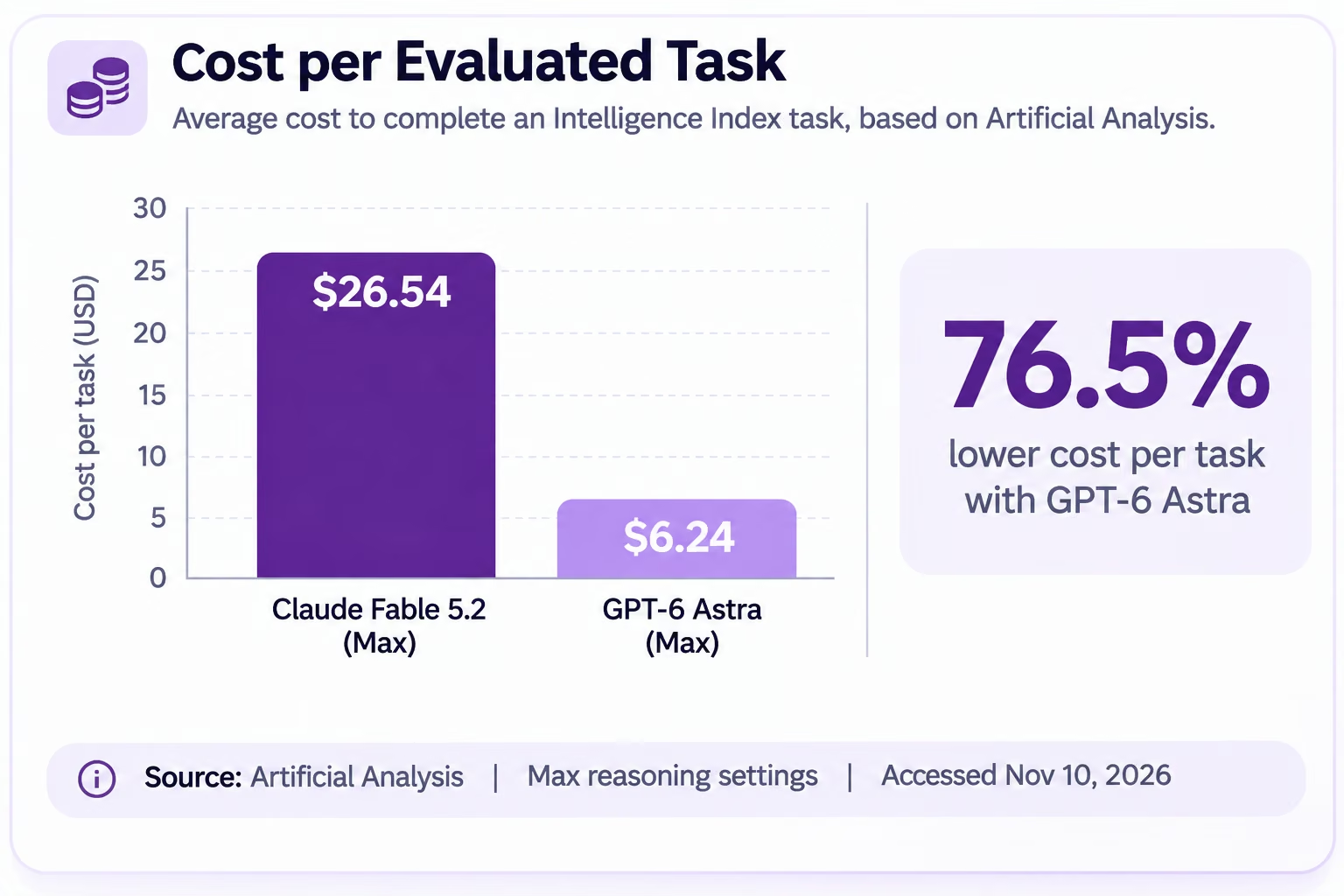
Average cost per evaluated Intelligence Index task at maximum reasoning effort. Claude Fable 5.2: $26.54; GPT-6 Astra: $6.24. Source: Artificial Analysis, accessed November 10, 2026.
GPT-6 Astra has a substantial cost-per-task advantage in the Artificial Analysis evaluation, making it worth considering for businesses that need to manage the expense of complex reasoning workloads.
The better choice depends on the task. Businesses should consider output quality, execution costs, response time, and the need for corrections or retries rather than comparing token prices alone.
Also Read: Claude Fable 5.2 pricing for caching, batch, and fast mode rates.
Claude Fable 5.2 vs. GPT-6 Astra: Context Window and Multimodal Capabilities
Both Claude Fable 5.2 and GPT-6 Astra can process large amounts of information within a single request. This makes them suitable for analyzing lengthy documents, reviewing codebases, and working with information spread across multiple sources.
Handling Large Documents and Codebases
Fable 5.2 supports a 1-million-token context window, while GPT-6 Astra supports 1.05 million tokens. Both models can generate up to 128,000 output tokens.
In practice, these capabilities allow users to work with extensive research materials, technical documentation, and large software projects without splitting every task into smaller requests.
However, a larger context window does not guarantee that a model will accurately recall or interpret every detail. Performance can vary depending on document structure, task complexity, and how information is presented.
Image Understanding and Multimodal Tasks
Both models accept text and images as inputs and generate text outputs.
They can support tasks such as interpreting charts, extracting information from screenshots, reviewing visual documents, and answering questions about images.
However, neither model's core API provides native audio or video input and output capabilities. These functions may require separate models or tools.
For businesses, the choice depends less on the small difference in context-window size and more on how reliably each model processes the information relevant to a particular workflow.
Claude Fable 5.2 vs. GPT-6 Astra: Which Should You Choose?
Claude Fable 5.2 performs better across several demanding intelligence and coding benchmarks, while GPT-6 Astra offers lower measured costs and faster completion times on the Artificial Analysis Intelligence Index evaluations.
The better choice depends on whether your priority is solving particularly difficult problems, controlling operating costs, or integrating AI into existing workflows.
Model Recommendations by Use Case
| Use case | Recommended model | Why? |
|---|---|---|
| Complex reasoning and scientific research | Claude Fable 5.2 | Stronger results on several demanding reasoning benchmarks |
| Advanced coding and debugging | Claude Fable 5.2 | Higher scores on selected coding evaluations |
| Multi-step AI agents | Claude Fable 5.2 | Stronger performance on evaluated automation tasks |
| Cost-sensitive reasoning workloads | GPT-6 Astra | Lower measured cost per evaluated task |
| Time-sensitive complex tasks | GPT-6 Astra | Faster completion on the evaluated Intelligence Index tasks |
| Professional document workflows | Task-dependent | Results differ across professional knowledge-work evaluations |
| Existing OpenAI-based applications | GPT-6 Astra | May simplify integration with an established OpenAI infrastructure |
| Large-document analysis | Either | Both support extensive context windows; task-specific accuracy matters more |
Practical model recommendations based on published benchmark results, API specifications, and integration considerations. Sources: Artificial Analysis, Anthropic, and OpenAI.
When Should You Choose Claude Fable 5.2?
Consider Fable 5.2 when your work involves particularly challenging reasoning, complex software engineering, or multi-step AI agents.
Its stronger performance on several demanding benchmarks may justify higher execution costs when solving the problem correctly is more important than minimizing cost or completion time.
When Should You Choose GPT-6 Astra?
Consider GPT-6 Astra when you need advanced AI capabilities but also want to manage execution costs and turnaround times.
It may be particularly suitable for businesses running complex workflows repeatedly, provided its output quality meets the requirements of those tasks.
What Should Guide Your Final Decision?
Before choosing either model, test it against a representative set of your own tasks. Compare the accuracy of its outputs, the number of corrections required, total execution costs, and completion times.
For business-critical workflows, prioritize consistent results over small differences in benchmark rankings.
Once you've selected a model, the next step is turning it into something useful. Emergent's AI app builder lets you describe your requirements in natural language and build an application with an interface, backend, and database without writing code manually.
For example, you could use Emergent as an internal tool builder to create an employee leave management application with attendance records and approval workflows, or as an AI dashboard builder to track business performance. Review the generated application, request changes, and test its functionality before deployment.
Claude Fable 5.2 is now available on Emergent, enabling users to build, test, and deploy AI-powered applications without extensive coding expertise.
Conclusion
Claude Fable 5.2 and GPT-6 Astra offer different advantages for demanding AI workloads. Fable 5.2 leads across several independent reasoning, coding, and automation benchmarks, while GPT-6 Astra delivers lower measured costs and faster completion times on the evaluated Intelligence Index tasks.
The better choice depends on your workload, output quality requirements, execution time, and total cost. However, choosing an AI model is only one part of building a functional application. You also need an interface, backend, database, and deployment infrastructure.
Emergent helps turn that model choice into a working product. Describe your requirements in plain English, and Emergent can build a full-stack application, whether that's an internal tool, customer-facing application, or business dashboard. For AI-powered functionality, its Universal Key provides access to supported models without requiring separate provider API accounts.
Once you've chosen a suitable model, you can use Emergent to build the application, review its functionality, make changes, and test it before launch. Confirm that your selected model is available through the intended integration before deployment.

Describe it. Build it. Launch it.
- End-to-End Creation
- No Code Needed
- Live in Minutes

Most AI app builders stop at prototypes. Emergent creates production-ready apps you can actually launch.
- Production-ready apps
- Web & mobile apps
- Deploy in minutes