TL;DR
- Claude Haiku 5.5 is the better pick for most short, high-volume work. It scores 43 against Gemini 3.8 Flash's 41 on Artificial Analysis and costs 7.5 times less per token.
- Per finished task, the gap is about six times: $0.21 for Haiku against $1.24 for Gemini.
- Gemini 3.8 Flash wins on factual recall, at 55% accuracy against Haiku's 36%, and on multi-step automation tests.
- Gemini's price doubles on January 1, 2027, to $1.50 input and $7.50 output.
- Pick Haiku for volume, coding agents, and tight budgets. Pick Gemini for knowledge-heavy answers and multimodal work.
Haiku 5.5 vs Gemini 3.8 Flash is a close race on quality and a lopsided one on price. Claude Haiku 5.5 scores two points higher on independent tests and costs a fraction as much, while Gemini 3.8 Flash answers more factual questions correctly.
This guide compares the two on price, benchmark scores, cost per finished task, reasoning settings, and fit. Anthropic released Haiku 5.5 on October 7, 2026, so its scores can still move. All figures are as of October 9, 2026.
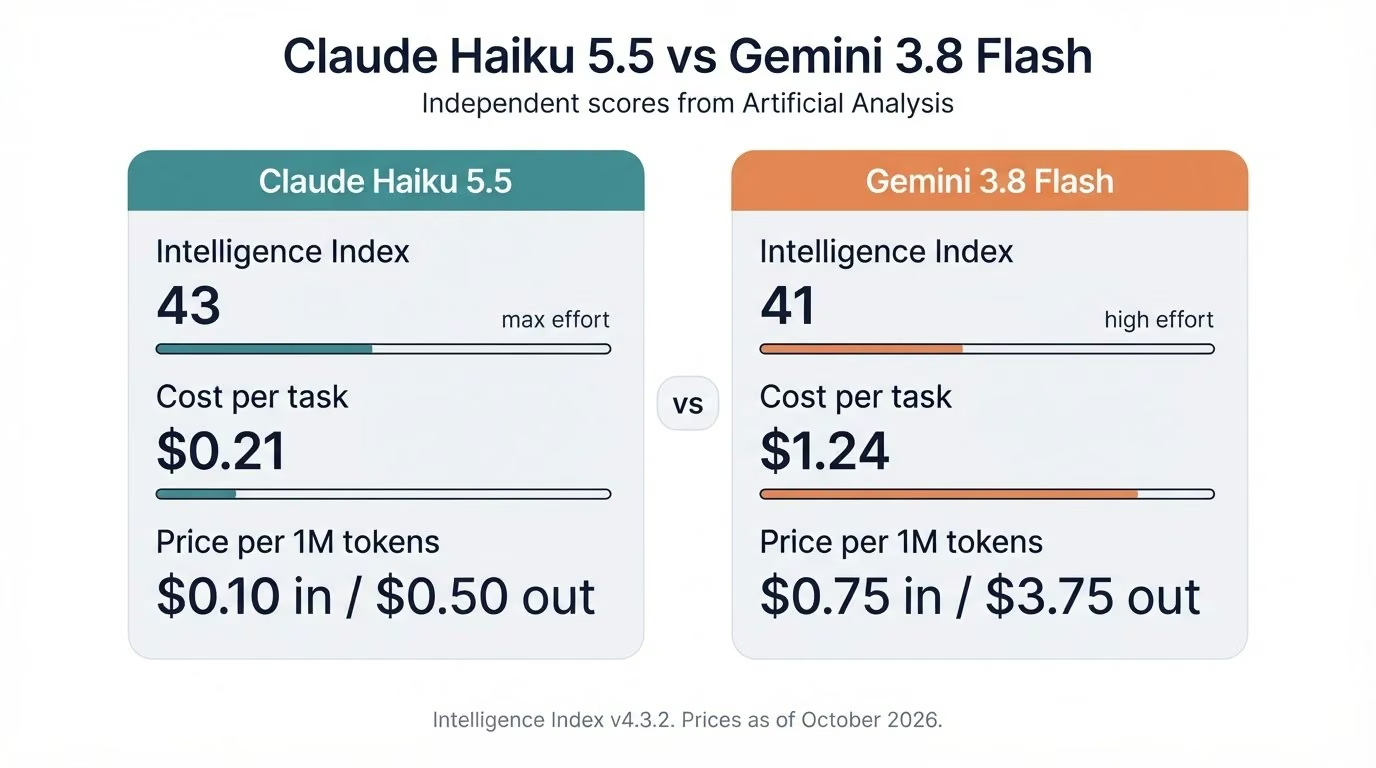
IMAGE 1: Side-by-side card graphic showing Haiku 5.5 vs Gemini 3.8 Flash on Intelligence Index (43 vs 41) and cost per task ($0.21 vs $1.24).
Source credit: Emergent
Haiku 5.5 vs Gemini 3.8 Flash at a Glance
The two models match on context size and differ on price, weights, and thinking controls. This table sums up the specs.
| Spec | Claude Haiku 5.5 | Gemini 3.8 Flash |
|---|---|---|
| Maker | Anthropic | |
| Context window | 1,000,000 tokens | 1,000,000 tokens |
| Input/output price, base tier | $0.10 / $0.50 up to 100K tokens | $0.75 / $3.75 through Dec 31, 2026 |
| Price above that | $0.50 / $2.50 over 100K tokens | $1.50 / $7.50 from Jan 1, 2027 |
| Cache read price | 0.05 over 100K) | 0.15 from 2027) |
| Reasoning controls | Effort from low to max, default medium | Adjustable thinking levels |
| Intelligence Index | 43 (max effort) | 41 (high) |
| Cost per Index task | $0.21 (provisional) | $1.24 |
| Weights | Closed | Closed |
Prices from Anthropic and Google's pricing page. Scores from Artificial Analysis, Intelligence Index v4.3.2.
What Are Haiku 5.5 and Gemini 3.8 Flash?
Both are small, fast, low-cost models built for high-volume work. They differ in how their makers position them.
Anthropic pitches Haiku 5.5 as a helper model. A larger model plans the work, and Haiku runs the many small jobs underneath. Our guide to what Claude Haiku 5.5 is covers the full feature list.
Google's developer guide calls Gemini 3.8 Flash its most intelligent workhorse model yet. It targets software engineering, agentic tasks, and multi-step reasoning, and it handles multimodal input. For background on Google's models, see our guide to what Google Gemini is.
Pricing: A 7.5x Gap and a January Price Rise
Claude Haiku 5.5 costs 7.5 times less than Gemini 3.8 Flash on short prompts, and the gap grows to 15 times in January. Haiku charges $0.10 input and $0.50 output, against Gemini's $0.75 and $3.75.
How the Price Tiers Differ
Haiku has a price cliff, and Gemini has a price rise. Both change your bill.
- Haiku 5.5: Every rate rises five times once a prompt passes 100,000 tokens. Input goes from $0.10 to $0.50, and output goes from $0.50 to $2.50.
- Gemini 3.8 Flash: Google's rate of $0.75 and $3.75 is an introductory price through December 31, 2026. From January 1, 2027, it becomes $1.50 and $7.50.
Price any plan that runs past this year at Gemini's 2027 rates. On long prompts over 100,000 tokens, Haiku's gap narrows to 1.5 times now and 3 times in 2027.
What Real Requests Cost
The table uses list prices with no thinking tokens, caching, or retries.
| Request | Haiku 5.5 | Gemini 3.8 Flash, 2026 | Gemini 3.8 Flash, 2027 |
|---|---|---|---|
| Short support reply (5K in, 1K out) | $0.001 | $0.008 | $0.015 |
| Help-center lookup (90K in, 2K out) | $0.010 | $0.075 | $0.150 |
| Long contract (150K in, 2K out) | $0.080 | $0.120 | $0.240 |
| Large document set (300K in, 2K out) | $0.155 | $0.233 | $0.465 |
At volume, the difference adds up fast:
| Monthly workload | Haiku 5.5 | Gemini 3.8 Flash, 2026 | Gemini 3.8 Flash, 2027 |
|---|---|---|---|
| 20,000 short support replies | $20 | $150 | $300 |
| 2,000 long contract summaries | $160 | $240 | $480 |
Calculated from list prices as of October 2026. Haiku figures match our Claude Haiku 5.5 vs GPT-6 Luna comparison.
Caching favors Haiku too. Its cache reads cost $0.01 per million tokens, against Gemini's $0.075, so reused instructions or documents are cheaper.

IMAGE 2: Bar chart of cost per request across the four request sizes for Haiku 5.5, Gemini 3.8 Flash (2026), and Gemini 3.8 Flash (2027).
Source credit: Emergent
Benchmarks: What Independent Tests Show
Haiku 5.5 leads Gemini 3.8 Flash on overall score and terminal work, and Gemini leads on factual recall and automation. The two are within two points on the overall index.
Each benchmark tests a different skill, so the table adds a plain-language note on what it means for you.
| Benchmark | What it measures | Haiku 5.5 | Gemini 3.8 Flash | What it means for builders |
|---|---|---|---|---|
| Intelligence Index | A blend of many independent tests | 43 | 41 | Rough overall ranking; Haiku leads by two points |
| Terminal-Bench 4.0 | Multi-step command-line tasks | 33% | 20% | Haiku is stronger for coding agents |
| AutomationBench-AA | Multi-step workflows across business software | 35% | 53% to 60% | Gemini is stronger for chained actions in CRMs and spreadsheets |
| AA-Briefcase (Elo) | Realistic knowledge-work projects | 1,578 | 1,203 | Haiku handles longer professional tasks better |
| AA-Omniscience accuracy | Facts answered correctly from memory | 36% | 55% | Gemini needs less help from source documents |
Haiku scores and the AutomationBench range come from Artificial Analysis's Haiku 5.5 analysis. Gemini's cost, token, and AA-Briefcase figures come from its comparison page. Gemini was tested at high effort and Haiku at max.
Two cautions apply. Artificial Analysis says a safety refusal bug likely understated Haiku's AutomationBench score, and it plans to re-run the test. Haiku 5.5 is also two days old, so recheck the table in a few weeks.
Reasoning Effort: How It Changes the Comparison
Haiku 5.5 at xhigh effort matches Gemini 3.8 Flash's score of 41 for about a tenth of the cost per task. Effort controls how long a model thinks before it answers. More thinking usually means better answers and a bigger bill.
Here is how Haiku's effort settings compare with Gemini at high effort.
| Setting | Intelligence Index | Cost per task | Time to first token |
|---|---|---|---|
| Haiku 5.5, medium (default) | 34 | $0.05 | 13.4 seconds |
| Haiku 5.5, high | 38 | $0.08 | 26.7 seconds |
| Haiku 5.5, xhigh | 41 | $0.12 | 78.8 seconds |
| Haiku 5.5, max | 43 | $0.21 | 341.0 seconds |
| Gemini 3.8 Flash, high | 41 | $1.24 | Not measured the same way |
Haiku figures come from our Haiku 5.5 vs GPT-6 Luna analysis of Artificial Analysis data. Times reflect long benchmark tasks, not everyday requests.
The xhigh row shows the trade-off. Haiku matches Gemini's score at $0.12 per task but waits about 79 seconds before it starts answering on these hard tasks. For live chat, use medium or high effort and measure on your own requests.
Also note that Haiku's cost figures are provisional. Artificial Analysis says they leave out the price step-up above 100,000 tokens.
Cost per Task: Why Token Price Is Not the Whole Story
Gemini 3.8 Flash uses fewer tokens than Haiku 5.5, but it still costs about six times more per task. Per-token price drives the bill more than token count here.
Artificial Analysis puts Gemini at about 71,000 output tokens per task, against about 162,000 for Haiku at max effort. Haiku writes roughly 2.3 times more tokens, yet it costs $0.21 per task against Gemini's $1.24. That is possible because Haiku's output rate is 7.5 times lower.
There is one more factor. Gemini's per-task cost will roughly double in 2027 if you keep the same workload, because both rates double.
If you want to cut Haiku's bill, lower the effort setting. Dropping from max to high cuts the cost per task from $0.21 to $0.08, at a cost of five points on the index.
Knowledge and Reliability: Recall vs Made-Up Answers
Gemini 3.8 Flash remembers more facts, but Haiku 5.5 makes up fewer answers. The two results pull in opposite directions, so the right choice depends on how you use the model.
On AA-Omniscience, Artificial Analysis reports:
- Accuracy: Gemini answers 55% of factual questions correctly. Haiku answers 36%.
- Hallucination rate: Gemini gives a confident wrong answer 55% of the time it responds. Haiku's rate is 40%.
Part of Haiku's lower accuracy comes from being more willing to say it does not know. That is a useful trait in a support bot or a legal tool, where a wrong answer costs more than a refusal.
Neither model should answer facts from memory alone. Give it the source material, such as a help article or product sheet, and ask it to answer from that.
Features, Inputs, and Where You Can Use Each
Both models offer a 1 million-token window, and Gemini accepts a wider range of media. Haiku 5.5 takes text and images and returns text. Gemini 3.8 Flash is multimodal, and Google's docs cover image, video, audio, and document inputs for its Gemini models.
Haiku 5.5 is available in the Claude apps, through Anthropic's API, on Amazon Bedrock, on Google Cloud, in Microsoft Foundry, and in GitHub Copilot, as covered in our Haiku 5.5 launch coverage. Gemini 3.8 Flash runs through the Gemini API and Google Cloud, and Google lists a free tier on its pricing page.
Both models have a 1 million-token context window, but the price behavior differs. Haiku's rate rises past 100,000 tokens, while Google lists one rate for Gemini 3.8 Flash.
Which Should You Choose?
Choose by workload first and prompt length second. Haiku 5.5 wins most cost-sensitive jobs, and Gemini 3.8 Flash wins when memory and media matter.
| Your situation | Better pick | Why |
|---|---|---|
| Short, high-volume tasks | Haiku 5.5 | 7.5 times cheaper per token |
| Coding agents and terminal work | Haiku 5.5 | 33% vs 20% on Terminal-Bench 4.0 |
| Support bots where wrong answers are costly | Haiku 5.5 | 40% vs 55% hallucination rate |
| Knowledge-heavy answers without source documents | Gemini 3.8 Flash | 55% vs 36% factual accuracy |
| Chained actions across business software | Gemini 3.8 Flash | 53% to 60% vs 35% on AutomationBench-AA |
| Audio, video, or mixed-media input | Gemini 3.8 Flash | Wider multimodal support |
| Prompts over 100,000 tokens | Neither is cheapest | See our Haiku 5.5 alternatives |
Long prompts are the weak spot for both. Past 100,000 tokens, GPT-6 Luna costs much less than Haiku, and our GPT-6 Luna benchmarks guide shows how it scores. For more options, read our guide to Gemini 3.8 Flash alternatives.
If you need more capability than either, step up to Claude Sonnet 5.5 or Claude Opus 5.5.
If your traffic is mixed, consider routing. Send short, cost-sensitive requests to Haiku and knowledge-heavy ones to Gemini. That only pays off if each type is a large share of your volume.
Final Thoughts
Haiku 5.5 is the better choice in the Claude Haiku 5.5 vs Gemini 3.8 Flash matchup. It scores two points higher, costs about six times less per finished task, and hallucinates less. Gemini 3.8 Flash earns its place when factual recall, multi-step automation, or audio and video input matter more than price, and its cost doubles in January.
The best next step is a small test. Consider running 20 to 50 real requests from your own app through both models, then compare answer quality and cost per finished task. Scores for a model this new tend to move, so recheck them before you commit.
If you are turning those AI features into an app, Emergent is a vibe coding platform where you describe what you want, and AI agents build and deploy it. With an AI app builder, you can add features like ticket tagging or document summaries in plain English. Emergent's Universal LLM Key gives your app access to Claude, GPT, and Gemini models through one credential, with usage drawn from your Emergent credits. Model lineups change as new versions launch, so confirm the current list in your workspace before you build.
Most AI app builders stop at prototypes. Emergent creates production-ready apps you can actually launch.
- Production-ready apps
- Web & mobile apps
- Deploy in minutes