TL;DR
- Coding: Early users are proficient in code analysis, debugging and problem-solving.
- Response time: Response time varies by user, especially compared with lighter models.
- Limits of use: Some users find they use up their allotment quickly.
- Complex projects: It was helpful for complex projects such as creating games and editing video.
- Verdict: For complex tasks, using Argon is worth investigating; its speed, limits of use, and accuracy must be taken into account.
Gemini 4 Argon is Google’s new flagship reasoning model for complex coding, research, and professional workflows
While Gemini 4 Argon seems well-suited for coding, research, and other complex AI-related tasks, early adopters warn of a trade-off between quality, speed, and usage. Here, we cover users' experiences, independent testing, benchmarks, pricing and limitations to help you decide whether it is worth using.
On October 13, 2026, Google unveiled Gemini 4 Argon. The model is designed for developers, businesses, researchers and professionals who require more than a quick answer from an AI assistant. It is built to tackle difficult problems that require sustained reasoning and attention to detail.
The review includes not only Google's claims and benchmark scores, but also what people have experienced while using the model.
What Is Gemini 4 Argon?
Gemini 4 Argon is a reasoning AI better suited to complex technical and professional problems. Whereas models optimized for quick responses may not have as much time to reason through difficult tasks and maintain context across multiple steps, Argon can take more time.
Google says the model is designed for software engineering, finance and law, cybersecurity, and scientific research. Its primary use is to help users with analysis, planning, and execution tasks that go beyond creating plain text.
Google also claims advancements in its engineering process. These claims indicate the model's intended use, and results in Google's environment may not necessarily translate directly to all organizations.
Gemini 4 Argon Features: What Makes It Different?
Key Gemini 4 Argon features include an extended context window, adjustable reasoning, multimodal inputs, and the ability to use tools to support more complex workflows.
Here is an overview of the major features.
| Feature | Specification | What it means |
|---|---|---|
| Context window | 1M tokens | It can process large amounts of information in one interaction, subject to the shared input-output limit. |
| Input formats | Text, images, audio, video, and PDFs | You can provide different types of source material for analysis. |
| Output format | Text | The API returns text rather than generating images or audio directly. |
| Thinking levels | Low, medium, and high | You can adjust how much reasoning the model applies to a task. |
| Maximum output | Up to 1M tokens with long decode | It can generate extended responses through the supported long-output workflow. |
| Tool support | Code execution, function calling, search grounding, and more | It can use supported tools to complete tasks and retrieve relevant information. |
| Computer use | Available in preview | Supported workflows can let the model interact with a computer environment. |
To sum up, Gemini 4 Argon is simple enough that it can be described as a combination of long-context processing, deeper reasoning and tool support. These skills are appropriate for projects with multiple sequential steps.
1. A 1-Million-Token Context Window
Unlike some other tools, Gemini 4 Argon has a 1M token context window that can process very large documents or codebases in a single context. It reduces the need for manual chunking. But practical limits, tool use, and cost still apply.
The context window also has limitations. The token allowance for input, internal reasoning, and output is unified. A 1M token context window does not mean the model can accept 1M input tokens and then produce 1M output tokens in the same session.
2. Adjustable Reasoning Levels
Argon supports low, medium, and high reasoning levels. This mode lets a developer specify the depth of reasoning for the task.
For less complex requests, low reasoning may be appropriate. Medium is the default option, and high is helpful for challenging coding, analytical or scientific issues.
More complex reasoning can lead to longer delays before responding and greater token usage. It also does not guarantee a correct answer. Different settings should be tested for accuracy, latency and cost requirements by the developers.
3. Multimodal Input Support
Argon can accept text, images, audio, video and PDF files via its API. This flexibility enables users to research information in various formats.
To investigate a business question, for instance, a team could provide a PDF report, a chart image and some accompanying text. Video data can be submitted to a researcher for supported workflows.
Notice the difference here - Argon's API output is text. This model does not support native image generation or audio generation. Some of the more creative features in the wider Gemini 4 Argon rely on other tools or models.
4. Tool Use and Multi-Step Workflows
Gemini 4 Argon features code execution, function calling, file search and search grounding. These tools help it execute tasks that require a more complex text response.
A developer might create a workflow that takes in data, calls a calculation tool, and returns a summary of the results. It can also be linked to approved external functions in an application.
None of these features make every workflow completely self-contained. Tool access permissions still need to be set, outputs need to be checked, and errors need to be managed by developers.
Gemini 4 Argon Review: What Are Early Users Saying?
Early reviews of Gemini 4 Argon are mixed. Users favor the logical and programming support it provides, though some worry about speed, usage limits, and a lack of uniformity across tasks.
The following reviews are from individual Reddit threads and an independent hands-on review that was published in October 2026. These are impressions and not a representative sample of users.
1. Coding and Security Analysis: A Positive First Impression
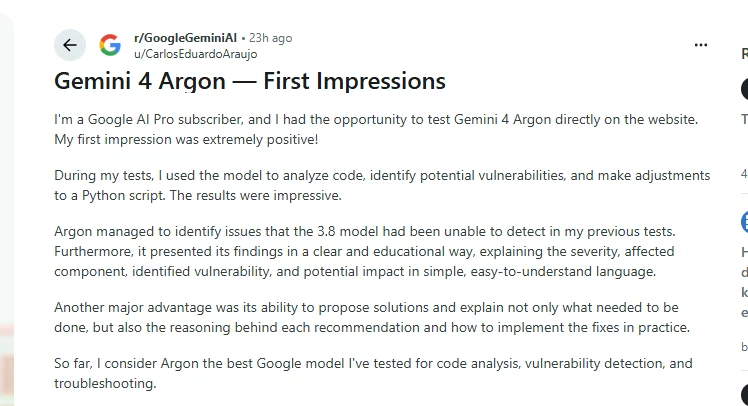
A Google AI Pro subscriber noted that Argon spotted potential security flaws in a Python script. It was missed in the earlier version of Gemini. The user was also impressed with the explanation of each issue, how it could affect the system, and what could be done about it.
The reviewer said, “Argon is helpful for code analysis, troubleshooting, and security applications.”
The same user also pointed out a significant downside. The available usage quota was exhausted during a challenging task. Other participants also complained about restrictive limits and unresponsiveness.
What this review reveals: Argon can be useful for developers seeking in-depth code analysis; however, it can be problematic during extended sessions.
2. Research and practical questions: Positive, but with a drawback
One user of the Student AI Pro subscription said Argon offered more relevant references and more practical responses than a rival AI. Still, he used up his monthly hour limit in just four short conversations.
Message for readers: The model's effectiveness may require a trade-off between answer quality and how often subscribers use it.

3. A user on X: Max Weinbach said on coding and reliability
According to Max Weinbach, a technology journalist, some of Gemini's earlier problems were solved by Argon, and it performed well in low-level programming and math. Max Weinbach said he used Argon to run Alan Wake 2 from Windows x86 to Arm64 macOS, where the game ran at more than 140 FPS.

Gemini 4 Argon Performance: What Do Practical Tests Show?
Initial testing indicates that Argon can perform complex analysis and document-based work. But further testing is required to verify its results.
Analytics Vidhya hands-on tested the model, including building a website, numerical analysis, and conflicting launch documents.
The results provide a more helpful picture than benchmark scores do.
| Test | Reported result | What it tells us |
|---|---|---|
| Data analysis | Correctly calculated conversion rates and challenged an unsupported conclusion. | It can identify misleading interpretations when the relevant data is available. |
| Document reconciliation | Correctly classified eight claims in a supplied document packet. | It can distinguish supported claims from contradictions and unresolved questions. |
| Launch summary | Included one unsupported statement. | Even a mostly correct analysis can introduce an error during summarization. |
| Website creation | Produced a working local booking-page prototype through Gemini Canvas. | The broader Gemini workflow can turn a specification into an interactive prototype. |
These tests have both strengths and weaknesses. Gemini 4 Argon performed well in the numerical analysis and document classification, but the summary still contained an unsupported claim.
Some context is needed for the website result. The video-generation demo used Gemini's dedicated video workflow, and the reviewer used the same workflow in the canvas. Don't see these results as proof that Argon can create websites or videos by itself.
The bottom line: Evaluate the full workflow, not only the model’s final written response.
Gemini 4 Argon Benchmarks: How Does It Compare?
Google's benchmarks show that Argon performs well on professional and technical tasks, but it isn't the best model in every situation.
Google says Argon ranks first on the Vals Index, which tests AI performance in professional areas such as coding, legal work, finance, and tax.
Google also claims to have seen improved engineering productivity within the company.
Teams that used Gemini 4 Argon recorded more than a 35% increase in agentic code submissions, and code rollbacks fell by about one-third.
This is encouraging, but it's based on Google's evaluations and internal processes. Don't be misled into thinking they guarantee productivity improvements for any team.
Independent benchmark coverage also highlights performance differences across test types. According to Analytics Vidhya, Argon performs exceptionally well on certain coding and long-context evaluations, whereas competing models excel on other tests.
This variation is important because the benchmarks assess different skills.
- Coding benchmarks measure either code accuracy or the ability to complete software tasks.
- Long-context benchmarks assess a model's ability to process information over long sequences.
- Professional-work benchmarks are aligned with specific tasks in professional domains such as finance or legal work.
- Agent benchmarking evaluates a model's effectiveness in multi-step workflows.
For the Gemini 4 Argon benchmarks, compare the same model types using the same tools, settings, and evaluation conditions. Don't combine different scores into an overall score.
Gemini 4 Argon Pricing: How Much Does It Cost?
The Gemini 4 Argon pricing offers introductory pricing until November 30, 2026. Rates change on December 1, 2026, so calculate costs based on the rates developers will be charged for their anticipated use.
| API usage | Through Nov. 30, 2026 | From Dec. 1, 2026 |
|---|---|---|
| Input tokens | $2 per million | $4 per million |
| Output tokens, including thinking | $10 per million | $20 per million |
| Cached input tokens, when eligible | $0.10 per million | $0.20 per million |
The introductory period offers lower rates, with output tokens costing more than input tokens. Output prices also include the model's internal reasoning tokens.
Let's start with an example API use case that sends 100k input tokens and receives 20k output tokens.
The estimated cost:
- Input: 100,000 × $2 / 1,000,000 = $0.20
- Output: 20,000 × $10 / 1,000,000 = $0.20
Total: $0.40 per request
This example does not cover discounts for caching or other charges that may apply, or any other services. There is no fixed cost, as it varies based on the number of tokens consumed and the tools used.
How Can You Access Gemini 4 Argon?
Google provides access through developer and consumer products. But your access depends on the route you choose.
| Access method | Best suited for |
|---|---|
| Gemini app | Users who want to interact with Argon through a consumer-facing interface. |
| Google AI Studio and Gemini API | Developers who want to experiment with the model or integrate it into applications. |
| Google Antigravity | Eligible users who want to use Argon in an AI-assisted development environment. |
| Google Cloud and enterprise offerings | Organizations exploring the model for business workflows. |
The Google release announcement includes Gemini app access for users subscribing to Google AI Pro and Ultra, while paid developer access enables API access. Antigravity access has separate eligibility criteria.
Please refer to the official model documentation to learn more about the access eligibility criteria.
What Are the Main Limitations of Gemini 4 Argon?
The main drawbacks of Gemini 4 Argon are the risk of factual errors, token-based costs, performance differences across tasks, and the technical effort required to deploy Argon reliably.
Keep these points in mind before using it for critical workflows:
- It can still produce unsupported claims: In an otherwise helpful launch summary, a hands-on document review uncovered an unsupported statement. Verify key information against the original documents.
- Complex tasks can take longer: More complex inferential tasks and longer responses can increase response time. These tasks can take several minutes, affecting the user experience and automation design.
- API costs can rise quickly: Long documents, reasoning traces, and long outputs consume tokens. Calculate the cost of completing a task rather than looking only at the price per million tokens.
- Tool integration requires planning: Function calling and computer-use capabilities must be configured, granted, and managed appropriately to handle potential errors. A model that can reason through a task does not necessarily have access to all the systems it needs.
- Benchmark results do not guarantee business outcomes: Accuracy on private data and reliability in production do not follow from a high score on a controlled test.
Use appropriate human oversight and organizational measures for sensitive transactions, such as those in finance, legal, healthcare, or cybersecurity.
Who Should Use Gemini 4 Argon?
As a result, Gemini 4 Argon is ideal for individuals who rely on extended, logical thinking, a big-picture perspective, or intricate technical tasks.
- Developers: Explore codebases, troubleshoot, and create workflows with tools.
- Data Analysts: Interpret data, verify calculations and question unsupported statements.
- Researchers: Make comparisons and summarize information from text sources.
- Business teams: Reports, conflict resolution, multi-step knowledge work.
- Reasoning and supported tool call integration for AI application builders.
For common scenarios like rewriting short emails, making simple captions, or answering simple questions, it might be unnecessary. A less expensive model might suffice for those requests.
It will depend on the complexity of your work and the value of the added reasoning.
Conclusion
For complex coding, research, document analysis, and multi-step AI workflows, Gemini 4 Argon performs strongly. Its capabilities, such as its 1M token context window, customizable reasoning, and tool support, are worth exploring for developers and professionals.
However, its advantages do not make verification redundant. Initial practical experiments show it can handle numerical tasks and document analysis effectively, but it also introduces unsupported claims. It is also worth noting its token-based pricing, especially after introductory pricing ends.
Our recommendation: Use Argon for tasks that require higher-level thinking, sustained reasoning, broad context, and multi-step analysis. Pilot it on sample tasks, evaluate accuracy and overall cost, and compare outcomes with other options before deploying it at the enterprise level.
If you want to build an AI-powered application while implementing your idea, you can start with Emergent. Prioritize a well-defined problem, test with real users, and expand only when the app delivers measurable value.
Most AI app builders stop at prototypes. Emergent creates production-ready apps you can actually launch.
- Production-ready apps
- Web & mobile apps
- Deploy in minutes
Most AI app builders stop at prototypes. Emergent creates production-ready apps you can actually launch.
- Production-ready apps
- Web & mobile apps
- Deploy in minutes