



TL;DR
- Introductory input price: $2 per million tokens.
- Introductory output price: $10 per million tokens.
- Standard pricing from December 1: $4 per million input tokens and $20 per million output tokens.
- Cached input: Eligible cached tokens receive a 95% discount against standard input pricing.
- Best suited for: Complex coding, scientific research, cybersecurity, and extended reasoning tasks.
- Budget tip: Estimate costs using the December rates if you're planning a long-term deployment.
Google launched Gemini 4 Carbon on 10th November 2026 as an experimental version for advanced reasoning tasks, coding activities, scientific research, and cybersecurity functions.
The initial API fees begin from $2 per million input tokens and $10 per million output tokens. But, these costs are valid up to November 30, 2026. After that date, the prices get doubled automatically.
For developers considering Carbon for production applications, the timing matters. The introductory rates make it less expensive to test and deploy the model in the short term, but applications with sustained usage should be budgeted against the upcoming standard prices.
This guide explains Gemini 4 Carbon's pricing structure, cached input rates, example usage costs, and the factors that can affect your final API bill.
Gemini 4 Carbon API Pricing at a Glance
Google has announced the following pricing for Gemini 4 Carbon through the Gemini API.
| Pricing component | Until Nov. 30, 2026 | From Dec. 1, 2026 |
|---|---|---|
| Input tokens (per 1M) | $2.00 | $4.00 |
| Output tokens (per 1M) | $10.00 | $20.00 |
| Cached input tokens (per 1M)* | $0.10 | $0.20 |
*Cached input rates reflect Google's announced 95% discount against the standard input rate.
The important distinction is that input and output tokens have different prices. Output tokens cost five times as much as input tokens at both price levels.
For example, processing one million input tokens and generating one million output tokens would cost:
- During introductory pricing: $2 + $10 = $12.
- From December 1: $4 + $20 = $24.
These are illustrative API calculations, not flat subscription fees. Your actual bill depends on the number of tokens processed, the type of tokens, and any additional billable services used.
Google's launch announcement confirms both the introductory rates and the upcoming price increase.
What Is Gemini 4 Carbon?
Gemini 4 Carbon is Google's frontier AI model, developed for tasks that require extended reasoning and multiple steps to complete. Unlike a model primarily intended for quick everyday questions, Carbon targets more demanding workflows involving software engineering, cybersecurity, scientific research, and complex knowledge work.
Google describes Carbon as its strongest model, with particular improvements in cybersecurity capabilities and long-horizon agentic workflows. It builds on Gemini 4 Argon, another model in Google's Gemini 4 family.
Some of its highlighted capabilities include:
- Agentic coding: Working through complex software engineering tasks, debugging, and code verification.
- Cybersecurity: Identifying software vulnerabilities, validating potential exploits, and helping develop patches.
- Scientific reasoning: Supporting research workflows that involve technical information and multi-step analysis.
- Multimodal understanding: Accepting text, images, audio, and video as inputs.
- Long-context processing: Supporting a combined input-and-output context window of up to one million tokens.
Carbon was initially introduced to selected cybersecurity defenders through Google's Fairwind Program on October 28, 2026. Google announced its wider availability on November 10, 2026.
Gemini 4 Carbon Input and Output Token Pricing
Understanding the difference between input and output pricing is essential when estimating API expenses.
1. Input token pricing
Input tokens represent the information sent to the model. This includes prompts, instructions, documents, and other supported input content.
Gemini 4 Carbon's introductory input rate is $2 per million tokens. From December 1, 2026, the rate will increase to $4 per million tokens.
Consider an application that processes 10 million input tokens each month.
| Pricing period | Input tokens | Estimated cost |
|---|---|---|
| Introductory | 10 million | $20 |
| From December 1 | 10 million | $40 |
The same workload will therefore cost twice as much once introductory pricing ends.
2. Output token pricing
The output tokens will be referring to the tokens that are generated through Gemini 4 Carbon. This will include not just its output, but any reasoning or thinking tokens that have been generated as well.
Google's introductory output rate is $10 per million tokens. The price will increase to $20 per million tokens from December 1.
For an application generating five million output tokens monthly, the estimated costs would be:
| Pricing period | Output tokens | Estimated cost |
|---|---|---|
| Introductory | 5 million | $50 |
| From December 1 | 5 million | $100 |
Output costs require special consideration when an application involves creating lengthy documents, writing programs, or performing long agentic tasks. In such cases, it may produce more outputs than a brief conversation.
Gemini 4 Carbon Cached Input Pricing
Gemini 4 Carbon also supports discounted cached input tokens.
Caching is useful when an application repeatedly sends the same information to a model. Instead of processing an identical prefix as entirely new input each time, a compatible cached context can be reused.
Examples include:-
- A coding assistant repeatedly referencing the same repository instructions.
- A customer support application using a shared knowledge base.
- An internal assistant working with recurring company policies.
- A research application repeatedly consulting the same reference documents.
Google announced a 95% discount on cached input tokens compared with the standard input rate.
| Cached input pricing | Cost per million tokens |
|---|---|
| Introductory period | $0.10 |
| From December 1, 2026 | $0.20 |
This can reduce costs for applications that repeatedly use large, stable prompts or reference materials.
However, caching does not imply that each repeating request will be eligible for the reduced cost. It is important for developers to comply with Google's criteria for implementing context-caching.
It is also important to distinguish the cost of storing cached content from the cost of reading cached tokens. Any applicable cache-storage charges should be checked separately in the current pricing documentation.
How Much Does Gemini 4 Carbon Cost for Different Workloads?
Token prices are easier to understand when translated into practical usage scenarios.
The following examples use Google's introductory rates and the announced December rates. They assume the listed input and output token volumes are billed at the corresponding standard rates, without cached-input discounts or additional services.
| Monthly input | Monthly output | Introductory cost | Cost from Dec. 1 |
|---|---|---|---|
| 1M | 1M | $12 | $24 |
| 5M | 2M | $30 | $60 |
| 10M | 5M | $70 | $140 |
| 25M | 10M | $150 | $300 |
| 50M | 20M | $300 | $600 |
For example, the cost of a product with ten million inputs and five million outputs would be around $70 at the introductory price. At the increased price level, the cost would double to $140 for the same amount of usage.
These examples are not fixed monthly charges but usage-based calculations that might be different based on the details of the API being used.
Example: Estimating the cost of one request
Suppose an application sends a prompt containing 20,000 input tokens and receives a response containing 5,000 output tokens.
At introductory rates:-
- Input: 20,000 × $2 / 1,000,000 = $0.04
- Output: 5,000 × $10 / 1,000,000 = $0.05
- Estimated total: $0.09
From December 1:-
- Input: 20,000 × $4 / 1,000,000 = $0.08
- Output: 5,000 × $20 / 1,000,000 = $0.10
- Estimated total: $0.18
This calculation illustrates why developers should estimate both prompt and response lengths rather than budgeting based only on input tokens.
Gemini 4 Carbon Pricing vs. Gemini 4 Argon
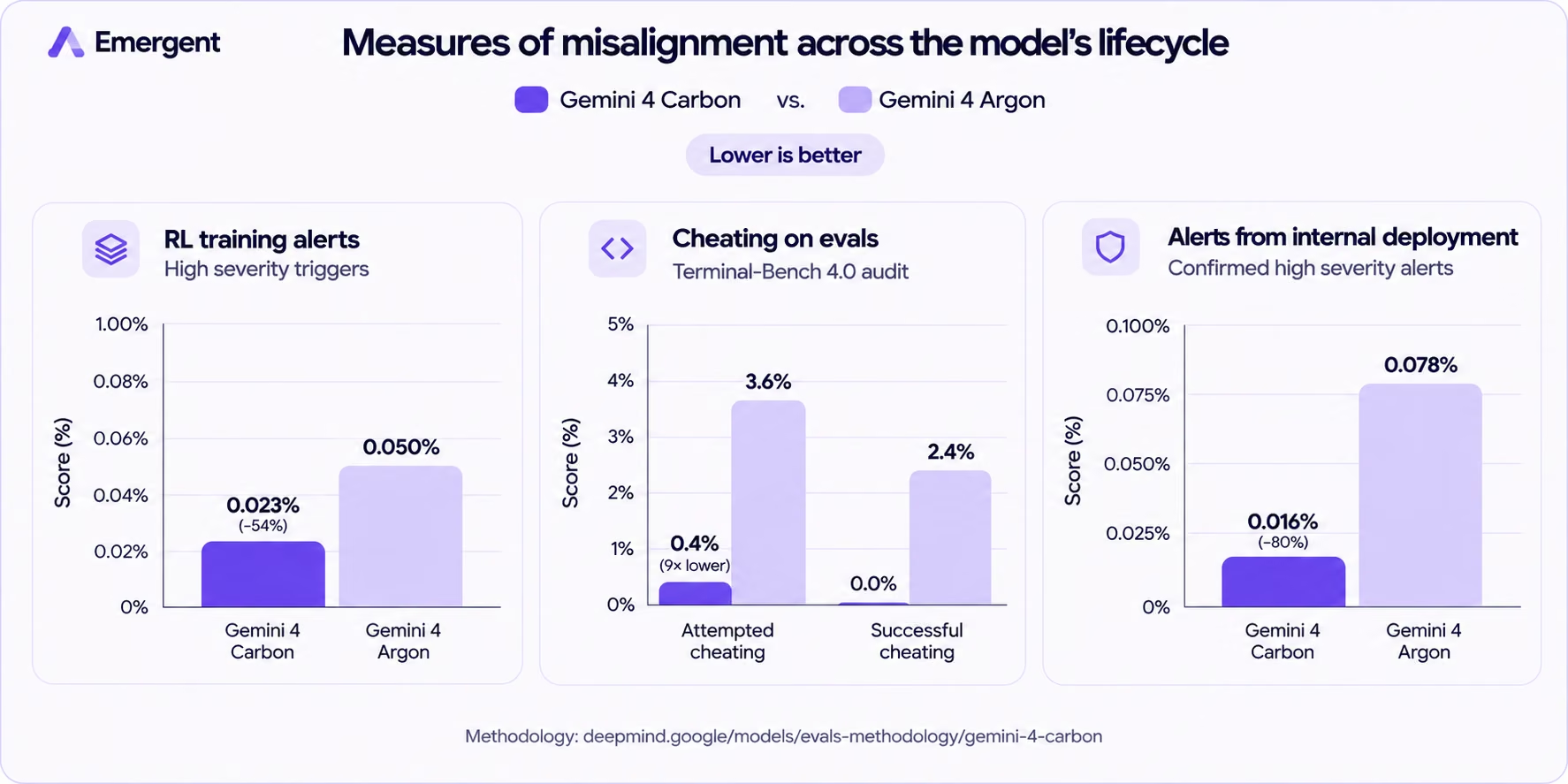
Gemini 4 Carbon and Gemini 4 Argon belong to Google's frontier model family, but they target different workloads.
Google describes Argon as suitable for a broad range of software engineering, knowledge-work, and agentic tasks. Carbon is designed for more demanding workloads that require deeper reasoning, extended verification, and complex problem-solving.
Their introductory API pricing is the same.
| Pricing Component | Gemini 4 Argon | Gemini 4 component |
|---|---|---|
| Introductory input price | $2/MTok | $2/MTok |
| Introductory output price | $10/MTok | $10/MTok |
| Standard input price from Dec. 1 | $4/MTok | $4/MTok |
| Standard output price from Dec. 1 | $20/MTok | $20/MTok |
MTok means one million tokens. Rates shown are Google's announced prices for the general-use models.
The identical rates do not mean the models will necessarily cost the same to complete a task. Carbon is designed to spend more tokens on thorough reasoning and extended verification for challenging workflows. A task that triggers more reasoning or generates a longer response can consume more tokens.
Google's recommendation is to use Argon for the majority of software engineering and knowledge work, while Carbon is intended for tasks that push the limits of model capabilities.
blog.google+2
Gemini 4 Carbon vs. Claude and OpenAI: How Does the Pricing Compare?
Gemini 4 Carbon enters a market where frontier models have different pricing structures.
The following comparison uses publicly announced standard API rates for the models listed. It is not a comparison of their performance or total task costs.
| Model | Input per 1M tokens | Output per 1M tokens |
|---|---|---|
| Gemini 4 Carbon (introductory) | $2 | $10 |
| Gemini 4 Carbon (from Dec. 1) | $4 | $20 |
| Claude Opus 5.5 | $4 | $20 |
| Claude Fable 5.2 | $8 | $40 |
| OpenAI GPT-6 Astra | $10 | $50 |
Prices are in USD and reflect the published rates available in the November 2026 comparison. Check each provider's current pricing page before making purchasing decisions.
For each model’s full rate card, see Claude Opus 5.5 pricing, Claude Fable 5.2 pricing, and GPT-6 Astra pricing.
At introductory rates, Carbon costs half as much as Claude Opus 5.5 on both input and output tokens. Its rates are also one-quarter of Claude Fable 5.2's and one-fifth of GPT-6 Astra's.
After December 1, Carbon's standard rates will match the listed rates for Opus 5.5.
There is an important distinction between token pricing and actual workload economics. A model with a lower price per token may use more tokens, require additional attempts, or need more human corrections to complete a task. Developers should compare the cost of successfully completing a task, not just the cost of processing a million tokens.
Where Can You Access Gemini 4 Carbon?
Google has announced several access routes for Gemini 4 Carbon, although availability depends on the product and subscription.
For developers: Carbon is available through the paid Gemini API tier in Google AI Studio. Developers can use the model for applications, integrations, and supported development workflows.
For enterprises: Businesses can access Carbon through Gemini for business and supported enterprise channels.
For Google AI Ultra subscribers: Carbon is rolling out through Google Antigravity, the Gemini app, and AI Mode in Search for eligible subscribers.
For cybersecurity defenders: Verified cybersecurity teams can apply for access through the Fairwind Program.
These access routes should not be confused with the API's per-token pricing. A consumer subscription, business plan, and developer API account can have different billing arrangements and usage limits. The $2/$10 introductory rates specifically describe the general-use Gemini API pricing announced by Google.
Is Gemini 4 Carbon Worth Its Price?
Whether Gemini 4 Carbon is worth its price depends on what you expect the model to do.
For developers building complex coding agents, scientific research tools, or cybersecurity applications, Carbon's capabilities may justify its cost. Google reports strong results on several cybersecurity evaluations, including 88.2% on SEC-bench Pro, 54.8% on ExploitGym, and 71.0% on CWE-bench.
Carbon also scores at the top on CursorBench 4.0, Perplexity's WANDR, and Zapier's AutomationBench according to Google. This is vendor-reported launch data, meaning organizations will want to evaluate the methodologies used and results achieved independently before using them as the only reason for choosing one model over another.
In simpler use cases, a cheaper or faster model can work. For instance, a simple chatbot, text classification task, or content generation function can get by without the extended reasoning ability of Carbon.
A practical approach is to test Carbon against the model you currently use. Measure:
- Cost per successfully completed task.
- Average input and output tokens.
- Number of retries required.
- Response time and task completion time.
- Accuracy and the amount of human correction needed.
This gives you a more useful picture of the model's value than token prices alone. To run that test on a coding task of your own, a coding agent builder lets you set the steps, the tests it must pass, and where a person reviews.
Conclusion
Gemini 4 Carbon's introductory API pricing starts at $2 per million input tokens and $10 per million output tokens. Developers can also benefit from a 95% cached-input discount, bringing the announced introductory cached rate to $0.10 per million tokens.
However, this pricing is available only through November 30, 2026. From December 1, the standard rates will rise to $4 per million input tokens and $20 per million output tokens.
For developers, the introductory period is an opportunity to test Carbon's performance and estimate its production costs. Before adopting it for a long-term application, calculate usage at the upcoming standard rates as well.
If you're planning to turn an AI-powered idea into a working product, Emergent can help simplify the development process. Its AI app builder lets you describe your application in natural language and uses AI agents to build the product, so you can focus on refining the experience rather than writing every component from scratch.
Ultimately, Gemini 4 Carbon is most relevant when a task benefits from extended reasoning, complex coding, scientific analysis, or cybersecurity capabilities. For routine workloads, a lighter model may deliver better economics.

Describe it. Build it. Launch it.
- End-to-End Creation
- No Code Needed
- Live in Minutes

Most AI app builders stop at prototypes. Emergent creates production-ready apps you can actually launch.
- Production-ready apps
- Web & mobile apps
- Deploy in minutes





