
TL;DR
- Choose GPT-6.1 Terra for the lower cost per token. Choose Sonnet 5.5 for the higher reported coding score.
- Terra costs $1 per million input tokens and $5 per million output tokens. Sonnet 5.5 costs $2 and $10.
- Sonnet 5.5 reports 70.6% on Terminal-Bench 4.0. Terra reports 50.3%. Each vendor ran its own test.
- Both models offer about 1M tokens of context, 128K output tokens, and text-and-image input.
- Cost per task depends on tokens used, so test both on your own work.
GPT-6.1 Terra vs Sonnet 5.5 comes down to one trade-off. Terra costs half as much per token. Sonnet 5.5 reports the higher coding score. Pick the one you run most, then test both.
OpenAI released Terra on October 26, 2026, while Anthropic released Sonnet 5.5 on September 28, 2026. Both are mid-level models suited for building AI apps and handling everyday office tasks.
This guide compares the two on specs, pricing, speed, coding, computer use, and safeguards. Every number comes from OpenAI or Anthropic. The vendors were tested under different setups, so treat each score as a starting point for your own test.
GPT-6.1 Terra vs Sonnet 5.5 at a Glance
Both models offer roughly 1M tokens of context and text-and-image input. But they were released at different times, serve different purposes, and are built for different kinds of work.
| Spec | GPT-6.1 Terra | Claude Sonnet 5.5 |
|---|---|---|
| Maker | OpenAI | Anthropic |
| Release date | October 26, 2026 | September 28, 2026 |
| Tier position | Mid-tier, below GPT-6.1 Sol and GPT-6 Astra | Mid-tier, below Claude Opus 5.5 |
| API model ID | gpt-6.1-terra | claude-sonnet-5-5 |
| Context window | 1,050,000 tokens | 1M tokens |
| Max output | 128,000 tokens | 128K tokens |
| Input types | Text and images | Text and images |
| Output type | Text | Text |
| Knowledge cutoff | June 1, 2026 | June 2026 |
| Effort settings | none, low, medium (default), high, xhigh, max | Low, Medium, High, Xhigh, Max |
Sources: OpenAI's GPT-6.1 Terra model page and Anthropic's Claude Sonnet 5.5 model overview.
What Is GPT-6.1 Terra?
GPT-6.1 Terra is OpenAI's mid-tier model in the GPT-6.1 line. OpenAI calls it fast and efficient, with detailed visual reasoning, precise computer use, and clearer writing. GPT-6.1 Terra is OpenAI’s newer, lower-cost successor to GPT-5.6 Terra.
What OpenAI Built Terra to Do
OpenAI aims Terra at the computer-based tasks that fill a workday. Its launch post lists these examples:
- Drafting proposals
- Interpreting technical drawings
- Filling out forms
- Editing videos
- Reading incoming invoices and entering the details into accounting software
The last example shows the target. It is high-volume work where a low per-token price matters.
How to Access Terra
- ChatGPT Work and Codex, for Plus, Pro, Enterprise, and Edu users
- The OpenAI API, as gpt-6.1-terra
OpenAI says the same plan allowance covers more tasks with Terra than with GPT-5.6 Terra, GPT-6.1 Sol, or GPT-6 Astra. Details are in OpenAI's launch post.
What Is Claude Sonnet 5.5?
Claude Sonnet 5.5 is one of the models in Anthropic's Claude 5.5 family. Anthropic calls it a faster, lower-cost complement to Claude Opus 5.5. It replaces Claude Sonnet 5, which is now a legacy model.
What Anthropic Built Sonnet 5.5 to Do
Anthropic says Sonnet 5.5 is strongest at well-scoped everyday tasks. Its examples include:
- Fixing bugs
- Creating polished documents, slides, and spreadsheets
- Following slide templates to build decks
- Adding polish to user interfaces
Anthropic also says Sonnet 5.5 writes more clearly than the previous generation of Claude models.
How to Access Sonnet 5.5
- Claude.ai on web, iOS, and Android
- The Claude Platform, as claude-sonnet-5-5
- Amazon Web Services, Google Cloud, and Microsoft
- Zero data retention, for teams that need it
Default effort differs by surface. Claude Code and the Claude apps default to Medium. The Claude Platform defaults to High. See Anthropic's Sonnet 5.5 announcement for the full list.
GPT-6.1 Terra vs Sonnet 5.5 Pricing
Terra costs half as much as Sonnet 5.5 per token at standard rates. The gap holds for input, output, and cached input.
Standard API Prices
All prices are in US dollars per 1 million tokens.
| Price type | GPT-6.1 Terra | Claude Sonnet 5.5 |
|---|---|---|
| Input | $1.00 | $2.00 |
| Cached input (read) | $0.05 | $0.10 |
| Output | $5.00 | $10.00 |
| Cache write | $1.25 (30 minutes), $2.50 (12 hours) | $2.50 |
Terra's rates come from OpenAI's API pricing page. Sonnet 5.5's rates come from Anthropic's announcement.
Sonnet 5.5 costs the same per token as Sonnet 5. Anthropic cut cost per task through lower token use, not through a lower price. Sonnet 5.5’s standard rates are $2 per million input tokens and $10 per million output tokens.
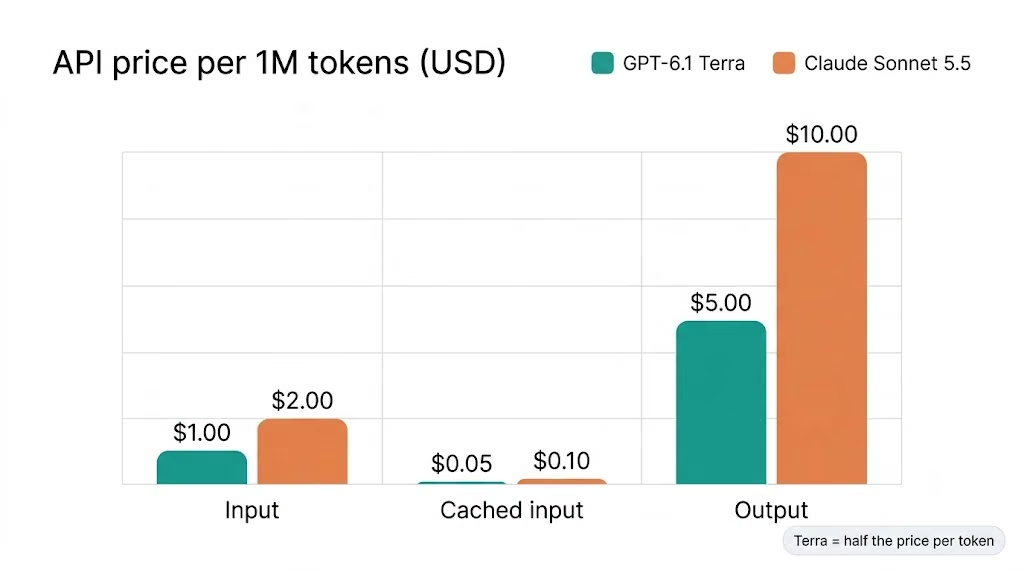
Terra's standard API rates are half of Sonnet 5.5's.
Also read: GPT-6.1 Terra pricing, a breakdown of caching, Batch, Flex, and Fast mode rates.
Other Terra Pricing Modes
OpenAI lists extra modes for Terra on its pricing page:
- Flex and Batch: $0.50 per million input tokens and $2.50 per million output tokens.
- Fast mode: Input costs $2.00 and output costs $10.00, the same as Sonnet 5.5's standard prices.
- Regional processing: For eligible models released after March 5, 2026, OpenAI charges 10% extra when using data residency endpoints.
- Long prompts: OpenAI charges different rates for long prompts. Check the Long tab if your prompt is close to the model's context limit.
Cost per Task: A Worked Example
Price per token does not equal price per task. This example uses a task with 50,000 input tokens and 5,000 output tokens. These sizes are illustrative, not measured.
| Model | Input cost | Output cost | Cost per task | Cost for 10,000 tasks |
|---|---|---|---|---|
| GPT-6.1 Terra | $0.05 | $0.025 | $0.075 | $750 |
| Claude Sonnet 5.5 | $0.10 | $0.05 | $0.15 | $1,500 |
Both rates double from Terra to Sonnet 5.5. The gap stays 2x at any mix of input and output. Sonnet 5.5 must finish the same task with half the tokens to match Terra's bill.
Anthropic's 30% saving compares Sonnet 5.5 with Sonnet 5, not with Terra. That saving alone does not close a 2x gap.
Speed and Token Efficiency
Neither vendor tests Terra against Sonnet 5.5 head-to-head. Each compares its model with earlier models from its own lineup.
What OpenAI Reports for Terra
- Terra completes tasks over three times faster than GPT-6 Astra and GPT-6.1 Sol.
- At medium effort, Terra scores 15 percentage points higher than GPT-5.6 Terra on Agents' Last Exam, at about one-third the cost.
- Terra matches GPT-6 Astra on that exam at one-tenth the price per token.
What Anthropic Reports for Sonnet 5.5
- Sonnet 5.5 generates output 30%+ faster than Sonnet 5. Anthropic calls it the fastest Sonnet to date.
- It costs up to 30% less per task than Sonnet 5.
- At Medium effort on Terminal-Bench 4.0, it beats Sonnet 5's best score for under a tenth of the cost per task.
- In direct tests, it grouped more tool calls together than Sonnet 5, reducing the number of steps and the cost.
How to Read These Claims
OpenAI compares Terra with GPT-5.6 Terra, GPT-6.1 Sol, and GPT-6 Astra. Anthropic compares Sonnet 5.5 with Sonnet 5 and Opus 5.5. Because they use different models for comparison, the results show how each model performs against its own benchmarks, not which model is better.
Coding: GPT-6.1 Terra vs Sonnet 5.5
Sonnet 5.5 reports the higher score on the one coding benchmark both vendors share. Terra reports a large jump over its own predecessor.
| Benchmark | GPT-6.1 Terra | Claude Sonnet 5.5 |
|---|---|---|
| Terminal-Bench 4.0 | 50.3% (max effort) | 70.6% (max effort) |
| Same benchmark, previous model | GPT-5.6 Terra: 21.5% | Sonnet 5: 10.3% |
| CursorBench 4.0 | Not reported | 55.5% |
On Terminal-Bench 4.0 at Max effort, Anthropic reports 70.6% for Claude Sonnet 5.5, while OpenAI reports 50.3% for GPT-6.1 Terra—a 20.3-point lead for Sonnet 5.5.
CursorBench 4.0 uses ambiguous, multi-file tasks from real coding sessions. OpenAI's launch post reports no score for it.
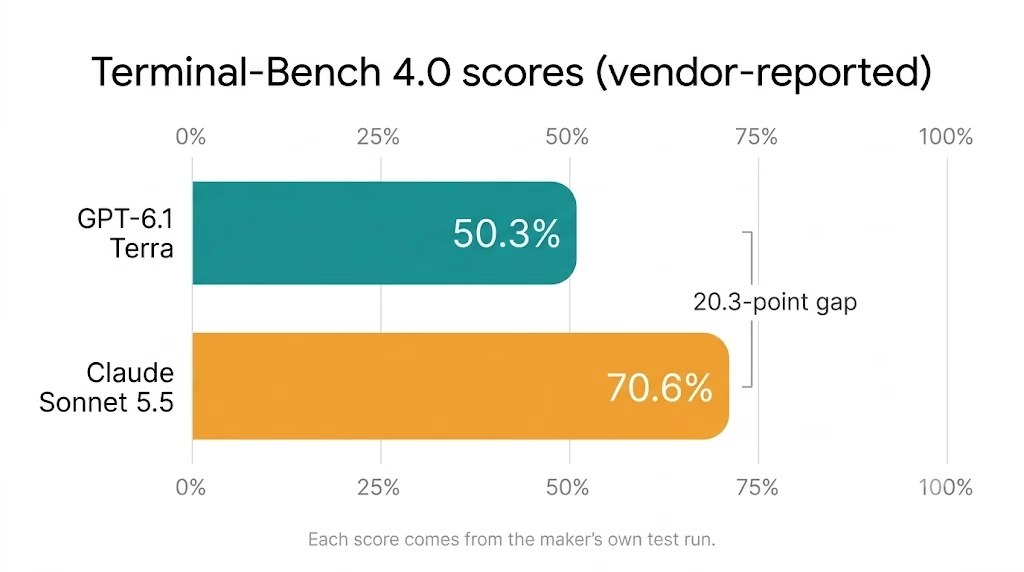
Each score comes from the maker's own report.
What Each Vendor Says About Limits
- OpenAI says GPT-6 Astra is best suited to the hardest coding and reasoning tasks, while GPT-6.1 Sol provides near-Astra performance for complex coding at a lower cost.
- Anthropic says Claude Opus 5.5 outperforms Sonnet 5.5 on complex, long-running tasks that require sustained judgment, planning, and decision-making.
Both makers place their mid-tier model below a higher tier for hard problems. Neither claims its mid-tier model wins every coding job.
Where Each Model Fits in a Coding Workflow
- Terra: routine fixes at high volume, where the $1 and $5 rates keep a large batch of tasks cheap.
- Sonnet 5.5: Best for fixing specific bugs and making limited changes across several files. Its strong coding skills, speed, and lower token use can mean fewer retries and less time spent reviewing the code.
Need an agent for bug fixes and multi-file changes? Build one with a coding agent builder.
Computer Use, Vision, and Office Work
Both models read images and work with documents. Terra's launch leads with computer use. Sonnet 5.5's launch leads with knowledge work.
Terra on Computer Use and Visual Reasoning
- On Agents' Last Exam, OpenAI tested tasks such as turning architectural drawings into a 3D model.
- Another task asked the model to review an animated film shot by shot and write a time-coded log.
- On MMMU-Pro, a visual reasoning test, Terra beats GPT-5.6 Terra at every effort setting.
- On OSWorld 2.1, Terra passes GPT-5.6 Terra's best score at medium effort.
OpenAI's launch text gives no numeric score for OSWorld 2.1 or MMMU-Pro. You cannot compare those results with Sonnet 5.5 from the text alone.
Sonnet 5.5 on Computer Use and Knowledge Work
- Sonnet 5.5 scores 80.1% on OSWorld 2.1, up from 57.0% for Sonnet 5.
- It scores 1844 on GDPval-AA, a test of real work across occupations. Sonnet 5 scored 1449.
- It scores 61.6% on Chartography, a chart recognition test, with no tools. Sonnet 5 scored 15.6%.
- In an internal test, Anthropic gave it earnings materials and a slide template. Two experts judged the 10-slide first draft ready to send.
Anthropic’s table gives GPT-6 Sol a score of 1487 on GDPval-AA, but it does not include Terra. This does not mean Terra got the same or a lower score.
Accuracy, Safety, and Data Controls
The vendors publish different safety numbers. That makes a direct accuracy comparison impossible today.
Terra: Error Rates and Safeguards
- With OpenAI’s internal prompts designed to cause errors, GPT-6.1 Terra’s factual-error rate at low effort dropped from 53.6% (GPT-5.6 Terra) to 16.7%.
- At max effort, the error rate fell by 18 points to 4.3%.
- OpenAI says Terra stays within scope more often and discloses limits and blockers more honestly than GPT-5.6 Terra.
- OpenAI says Terra meets the Critical threshold in cybersecurity under its Preparedness Framework and keeps the protections built for GPT-6 Astra.
Sonnet 5.5: Safeguards and Fallbacks
- Sonnet 5.5 is the first Sonnet model to launch with cyber safeguards modeled on Anthropic's most capable models.
- Higher-risk cybersecurity tasks visibly fall back to Sonnet 5. Routine bug fixing is not affected.
- Biology safeguards match Sonnet 5's. Anthropic says its filters sometimes flag microbiology and virology requests in error.
- Anthropic’s behavioral audit of about 1,850 scenarios found that Sonnet 5.5 improves on or matches Sonnet 5 on most alignment measures.
- Zero data retention is available.
What This Means for Your Team
OpenAI’s error-rate figures come from its own internal testing. Anthropic has not published a comparable error-rate figure for Sonnet 5.5. Before using either model for client work, test both on documents and data you know well.
Which Model Should You Choose?
Choose the model that fits your usual work. Test it with a few tasks before deciding.
Choose GPT-6.1 Terra If You Need
- High-volume work on a tight budget, such as invoice entry or form filling
- Image and screen understanding, such as reading technical drawings
- Lower batch costs, using Flex or Batch pricing at $0.50 and $2.50
- Access through ChatGPT Work or Codex on a Plus, Pro, Business, Enterprise, or Edu plan
Choose Sonnet 5.5 If You Need
- The higher reported coding score on Terminal-Bench 4.0
- Documents, slides, and spreadsheets that need little editing
- Access through Claude.ai or the Claude Platform
- Zero data retention, or a stack that already runs on AWS, Google Cloud, or Microsoft
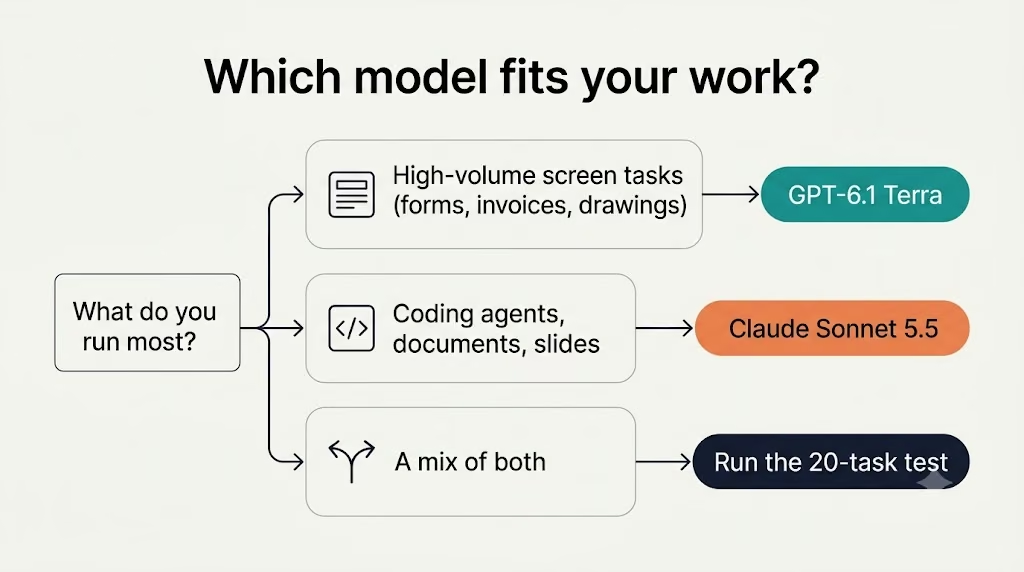
Match the model to the work you run most.
Test Both on Your Own Work
- Pick 20 real tasks from your last month of work.
- Run each task on both models at medium effort.
- Record tokens used, time taken, and whether the result passed your review.
- Divide the total cost by the number of tasks completed successfully to find the cost per successful task.
- Run failed tasks again at high effort, then compare the results.
Cost per passed task is the fairest measure. It captures price, token use, and quality in one number.
Conclusion: GPT-6.1 Terra vs Sonnet 5.5
Terra and Sonnet 5.5 solve different problems well. The better choice depends on the tasks you need to do, not just the test scores.
Key Takeaways:
- Terra costs half as much per token: $1 and $5 against $2 and $10.
- Sonnet 5.5 reports 70.6% on Terminal-Bench 4.0, against Terra's 50.3%.
- Both models share a roughly 1M-token context window and text-and-image input.
- No vendor test compares the two directly, so run your own 20-task trial.
- Judge each model by cost per passed task, not by price per token.
Emergent added Claude Sonnet 5.5 on September 29, 2026. Anthropic's newest Sonnet runs 30%+ faster than Sonnet 5, and cuts cost per task by up to 30%. To see how it handles a real project, build an app with Emergent’s AI app builder and judge speed, quality, and cost on your own work.

Most AI app builders stop at prototypes. Emergent creates production-ready apps you can actually launch.
- Production-ready apps
- Web & mobile apps
- Deploy in minutes