None of the models can be regarded as the winner per se. The choice depends on the user's specific tasks and conditions.
Llama vs. Claude: At a glance
This comparison focuses on Meta Muse Spark Open (Xhigh) and Claude Opus 5.5 (Xhigh, Default Fallback). Muse Spark Open is a member of Meta’s Muse family, rather than a Llama model. The broader Llama vs. Claude discussion is often used to describe Meta’s open-model ecosystem against Anthropic’s closed Claude models, but these two models are the specific releases being compared here.
Benchmark and pricing figures are based on the Artificial Analysis comparison. Muse Spark Open pricing reflects the median across providers serving the model, while Claude Opus 5.5 pricing reflects Anthropic’s API rates. These are not necessarily the prices a particular developer will receive.
What are Meta Muse Spark Open and Claude Opus 5.5?
Meta Muse Spark Open
Muse Spark Open is an open-weight multimodal reasoning model developed by Meta Superintelligence Labs. It has 816 billion total parameters, with 42 billion active during inference. This mixture-of-experts architecture allows the model to activate a subset of its parameters for each token rather than using the entire model at every step.
The model supports text, image, audio, and video inputs, with text generation as its output modality. It also has a context window of up to one million tokens, making it suitable for workloads that involve large documents, extended conversations, and substantial contextual information.
Its defining feature is access to the model weights. Developers can examine, deploy, and adapt the model within the terms of Meta’s Muse Model License. That provides more deployment control than a conventional closed API model.
However, open-weight does not mean unrestricted open source. Muse Spark Open is distributed under a custom license with conditions on use. Teams should review the license before building commercial products or redistributing modified versions.
Meta’s official release and model documentation provide details about the architecture, supported inputs, deployment, and available checkpoints.
Claude Opus 5.5
Claude Opus 5.5 is Anthropic’s high-capability model for complex professional and technical workloads. It is designed for tasks that require multi-step reasoning, coding, analysis, and working with substantial context.
Unlike Muse Spark Open, Opus 5.5 is proprietary. Developers access it through Anthropic’s supported products and API rather than downloading and hosting its model weights.
The model supports text and image inputs and text output. Its one-million-token context window gives it room to process lengthy documents, codebases, and extended task histories.
Anthropic’s model documentation lists a maximum output of 128K tokens. This is distinct from the context-window limit: context capacity describes the combined input and output space, while the output limit describes how much the model can generate in a single response.
For teams that want a managed model without maintaining large-scale inference infrastructure, Claude offers a more straightforward deployment path.
Why the models take different approaches
What sets Muse Spark Open apart from Claude Opus 5.5 is more than just the differences in their performance metrics. Their models’ deployment mechanisms reveal divergent approaches as well.
Meta provides its model weights to developers, which allows for possibilities such as self-hosting and custom deployments, while also requiring one to think about infrastructure, hardware specifications, and licensing.
Anthropic takes a managed-model approach. Developers use an API or supported platform, while Anthropic manages the underlying model infrastructure. This reduces the burden of running the model but gives customers less control over the model’s underlying weights and deployment environment.
These approaches suit different teams.
A company with its own infrastructure and model-serving expertise may value the control offered by open weights. A product team that wants to integrate a high-capability model without managing GPUs may prefer an API-based service.
Llama vs. Claude benchmarks: Which model performs better?
Artificial Analysis provides a useful comparison because it evaluates the models across multiple categories rather than relying on a single coding or reasoning score.
In this comparison, Claude Opus 5.5 scores 57 on the Artificial Analysis Intelligence Index, while Muse Spark Open scores 25. That is a substantial difference, and the individual benchmark results generally reinforce it.
Source: Artificial Analysis model comparison. Results reflect the specified Xhigh configurations and the benchmark versions shown.
Claude Opus 5.5 benchmark leads every benchmark in this table. Its advantage is particularly visible in coding and technical problem-solving evaluations, including Terminal-Bench and FrontierCode-AA.
AA-Omniscience test case also requires careful consideration. The evaluation takes into account factual knowledge and calibration, rewarding correct responses and punishing hallucinations but not the lack of response by the model. Therefore, an increased score means better performance according to the evaluation metrics of the benchmark, but does not guarantee reliability overall.
Based on the analysis, it can be concluded that Claude Opus 5.5 is the better option when a high level of accuracy is needed to deal with difficult tasks involving complex reasoning, technical work, and other knowledge-based problems.
However, the low scores obtained by Muse Spark Open do not mean that it is inappropriate for development purposes. On the contrary, such characteristics as open-weight deployment, low provider prices, and fast performance evaluations may make it an interesting option.
Coding performance: Claude leads on the benchmarks
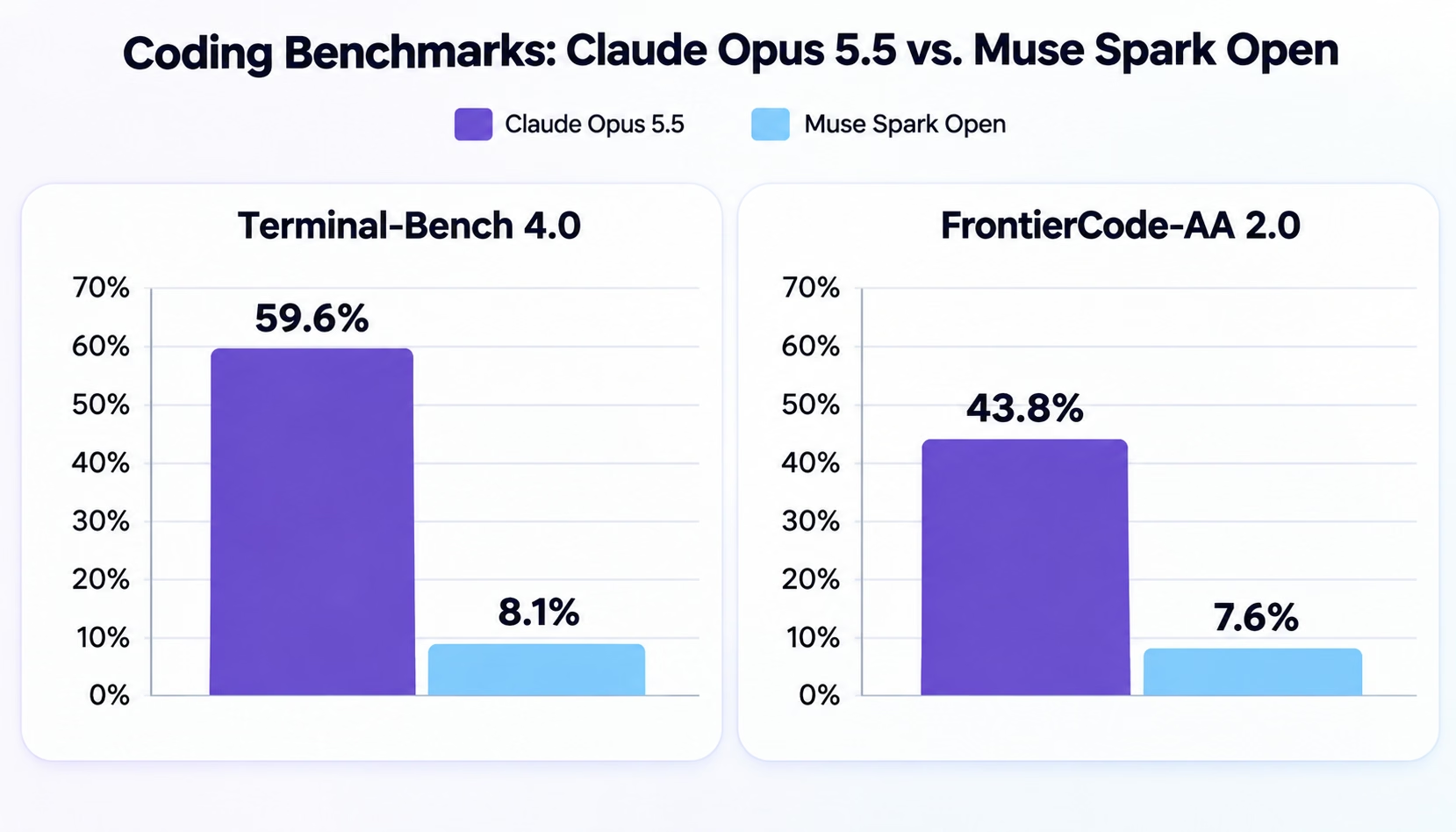
Coding is one of the clearest areas of separation in this comparison.
Claude Opus 5.5 scores 59.6% on Terminal-Bench 4.0, compared with 8.1% for Muse Spark Open. On FrontierCode-AA 2.0, the scores are 43.8% and 7.6%, respectively.
These results indicate that Opus 5.5 is better suited to demanding coding tasks in the tested configurations. That can include working through unfamiliar code, debugging, handling multi-step development tasks, and following complex instructions.
Meta also offers Muse Code, a coding agent designed for its Muse models. Meta describes it as a multi-agent coding experience that works in the terminal. Its developer offering includes workflows for coding and agentic development.
It is important to distinguish the coding tool from the model itself. Muse Code is a development environment and agent experience; its availability does not mean Muse Spark Open achieves the same coding benchmark performance as Claude Opus 5.5.
For teams choosing a model primarily for software engineering, Opus 5.5 has the stronger benchmark case. Muse Spark Open may still appeal to developers who want to experiment with open-weight models, control deployment, or build custom coding workflows around Meta’s ecosystem. If you land on Muse Spark Open for its open weights, the coding tooling around it is yours to assemble. A coding agent builder lets you build an AI coding agent that follows your repo's structure and test commands.
Multimodal capabilities: Muse supports more input types
Both models support text and image inputs, but Muse Spark Open accepts a broader range of modalities.
Muse Spark Open’s support for audio and video inputs creates more possibilities for applications that process different types of media. Developers can explore workflows involving visual content, recorded material, and multimodal information without relying solely on text and images.
Claude Opus 5.5 remains a strong option for text- and image-based tasks. Its benchmark advantage is relevant when the main requirement is complex analysis rather than broader input coverage.
A wider modality list does not automatically mean better results on every multimodal task. Teams should test their own audio, image, and video workflows before choosing a model.
Pricing: Muse Spark Open is less expensive in the comparison
Pricing is another meaningful difference.
Artificial Analysis reports the following token prices:
The blended price uses a 7:2:1 ratio of cache hits, input tokens, and output tokens. Under that assumption, Muse Spark Open costs approximately $0.78 per million tokens, compared with $2.94 for Claude Opus 5.5.
That makes Muse Spark Open roughly 73% less expensive on this blended measure. Its reported cost per task is also lower in this comparison.
There is an important pricing qualification: Artificial Analysis uses the median price across providers serving Muse Spark Open. The Muse figure is therefore not a direct Meta Model API rate. Claude Opus 5.5’s pricing is based on Anthropic’s API pricing.
Actual costs can vary depending on the inference provider, usage pattern, caching, infrastructure, and the number of tokens generated. Teams should compare the rates of the specific provider they intend to use before estimating production costs.
Speed and latency: Muse Spark Open is faster
Muse Spark Open has the advantage in the reported performance measurements. It delivers higher output throughput and lower time-to-first-answer-token and end-to-end response times.
The following figures reflect the current Artificial Analysis comparison snapshot supplied for this article.
Muse Spark Open’s output speed is approximately 1.4× faster than Claude Opus 5.5’s in this comparison. It also returns its first answer token sooner and completes the measured single-request workloads in less time.
The distinction between time to first token and time to first answer token matters. A reasoning model may spend time processing a request before producing its first user-facing answer. Time to first answer token accounts for that thinking time, making it more useful when comparing how long a user waits for an actual response.
Artificial Analysis defines output speed as output tokens divided by total request time, including time to first token. It should not be interpreted as generation speed measured only after the model starts producing tokens.
Muse Spark Open is also faster on the reported time-per-Intelligence-Index-task measure. This measures the weighted average time needed to complete the tasks in the Intelligence Index. It does not mean Muse performs better on the index itself: Claude still has the higher Intelligence Index score.
In practical terms, Muse Spark Open is attractive when throughput and response time are important. Claude Opus 5.5 takes longer in these measurements but delivers stronger benchmark performance.
Performance figures can change as Artificial Analysis updates provider measurements. Check the live comparison before using these values in procurement or production planning.
Open weights, privacy, and deployment flexibility
This is one of the most important differences between the two models.
Muse Spark Open: More control over deployment
Muse Spark Open is distributed as an open-weight model under Meta’s Muse Model License. Developers can access its weights and choose a supported deployment approach, including self-hosting or using an inference provider.
Meta’s distribution comes with BF16 and NVFP4 checkpoints. Format availability may influence memory requirements, hardware support, and inference efficiency. Before deploying, developers are expected to check the relevant model card and the deployment guide.
The size of the model is one of the important aspects. With 816 billion parameters, it is far from being a light model. Quantized checkpoints help reduce memory consumption, but self-hosting is resource-demanding anyway.
The Muse Model License also plays a role. Free weights do not mean free use. Teams should take a look at the relevant license terms.
Claude Opus 5.5: Managed access
Claude Opus 5.5 is a proprietary model. Developers access it through Anthropic’s API and supported platforms rather than downloading its weights.
This approach reduces the need to manage model-serving infrastructure. Teams can integrate the model into applications without provisioning the hardware required to run a model of this scale.
The trade-off is less control over the underlying model and deployment environment. Data handling, retention, regional availability, and contractual protections depend on the service and configuration being used.
Which approach is better for enterprise teams?
There is no universal answer.
Muse Spark Open may suit organizations that want more control over deployment, need to evaluate open-weight models, or have the infrastructure to operate large models. It can also support teams that want to explore model adaptation within the applicable license terms.
Claude Opus 5.5 may be a better fit for organizations that prioritize managed access and strong performance without operating their own model-serving stack.
Neither model should be assumed to meet a company’s privacy or data-residency requirements by default. Enterprise teams should review the relevant provider agreements, deployment architecture, security controls, and data-processing terms before using either model with sensitive information.
If you came here comparing Meta's Llama line with a closed model, see our Llama vs ChatGPT comparison.
Latest head-to-head: What the comparison tells us
The current Artificial Analysis comparison points to a clear division of strengths.
Claude Opus 5.5 leads on the Intelligence Index and all the listed benchmark results. Its advantage is especially pronounced in coding and technical evaluations. For tasks where accuracy and complex reasoning are the main requirements, it has the stronger evidence in this comparison.
Muse Spark Open leads on output speed, time to first answer token, end-to-end time, and time per Intelligence Index task. It also has lower listed provider-based pricing and supports more input modalities. Its open-weight distribution gives developers more deployment flexibility, although the hardware and licensing requirements need to be considered.
The comparison is not a simple contest between an open model and a closed model. It is a choice between different combinations of capability, cost, speed, and operational control.
Which model should you choose?
The best model depends on what you are building and what constraints your team needs to work within.
If you are still deciding, start with a small evaluation using your actual prompts, documents, code, and expected request volume. Benchmark scores provide a useful baseline, but the best model for a particular product is the one that performs reliably on its real workload at an acceptable cost.
If Opus 5.5's $6.05 cost per task or 79.62-second first answer token is a sticking point, our Claude Opus 5.5 alternatives guide covers other models worth testing.
Conclusion: Llama vs. Claude comes down to control or capability
Choosing between Meta Muse Spark Open and Claude Opus 5.5 ultimately depends on what you value most. Claude Opus 5.5 is the stronger choice for demanding software engineering tasks, complex debugging, and multi-step development workflows, backed by its higher scores on the coding benchmarks discussed in this comparison. Meta Muse Spark Open, on the other hand, appeals to developers who prioritize open-weight models, deployment flexibility, and building custom workflows within Meta's ecosystem. If coding performance and reliability on complex tasks are your priorities, Claude has the edge. However, if control over deployment and experimentation matter more, Muse Spark Open is worth considering.
Once you've chosen the right model, the next step is turning its capabilities into a working application. Emergent makes that easier with an AI-powered app builder that converts natural-language prompts into functional web and mobile applications. Simply describe your idea, and its AI agents can help build the application and develop its features. Whether you're creating an AI-powered assistant, a productivity tool, or a new software product, Emergent helps you move from concept to application without writing every line of code yourself.
Describe it. Build it. Launch it.
- End-to-End Creation
- No Code Needed
- Live in Minutes

Most AI app builders stop at prototypes. Emergent creates production-ready apps you can actually launch.
- Production-ready apps
- Web & mobile apps
- Deploy in minutes