The choice between Mistral and Llama comes down to price and coding versus multimodal input and speed. Mistral Large 4 wins on price and coding. Modality and latency are the keys to Meta Muse Spark Open's victory.
Mistral vs. Llama at a Glance
The bigger Mistral Large 4 is the more cost-effective choice for coding. Choose Muse Spark Open for multimodal input and speed. Both models are frontier open-weight models with 1M-token context windows. The list of the primary differences is below:
Scores and specs as of November 2026. Both models are open-weight frontier models with 1M-token contexts.
Mistral has more total parameters, while both use a MoE architecture with a subset active per token. Mistral is on par with the index in terms of price, but is slightly behind. Meta supports more input types. MoE: mixture of experts. Only a fraction of the model is active for each token, which helps to lower the serving costs compared to an all-active dense model of the same size.
What are Mistral and Llama? Mistral AI vs. Meta
Mistral AI has just released model families, and Meta has just released Llama model families. Both companies provide open-weight models, so you can download them and run them yourself.
Mistral includes the Mistral app, the Mistral API, and Mistral Studio. It is shipped under the Mistral Ecosystem Open Weight License.
Llama includes the Llama app and the Meta Model API. Meta's new open weights platforms are available under the Muse Model License.
This section compares Mistral Large 4 and Muse Spark Open, since both are recent, open-weight frontier models with 1M-token contexts. Mistral Medium 3.5 (the one that preceded Large 4) isn't comparable to the latest open Mistral model.
Meta Muse Spark Open and Mistral Large 4: Where They Differ
The two models differ most in coding, pricing, input types, and speed. Intelligence and context are close second place. All the following comparisons are between Mistral Large 4 (High) and Meta Muse Spark Open (Xhigh).
1. Architecture and efficiency
The larger Mistral is Mistral Large 4. It features a 1.05T-parameter MoE model and has 52B active parameters per token. Muse Spark Open is an 816B-parameter MoE that has 42B active parameters per token.
2. Intelligence and reasoning
Mistral Large 4 has an Intelligence Index of 26 and Muse Spark Open has an Intelligence Index of 25. That's a one-point lead for Mistral, which is narrow. The one-point gap will not be noticeable in daily use. Benchmarks are more important than tasks.
3. Context window and modality
Both models have 1 M contexts listed. Mistral Large 4 can handle text and image input. Muse Spark Open includes speech and video input.
4. Speed and latency
Muse Spark Open is quicker. It can produce 166 tokens per second and has a time-to-first-token of 1.16 seconds. Mistral Large 4 has 99 tokens per second and a time-to-first-token of 3.43 seconds. The first-token gap is the bigger one for chat and voice apps.
5. Weights and licensing
Both are open-weight models and licensed separately. Before building a product on a license, read each license.
Mistral vs. Llama Benchmarks
Mistral Large 4 leads in coding and agentic tasks. Muse Spark Open outpaces it on knowledge- and reasoning-based assessments. Artificial Analysis is an independent evaluator whose figures are below.
What these benchmarks are measuring:
- Test coding and command-line agent work in Terminal-Bench 4.0 and FrontierCode-AA 2.0. They should be monitored by the developers and agent builders.
- Business workflow tasks are tested by AutomationBench- AA and AA-Briefcase. Operations teams need to care.
- AA-Omniscience tests factual knowledge. Users of Research and Q&A should care.
- GDP.pdf is a test that assesses document-based work. Long files need to be cared for by teams.
- The HLE-Diamond is a hard-level, expert-level reasoning test. It is relevant for research-intensive use.
Mistral takes 6 of the 10 rows. Meta takes the three knowledge and document rows by a country mile. On AA Omniscience, it's 26-5.
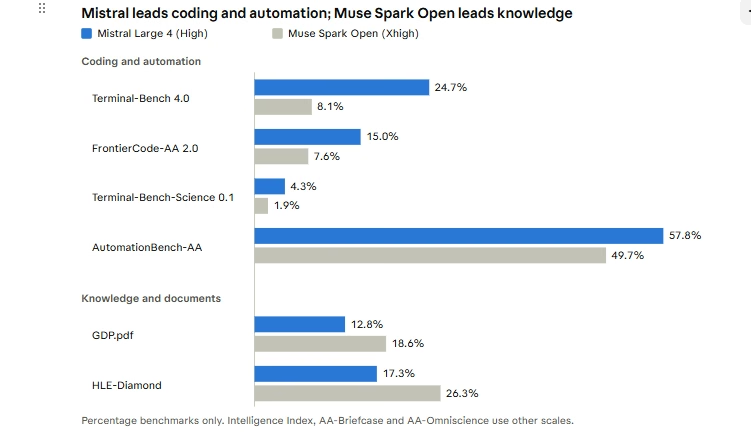
The six percentage-based benchmarks are displayed on the chart. There's a gap of both sorts: Mistral is a long way in front on Terminal-Bench 4.0, and Muse Spark Open has a long lead on HLE-Diamond.
Vendor-reported claims. Vendors market their own models. Mistral describes Large 4 as a "state-of-the-art, open-weight, general-purpose multimodal model. Meta's open-weight, multimodal agentic coding model is Muse Spark Open. See these as positioning, not test results.
What is more suitable for coding: Mistral or Llama?
Mistral Large 4 outperforms the other coding model in independent tests. It earns a 24.7% in Terminal-Bench 4.0, while Muse Spark Open gets 8.1%. On FrontierCode-AA 2.0, it scores 15.0% against 7.6%.
Absolute scores are still low. Neither model replaces a developer on difficult tasks. Check all the code that has been created.
Different coding tools are available for each family, and some agents do not work with certain tools. Before committing, look at each vendor's most up-to-date documentation to see which editor and agent frameworks they support.
Absolute scores are low on both, so a 24.7% against 8.1% gap won't tell you how either handles your repo. Build an AI coding agent around your own tests with a coding agent builder.
Mistral vs. Llama for Multimodal Work
Muse Spark Open supports more input types. It can process text, image, speech and video. Only text and image can be sent with Mistral Large 4.
- Mistral Large 4: Mistral claims it is a general multimodal model, taking text and images as input.
- Muse Spark Open: Meta positions it as an open-weight, multimodal agentic coding model with text, image, speech, and video input.
The two can't be used together if you are using your product with speech or video input. For text and images, Mistral Large 4 will do the job at a more affordable rate.
Both descriptions are vendor-reported. Independent multimodal quality scores are not part of this comparison, so test with your own files before you commit.
Mistral vs. Llama Pricing, Speed, and Access
For blended cost per million tokens, Mistral Large 4 is about half the price of Muse Spark Open: $0.40 versus $0.78. Input and output prices are also lower: $0.70/$2.10 versus $1.25/$4.25.
The table's message: At the border, Mistral is cheaper. Mistral Small 4 is much more budget-friendly than Muse Spark 1.3 at the lower end of the spectrum. The exception is the middle tier, where Medium 3.5 is more expensive than Muse Spark 1.3.
Cost per task. The token price is not the cost of the task. Some models may require more tokens to complete a task but have a lower rate. Please refer to the live Artificial Analysis page for the cost of tasks for both models. Our guide to AI agent cost shows how token use drives the real bill.
Speed. The difference in speed between Muse Spark Open and Muse Spark is 166 tokens per second compared to 99. It also has a much earlier time to first token of 1.20s compared to 3.24s.
Access.
- Mistral: Mistral app, Mistral API, Mistral Studio and open-weight checkpoints.
- Llama: Llama app, Meta Model API and open-weight checkpoints.
Open Weights, Privacy, and Data Residency
Self-hosting is available for both families, each with its own license. Mistral Large 4 is shipped under the Mistral Ecosystem Open Weight License. Muse Spark Open is shipped under the Muse Model License. Read both licenses before commercial deployment, as they may differ in terms of use, size, and redistribution.
- Self-hosting: Both models are mixture-of-experts models with many experts. Plan for multi-GPU hardware. Self-hosting gives you control over data and fine-tuning, but it also means you're responsible for serving, scaling, and security.
- Fine-tuning and lock-in: Open weights minimize lock-in. The model can be transferred from one host to another. Tuned versions may also have license requirements; be sure to check.
- Data residency/retention: Mistral also provides European hosting and data residency. This is a benefit for organizations based in the EU. Please review the latest documentation from Mistral and Meta for retention periods, regions, and enterprise controls. Conditions are always in flux, and your contract is more important than any summary.
Mistral Large 4 vs. Meta Muse Spark Open: The Latest Models, Head to Head
Mistral Large 4 wins on coding, agentic work, and cost. Muse Spark Open's winning points are modality, speed and knowledge benchmarks. Most builders will choose which option to use after the bulk of the work is done.
Scores and specs as of November 2026.
Mistral Large 4 leads in coding and automation benchmarks. Muse Spark Open outperforms on the knowledge, document and hard-reasoning benchmarks. Mistral Large 4 is approximately 50% more cost-effective on the blended cost per million tokens.
Which Should You Choose? Mistral or Llama by Use Case
Choose by workload, not by brand. The table maps each use case to a model.
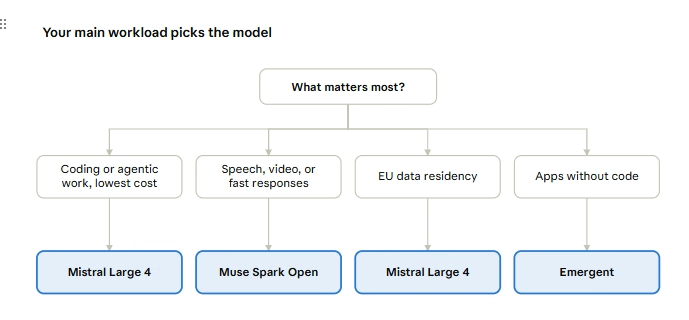
Coding and EU residency lead to Mistral Large 4. Multimodal input and speed lead to Muse Spark Open. No-code builds lead to Emergent.
Weighing either family against a closed model? See our Mistral vs ChatGPT and Llama vs ChatGPT comparisons.
Conclusion
Select Mistral Large 4 for coding, agentic or lowest-cost situations. Use Meta Muse Spark Open when multimodal input, speed or the Meta ecosystem are the most important features.
If volume and unit economics are most important, consider Mistral Medium 3.5 or Muse Spark 1.3. If you are deploying edges, you might want to use Mistral Small 4 or Llama 3.x small variants. Test with your own data.
The shortlist is created using benchmarks. The winner is determined by how much work you put in. However, you can test these models on Emergent, an AI-backed app builder platform that lets you custom-build your idea. You can provide the prompt in plain language and decide how your dashboard should look, what features you want to add to your app, and what type of access you want to provide to your client on your website. Also, Emergent offers you your first domain for free, and your first application preview can ship your idea to your customer with the next click.
Start building with Emergent.
Describe it. Build it. Launch it.
- End-to-End Creation
- No Code Needed
- Live in Minutes
Most AI app builders stop at prototypes. Emergent creates production-ready apps you can actually launch.
- Production-ready apps
- Web & mobile apps
- Deploy in minutes