Mistral vs. ChatGPT compares frontier AI models on coding, benchmarks, pricing, and deployment flexibility to help technical teams choose the right model for production applications.
Mistral vs. ChatGPT brings together two AI model families with different approaches to performance, pricing, and deployment. Mistral Large 4 was released on 6 October 2026 as a multimodal mixture-of-experts (MoE) model with 1.05 trillion parameters. Its open weights followed on 29 October 2026 under a modified MIT license.
OpenAI, the San Francisco-based company behind ChatGPT, developed GPT-6.1 Sol, a closed-weight reasoning model with a 1.05-million-token context window. Both models accept text and image inputs, generate text, and offer reasoning-effort controls that affect performance, latency, and cost.
However, their differences become clearer when comparing independent benchmark performance, cost per completed task, and deployment flexibility. GPT-6.1 Sol leads on several demanding reasoning and coding evaluations, while Mistral Large 4 offers open-weight deployment, self-hosting, and fine-tuning capabilities that may appeal to organizations seeking greater infrastructure and data control.
Mistral vs. ChatGPT at a Glance
Mistral AI and OpenAI offer different approaches to model performance, pricing, and deployment. Paris-based Mistral AI provides open-weight models and European hosting options, while OpenAI offers proprietary models through ChatGPT and its API. The table below compares Mistral Large 4 and GPT-6.1 Sol on the specifications, costs, and capabilities most relevant to businesses.
Table: Mistral Large 4 vs. GPT-6.1 Sol. Pricing and benchmark figures checked on 12 November 2026. Artificial Analysis scores compare Mistral Large 4 (High) with GPT-6.1 Sol (Max). Results may change as evaluations are updated.
What Are Mistral and ChatGPT?
Mistral AI is a Paris-based artificial intelligence company that develops large language models (LLMs). Users can access its models through the Mistral application, Mistral Studio, and the Mistral API, while Mistral Vibe provides coding-focused tooling. A key distinction from OpenAI is Mistral's open-weight strategy, which allows organizations to download and deploy supported models on their own infrastructure, subject to licensing conditions.
Mistral Large 4 is available under the Mistral Ecosystem Open-Weight License, a modified MIT license. It permits use, modification, fine-tuning, and commercialization, subject to its terms. Businesses offering the model to third parties as a Model-as-a-Service must obtain a separate commercial license from Mistral. Organizations should review the applicable license before deployment.
ChatGPT is OpenAI's AI assistant for individuals and businesses, powered by models from the GPT family. OpenAI also provides API access for developers building their own applications and Codex for coding-related workflows. ChatGPT subscriptions, API usage, and enterprise offerings have separate access arrangements and pricing.
Both companies offer models for different levels of complexity, cost, and deployment requirements. OpenAI positions GPT-6 Astra as its most capable model, GPT-6.1 Sol as a balance between intelligence and cost, GPT-6.1 Terra for efficient general-purpose work, and GPT-6 Luna for high-volume tasks.
Mistral's lineup includes Large 4 for demanding general-purpose workloads, Small 4 for efficient reasoning and coding, and Ministral 3 for smaller-scale and edge deployments. Mistral Medium 3.5 and Large 3 also appear in the broader model family, although availability and lifecycle status should be checked before selecting them for new projects.
This article focuses on Mistral Large 4 and GPT-6.1 Sol because they offer a useful comparison between open-weight deployment flexibility and proprietary frontier-model performance at different price points. GPT-6 Astra represents OpenAI's premium tier, making it a less direct comparison for readers balancing capability with operating costs.
Mistral Large 4 vs. GPT-6.1 Sol: Key Differences
Mistral Large 4 and GPT-6.1 Sol are frontier models with context windows of approximately one million tokens. However, they differ in architecture transparency, reasoning controls, licensing, and independent benchmark performance. These differences affect how businesses evaluate their capabilities, operating costs, and deployment requirements.
Architecture and Size
Mistral Large 4 uses a mixture-of-experts (MoE) architecture with 1.05 trillion total parameters and 52 billion active parameters, according to Mistral's official documentation. Rather than activating the entire model for every token, MoE architecture uses selected experts, which can reduce computation compared with a similarly sized dense model. OpenAI has not publicly disclosed GPT-6.1 Sol's parameter count or architecture, so a direct comparison is not possible.
Reasoning Modes and Effort Settings
GPT-6.1 Sol supports five reasoning-effort settings: low, medium, high, xhigh, and max. Mistral Large 4 supports three settings: low, medium, and high, with high recommended for complex tasks. Unlike earlier preview versions, Mistral Large 4 does not support a none setting; low is its least compute-intensive option.
Reasoning effort affects token consumption, latency, and potentially response quality. In this article, Artificial Analysis benchmarks compare GPT-6.1 Sol at Max effort with Mistral Large 4 at High effort. Since the configurations differ, the results should not be treated as a strictly like-for-like comparison.
Context Window and Multimodal Window
Mistral Large 4 supports a context window of 1 million tokens, while GPT-6.1 Sol offers 1.05 million tokens with a maximum output of 128,000 tokens. Both models accept text and image inputs and generate text outputs.
These large context windows can support tasks involving lengthy documents and codebases. However, the usable context limit may vary by platform or deployment configuration, so businesses should confirm the limits offered by their chosen provider.
Weights and Licensing
Mistral released the open weights for Large 4 on 29 October 2026, including optimized checkpoint formats such as FP8 and NVFP4. The model is distributed under the Mistral Ecosystem Open Weight License v26.10, which permits certain uses, modifications, and commercial deployments subject to its terms.
Organizations planning to offer the model as a hosted service should review the license carefully and confirm whether a separate commercial agreement is required. GPT-6.1 Sol, by comparison, is a proprietary, closed-weight model accessed through OpenAI and supported cloud distribution channels. Its weights are not available for self-hosting.
Mistral vs. ChatGPT Benchmarks
Artificial Analysis provides independent benchmark results for Mistral Large 4 and GPT-6.1 Sol across coding, reasoning, automation, and other demanding tasks. The comparison below uses selected evaluations from its Intelligence Index v5.0.1 methodology to highlight differences relevant to businesses choosing between the two models.
Source: Artificial Analysis: Mistral Large 4 (High) vs. GPT-6.1 Sol (Max). Figures checked on 12 November 2026; results are subject to updates.
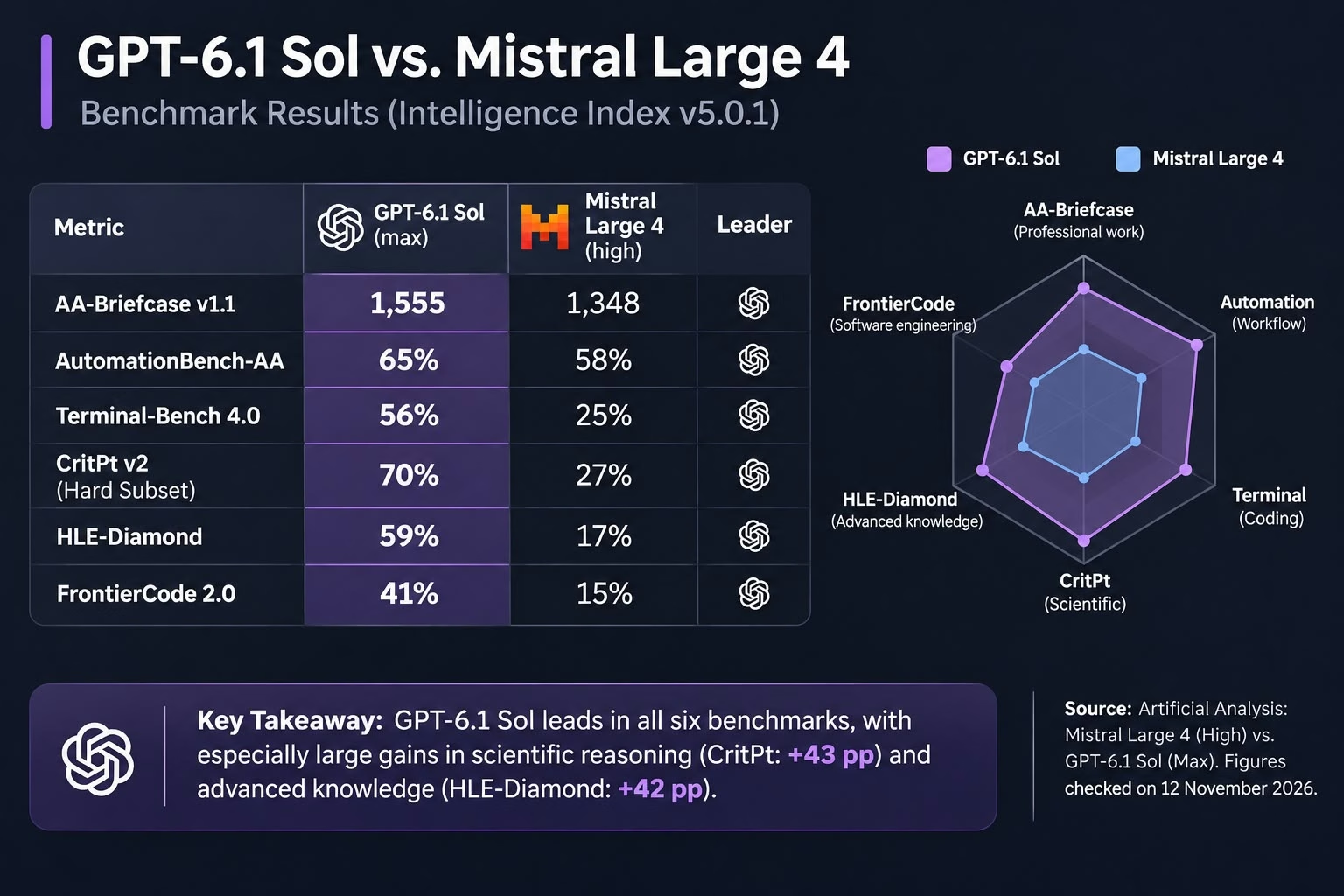
GPT-6.1 Sol vs. Mistral Large 4 benchmark scores: GPT-6.1 Sol leads across all six evaluated benchmarks, outperforming Mistral Large 4 in coding, workflow automation, scientific reasoning, and professional knowledge tasks. Explore the infographic for a metric-by-metric breakdown of their performance
The smallest gap appears in workflow automation, where Mistral scores approximately 58% against Sol's 65%. Mistral has lower token prices, but benchmark measurements suggest that lower prices do not always translate into lower costs per completed task.
For Sol's own scores across all nine Index tests, see our GPT-6.1 Sol benchmarks guide.
Mistral vs. ChatGPT for Coding
GPT-6.1 Sol leads Mistral Large 4 on the selected independent coding benchmarks, including Terminal-Bench 4.0 and FrontierCode-AA 2.0. The results suggest an advantage for Sol on complex software-engineering tasks, although performance also depends on the coding agent, tools, and evaluation setup.
What the test measures
Terminal-Bench 4.0 tests how well an AI agent handles practical tasks in a terminal environment. For example, can it install software, troubleshoot a system, or fix a problem without getting stuck? The benchmark evaluates whether the agent successfully completes the assigned task.
FrontierCode-AA 2.0 takes a different approach. It evaluates software-engineering tasks involving real codebases, where the model must understand the problem, make changes, and meet the required checks. A solution that looks correct is not necessarily enough; it must also work.
Both benchmarks tell us something useful about coding ability. However, the results also depend on the tools, testing environment, and agent configuration. A higher score is encouraging, but it does not guarantee that the same model will perform equally well on every real-world project.
What the Results Show
According to the benchmark data, Sol scored more than twice as high as Mistral Large 4 on Terminal-Bench 4.0. It also performed considerably better on FrontierCode-AA 2.0, which evaluates software-engineering tasks. These results suggest that Sol has an advantage in handling complex coding problems, although performance can vary depending on the tools and testing environment. Real-world development still requires testing and human review.
If you want an AI agent for coding that runs your own tests and review steps, you can build one with a coding agent builder.
Mistral Vibe vs. OpenAI Codex
Mistral Vibe and OpenAI Codex extend AI coding beyond generating snippets. Both can work with existing codebases, edit files, execute development commands, and assist with debugging and testing.
Mistral Vibe Code supports development through a terminal, VS Code, and remote web-based coding sessions. OpenAI Codex similarly provides coding workflows through its CLI, editor integrations, and cloud-based environment.
For businesses, the choice depends on the development environment, available models, usage costs, and data-control requirements. Neither tool should be judged solely by its underlying model's benchmark score, since agent configuration and access to development tools can influence the outcome.
For a wider ranking, see our best AI models for coding guide.
Mistral’s Case
Three points work in favor of Mistral Large 4. First, the testing environment matters. Mistral Large 4 scored approximately 41% on Terminal-Bench 4.0 when evaluated with Mistral Vibe, compared with approximately 25% in the separate Artificial Analysis Intelligence Index evaluation. This shows why the coding agent and testing setup matter when comparing results.
Second, Mistral Large 4 scored approximately 48% on the Artificial Analysis Coding Agent Index, close to GLM-5.3's 49%, while using 47% fewer tokens per task on average. This suggests that Mistral can offer competitive coding performance with lower token consumption in that evaluation.
Third, its open weights allow organizations to fine-tune the model on their own codebases and deploy it on their own infrastructure, subject to licensing and hardware requirements.
Evaluation note: This comparison draws on published benchmark results and official product documentation. It does not include an original hands-on coding test. Actual results may vary depending on the coding agent, model configuration, tools, and project requirements.
Mistral vs. ChatGPT Pricing, Speed, and Access
Pricing is one area where Mistral Large 4 becomes particularly attractive. Its standard API rates are $0.70 per million input tokens and $2.10 per million output tokens, compared with $2 and $10, respectively, for GPT-6.1 Sol. Based on these rates, Mistral Large 4 is approximately 65% cheaper for input tokens and 79% cheaper for output tokens.
However, lower token prices do not always translate into a lower cost for completing a task. The number of tokens a model uses and how often it successfully completes the work also matter.
What does one task cost?
Consider a workload with 100,000 input and 10,000 output tokens, without caching or other charges being involved.
So, for similar token volumes, Mistral Large 4 is substantially cheaper. But independent measurements introduce a crucial complication. Lower API pricing does not necessarily mean lower costs for every task. According to Artificial Analysis, Mistral Large 4 costs approximately $2.06 per evaluated Intelligence Index task at High reasoning effort, compared with $0.59 for GPT-6.1 Sol at High reasoning effort.
In other words, Mistral is cheaper per input and output token, but Sol is cheaper per evaluated task in this particular benchmark. The actual cost for a business will depend on the task, token consumption, and model configuration. Sol's caching, Batch, and long-prompt rates are laid out in our GPT-6.1 Sol pricing guide.
Which model is faster?
According to Artificial Analysis, Mistral Large 4 generates approximately 118 output tokens per second at High reasoning effort, compared with 52 tokens per second for GPT-6.1 Sol at High. However, faster output generation does not necessarily mean faster task completion. In the same evaluation, Sol averaged 7.2 minutes per task, compared with 11.6 minutes for Mistral.
How can developers access them?
Mistral models can be accessed through the Mistral application, Mistral Studio, APIs, and downloadable model checkpoints. They are also available through Microsoft Foundry, OpenRouter, and NVIDIA-hosted endpoints.
OpenAI offers ChatGPT through Free, Go, Plus, Pro, Business, and Enterprise plans. Developers can access supported OpenAI models through the OpenAI API and Codex, while GPT-6.1 Sol is also available through Azure.
One distinction is worth keeping in mind: ChatGPT is OpenAI's user-facing product, while GPT-6.1 Sol is a specific model. Sol is available through supported developer and work environments, including Codex, ChatGPT Work, and the OpenAI API, but it is not offered as a separate model selection in the standard ChatGPT chat interface.
Open Weights, Privacy, and Data Residency
Open weights are one of Mistral’s clearest advantages. Self-hosting gives businesses greater control over where their AI model runs, how data is handled, and whether the model can be fine-tuned for specific requirements. It can also reduce dependence on a single API provider. However, companies still need to manage infrastructure, security, access controls, and regulatory compliance themselves.
Once model weights are downloaded and deployed, organizations can continue operating those checkpoints independently of Mistral's hosted services, subject to the applicable licensing terms and their ability to maintain the infrastructure.
Self-hosting Mistral Large 4 also requires substantial computing resources. For example, Hugging Face documents an FP8 inference setup using eight NVIDIA H200 GPUs, supporting approximately 131,000 tokens of context. This is one deployment configuration, not a fixed hardware requirement for every setup.
Data Residency on APIs
Both Mistral and OpenAI offer regional processing options for eligible API workloads, with a 10% premium over their applicable standard rates. However, regional inference should not be confused with complete data residency, as some operational data may still be processed outside the selected region.
Which Should You Choose? Mistral or ChatGPT by Use Case
The following table compares common use cases to help businesses decide whether Mistral Large 4 or GPT-6.1 Sol is the better fit.
Conclusion
Mistral Large 4 makes a strong case for businesses that prioritize lower API costs, open-weight deployment, and greater control over their AI infrastructure. GPT-6.1 Sol, on the other hand, performs better on the selected independent coding, reasoning, and automation benchmarks. The right choice depends on what you want to accomplish, how much you're willing to spend, and how much control you need over deployment.
But choosing an AI model is only one part of building an application. A model can write code, answer questions, or help debug problems, but will that alone give you a working product? You still need an interface, a database, a backend, and somewhere to deploy it.
That's where Emergent comes in. Have a SaaS product, dashboard, or web application in mind? Describe what you want to build in plain English, and Emergent can help you create, test, and deploy the application without managing every technical step yourself.
Emergent also supports AI-powered features through its Universal LLM Key, including access to supported Claude models without requiring a separate Anthropic API key.
Get Started with Emergent, a full-stack App Builder.
Describe it. Build it. Launch it.
- End-to-End Creation
- No Code Needed
- Live in Minutes

Most AI app builders stop at prototypes. Emergent creates production-ready apps you can actually launch.
- Production-ready apps
- Web & mobile apps
- Deploy in minutes