Picking a Claude model by name alone wastes money, because the effort setting changes both the bill and the quality. Claude Opus 5.5 (low effort) vs Claude Sonnet 5.5 (high effort) is a close call with a clear split. Sonnet scores higher. Opus at low effort costs less per task and answers sooner. Start with Claude Sonnet 5.5 if you need the model basics.
This guide explains how Claude effort levels work, compares both setups, and shows which trade-off pays off.
Opus 5.5 Low Effort and Sonnet 5.5 High Effort at a Glance
Both setups share a 1M-token context window and a June 2026 knowledge cutoff. The differences come from the model and the effort level.
Specs come from Anthropic’s Opus 5.5 and Sonnet 5.5 model pages.
What Effort Actually Changes in Claude
Effort tells Claude how much work to put into a response. Lower levels cut thinking and tool calls and keep confirmations short. Higher levels add more of each.
Claude Effort Levels Explained
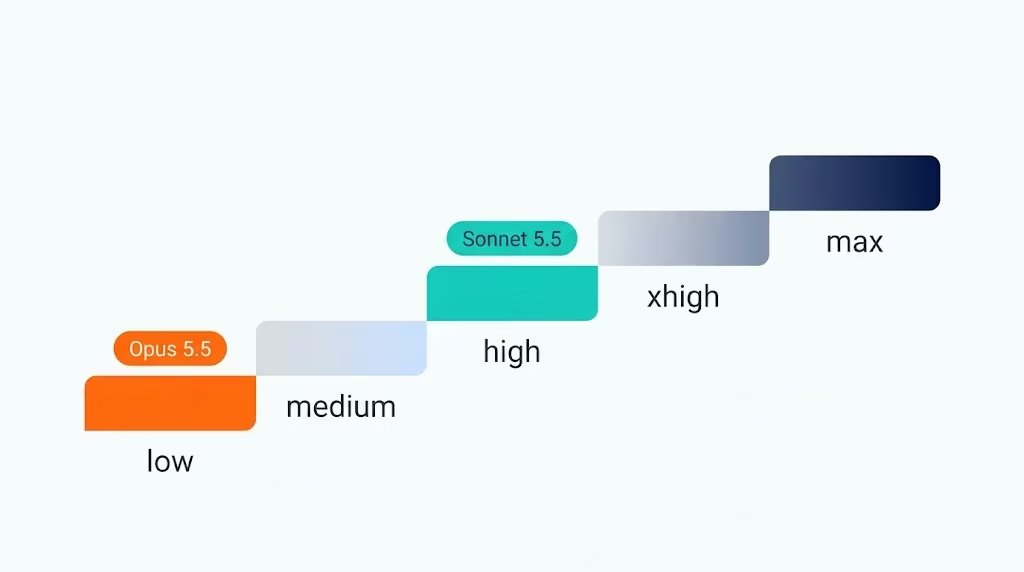
Claude uses more tokens at higher effort levels because it spends more time thinking. Anthropic’s effort docs list five levels.
The docs describe effort as a guide to how much the model thinks, not a fixed token limit. Even at low effort, Claude still works through hard problems, but spends less time thinking.
Defaults Differ by Model
On the Claude API, Opus 5.5 defaults to medium and Sonnet 5.5 defaults to high. Setting the default value behaves the same as leaving the field out.
- Leave effort out on Opus 5.5, and you get medium. You must set it to low yourself.
- Leave it out on Sonnet 5.5, and you get high, the setup in this article.
- Opus 5.5 always thinks, so low is its lightest setting. Sonnet 5.5 has a separate between_tools mode that skips up-front thinking, available at high effort or below.
How to Set Effort
You can choose the effort level by adding one field to your request.
Opus 5.5 at low effort
output_config={'effort': 'low'}
Sonnet 5.5 at high effort
output_config={'effort': 'high'}
Both models count thinking tokens toward max_tokens. Make sure the limit has enough room for them. Otherwise, the model may cut off its reply before finishing.
Quality and Reasoning Compared
Sonnet 5.5 performs better in quality tests at high effort, while Opus 5.5 does better than you might expect at low effort.
Head-to-Head Score
Artificial Analysis (AA) runs both setups through its Intelligence Index v5.0. As of October 30, 2026, the scores are:
Sonnet leads by six points. AA may change the scores when it updates the index, so check the model pages for the latest numbers.
Claude Opus 5.5 Low Effort Performance
Anthropic’s launch materials show that Opus 5.5 still performs well at low effort, despite what the label might suggest. Three data points back that up:
- Anthropic’s Opus 5.5 prompting guide reports a narrow gap. On several coding evaluations, low nears Opus 5 at high effort for far less cost.
- On dense charts, Opus 5.5 at its lowest setting read values more accurately than Opus 5 at its highest. It used a fraction of the output tokens.
- One customer quoted on Anthropic’s Opus page caught 72% of known bugs in code reviews at low effort. Opus 5 at high effort caught 56%.
All three compare Opus 5.5 with the older Opus 5. None test it against Sonnet 5.5, and the customer figure is self-reported.
Claude Sonnet 5.5 High Effort Performance
High effort gives Sonnet room to work problems out. Its AA score of 41 reflects that. Anthropic’s Sonnet 5.5 prompting guide adds two findings:
- On reasoning tasks with JSON answers, a one-line instruction to think first brings high effort close to high accuracy.
- On charts, Sonnet at high effort with a crop tool read more accurately than Sonnet at max without one. It cost a fraction as much.
Speed, Cost, and Token Usage Compared
Sonnet 5.5 costs half as much per token. Even so, Opus 5.5 at low effort costs less per task and starts answering sooner.
Token Prices
Opus 5.5 vs Sonnet 5.5 pricing follows a clean 2-to-1 ratio on every line, in US dollars per million tokens.
Cost Per Task
Token price is only part of the cost because each setup uses a different number of tokens. Both were tested on the same tasks.
Sonnet writes about 2.6 times more output tokens. At half the price per token, that still comes to about 1.3 times Opus’s output spend. AA’s full cost figure also counts input and cache tokens, and it lands about 1.7 times higher.
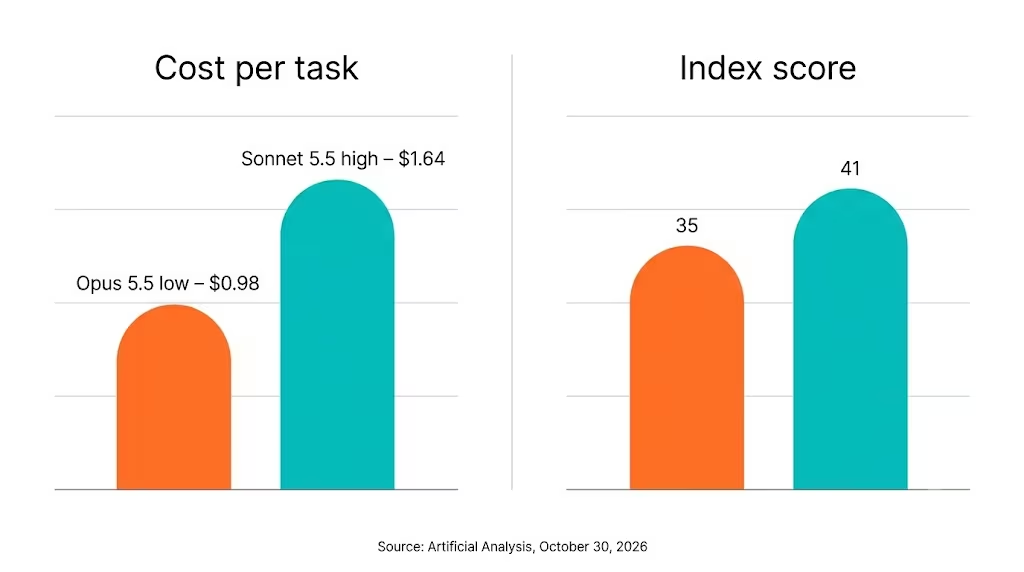
Source: Artificial Analysis, October 30, 2026.
Token usage is only one part of AI agent cost. Retries, tool fees, and hosting also add to the cost. So, look at the cost of the entire run, not just one request.
Wait Time and Output Speed
Sonnet 5.5 at high effort streams faster, but Opus 5.5 at low effort starts sooner and finishes the benchmark tasks much faster. AA reports:
- Output speed: 82 tokens per second for Opus 5.5 low, and 111 for Sonnet 5.5 high.
- Time to first token: 5.14 seconds for Opus 5.5 low, and 10.37 for Sonnet 5.5 high.
- Time per task: 146.68 seconds for Opus 5.5 low, and 337.56 seconds for Sonnet 5.5 high.
Streaming speed alone doesn't tell the full story. AA’s measured time per task is 146.68 seconds for Opus 5.5 low and 337.56 seconds for Sonnet 5.5 high—about 2.24 times longer for Sonnet. Opus also starts answering more than twice as quickly, so it finishes these benchmark tasks sooner despite streaming more slowly.
Anthropic’s guide explains the delay. From medium up, Sonnet thinks before almost every reply, even a greeting. For chat, Anthropic suggests starting at medium or low.
Opus 5.5 also offers a fast mode that runs up to 2.5 times faster. It costs $8 per million input tokens and $40 per million output tokens.
Coding and Agentic Work Compared
Anthropic recommends using Sonnet at high effort for more complex coding tasks and Opus at low effort for simple, repeated tasks.
Coding Tasks
- For agentic coding, Anthropic says to start Sonnet 5.5 at medium for well-specified tasks. Move to high for harder or longer ones.
- At higher effort, Sonnet adds tests, docs, and small files that fit your repo without being asked. One prompt line limits changes to what you requested.
- Anthropic calls Opus 5.5 its strongest Opus model for agentic coding. It traces the root cause before changing code and checks its work as it goes.
- Anthropic suggests using low effort for simple tasks. So, use Opus low for small edits instead of changes that involve multiple files.
Agents and Tool Use
Effort changes how an agent behaves, not only how much it thinks.
- With lower effort, Claude handles more tasks in a single tool call, skips the introduction, and keeps confirmations short.
- At higher effort, it uses more tool calls, explains what it plans to do, and gives longer summaries.
Opus at low effort works well for subagents with simple tasks. Sonnet at high effort is a better fit when a person checks each step, as it provides more detail to review.
Opus 5.5 may give a progress update before the task is finished. If an unattended loop treats that update as a sign of completion, it may stop too soon. Keep a checklist of unfinished tasks to avoid this. If you're new to building agents, start with how to build AI agents from scratch. If the loop runs unattended, a coding agent builder lets you define that checklist and the stopping rule up front.
Where Each Setup Falls Short
Both setups have their downsides. Opus at low effort may not think as deeply, while Sonnet at high effort takes more time and uses more resources.
Opus 5.5 at Low Effort
- Anthropic’s effort table shows the trade-off clearly: fewer tokens are used, but some capabilities are reduced.
- Input-heavy jobs pay Opus’s $4 input rate on every request. Long-document review erodes the savings from short thinking.
Sonnet 5.5 at High Effort
- For the hardest long-horizon work, Anthropic says an Opus model is the better choice.
- Its effort levels were recalibrated after Sonnet 5, so a level no longer produces the same amount of thinking. Rerun your tests instead of carrying settings over.
- It rejects forced tool use and thinking: disabled, which breaks code written for Sonnet 5.
Limits Both Share
- Text between tool calls appears in thinking blocks. Apps that show progress updates won't display them until you change a display setting.
- Both models run safety classifiers, and a declined request returns a refusal stop reason.
- Thinking blocks are tied to the model, per Anthropic’s Sonnet 5.5 release notes. On the Claude API, a chat that moves from Sonnet 5.5 up to Opus 5.5 keeps its reasoning. Moving the other way drops it.
Which Setup Should You Choose?
Opus 5.5 at low effort costs less per task, responds sooner, and finishes benchmarks faster. Sonnet 5.5 at high effort is the better choice when quality matters more.
Quick Decision Table
Anyone asking which Claude model I should use can match the task to a row.
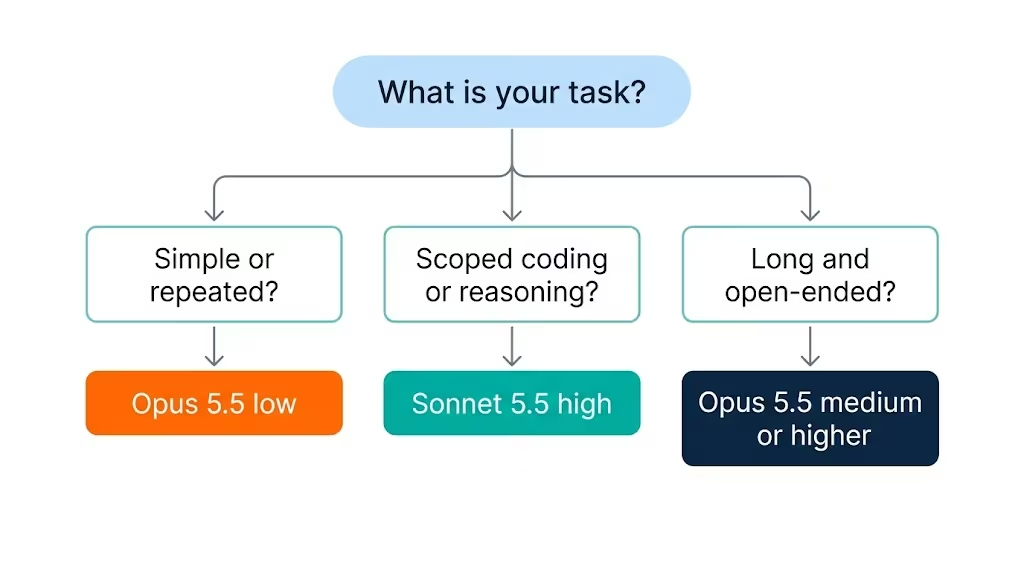
A team that wants to build an internal tool with AI sees both rows. Quick form checks suit the cheaper setup, and the data logic suits the higher-scoring one.
When Neither Setup Fits
- Try Opus 5.5 at medium. It is Anthropic’s default, and in Anthropic’s tests it matches Opus 5 at high on coding and knowledge work.
- For simple, high-volume jobs, read what Claude Haiku 5.5 is. It starts at $0.10 per million input tokens and $0.50 per million output tokens.
- Non-technical readers can skip the API fields. The same trade-off applies in any tool that lists these models, including when you build software without coding.
Test Both on Your Own Work
Anthropic advises running an effort sweep on your own tests. A simple plan:
- Start with 20 to 50 actual tasks from your workflow.
- Use the same prompt for both setups and give each a large max_tokens limit.
- Track how many tasks pass, the output tokens used, the cost, and the time to produce the first token.
- Focus on the cost of each successful task rather than each request.
- Include Opus 5.5 at medium effort in the test so you have a third option to compare.
Conclusion
Sonnet 5.5 at high effort gives you the higher score. Opus 5.5 at low effort gives you the lower cost per task and the faster first word.
Key Takeaways:
- Effort controls how much time a model spends thinking, so the setting matters.
- A model with half the token price won't necessarily cost half as much to complete a task.
- Opus at low effort works well for simple tasks that come up often. Sonnet at high effort is more useful for harder, clearly defined tasks.
- Before settling on either one, try both on the tasks you actually need them for.
Claude Opus 5.5 and Claude Sonnet 5.5 are both live on Emergent. It is an AI app builder that turns a plain-English description into a working, deployable app. Build the same project with each model and compare the results yourself.


Most AI app builders stop at prototypes. Emergent creates production-ready apps you can actually launch.
- Production-ready apps
- Web & mobile apps
- Deploy in minutes