TL;DR
- Shopify: Best for ecommerce brands that want a stronger online store, more sales channels, and room for custom apps.
- Square: Best for local retail, food, beauty, and service businesses that want payments, scheduling, loyalty, and staff tools in one account.
A low monthly price can look great until card fees, hardware, staff tools, and extra locations enter the bill. When this happens, the Shopify vs Square choice gets less obvious.
I reviewed both platforms’ current US pricing, point-of-sale tools, payment fees, hardware, support pages, app options, and recent seller discussions.
Shopify is the better choice for an online-first store. Square is the better choice for a local business that wants to start selling in person with less setup and a lower fixed cost.
Shopify vs Square: What’s the Difference?
Shopify starts with ecommerce and extends into physical retail. Square starts with payments and in-person selling, then adds an online store and business tools.
Choose Shopify when your website is the center of the business. It gives you a full online storefront, a mature checkout, broad sales-channel support, and more than 16,000 apps. Its in-person tools work well, but advanced retail features cost another $89 per month for each POS Pro location.
Choose Square when the counter, appointment book, dining room, or service route comes first. Square Free includes payment tools, a basic website or online store, invoicing, booking, an item library, and banking tools. Square Plus adds loyalty, email and text marketing, staff management, and advanced point-of-sale features for $49 per month per location.
Meet Shopify
Shopify is a commerce platform for selling through an online store, social channels, marketplaces, and physical locations. Every main plan includes a full online store and casual in-person selling.
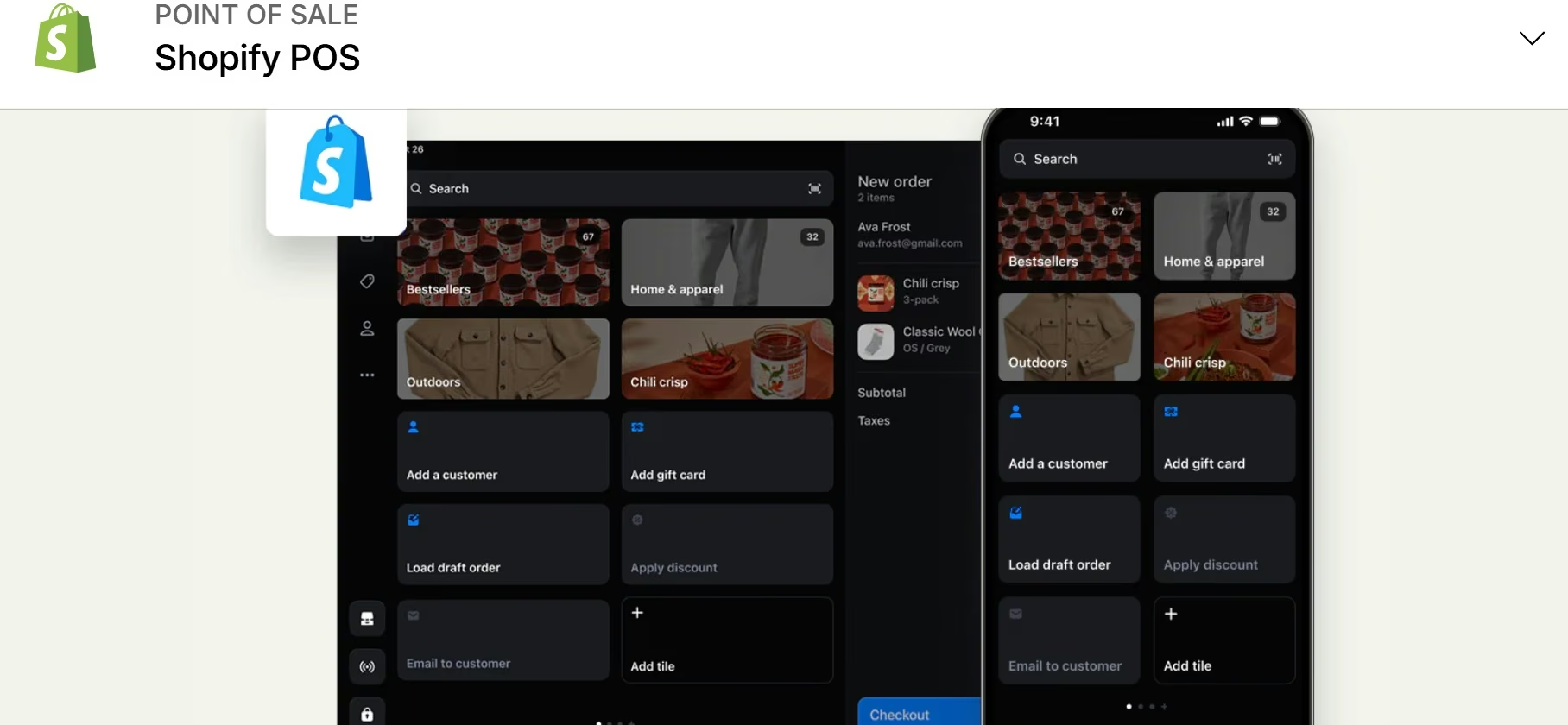
Larger retailers can add POS Pro for staff permissions, cross-location returns, purchase orders, inventory counts, customer profiles, and retail reports.
Shopify Pricing
Basic costs $39/month ($29/month billed annually), Grow costs $105/month ($89/month billed annually), and Advanced costs $399/month ($359/month billed annually).
Plus costs $2,300/month. POS Pro is included for up to 200 locations on Plus; otherwise, it adds $89/month per location and is billed yearly.
Basic is the fair starting point for this comparison because it includes Shopify’s full online store.
Choosing an ecommerce platform depends on your store’s needs, budget, and growth plans, and Best Shopify Alternatives and Competitors looks at the options beyond Shopify.
Meet Square
Square combines payment processing, point-of-sale software, online selling, inventory, invoicing, appointments, loyalty, marketing, team tools, and first-party hardware.
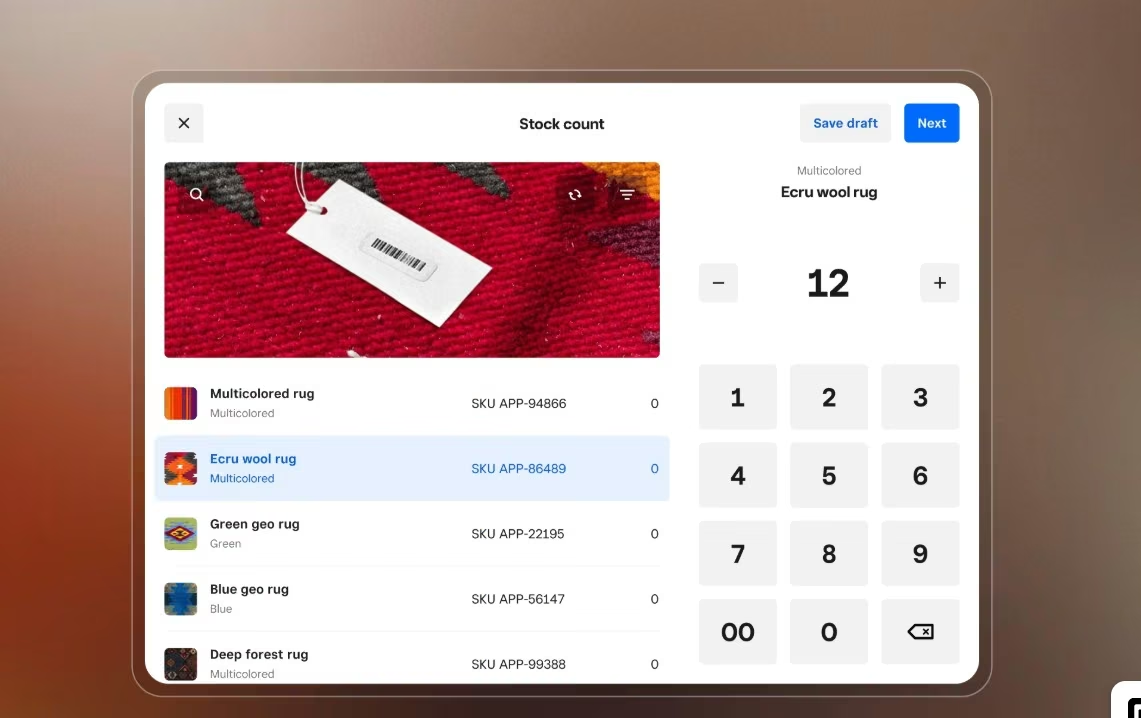
Its current US plan structure was launched in October 2025. Free, Plus, and Premium replaced 18 separate software subscriptions.
Square Pricing
Square Free costs $0/month per location, Square Plus costs $49/month per location, and Square Premium costs $149/month per location. Square Pro has custom pricing for businesses that process more than $250,000 per year.
Square’s public US pricing page doesn’t show a discounted annual-equivalent rate.
Older comparisons may still show a $29 monthly Square Online plan. That is prior pricing. Current US sellers should compare the unified Free, Plus, and Premium plans.
How I Compared Shopify and Square
I used the same five questions for both platforms:
- How much does the first useful setup cost?
- What happens when you sell online and in person?
- Which tools are included before you add apps?
- How does the cost change across locations?
- What becomes harder when the internet drops?
While I didn’t run live card transactions or claim hands-on use, I checked official US pricing, product, hardware, help, and support pages.
I also reviewed a “Shopify POS vs Square POS” Reddit discussion. It showed which problems sellers raised after setup, including weighted products, payout concerns, and industry-specific workflows.
Shopify vs Square at a Glance
The clearest split is online-first versus in-person-first:
| Category | Shopify | Square |
|---|---|---|
| Best for | Ecommerce-led brands | Local and service businesses |
| Free plan | No permanent free plan | Yes |
| Entry paid plan | $39/month ($29/month billed annually)for Basic | $49/month per locationfor Plus |
| Core strength | Online store and sales channels | POS, payments, and bundled local tools |
| Main weakness | Advanced retail adds cost | Online store is less flexible |
| Entry card reader | $49 | $59 |
| Advanced retail software | $89/month per POS Pro location (included for up to 200 locations in Plus) | Included in Plus and Premium |
| App choice | More than16,000 apps | Square App Marketplace |
Pricing and plan features are current for the United States as of July 2026.
Shopify vs Square: Feature-by-Feature Comparison
Pricing and Total Cost
Shopify has a higher fixed starting cost because a full store begins with Basic at $39 per month. Paying annually lowers the effective monthly price to $29.
A permanent retail location that needs POS Pro brings the base software total to $128 per month before card fees and apps.
Square is free per month per location. You pay processing fees when you take a payment.
Square Plus costs $49 per month per location and includes loyalty, marketing, staff scheduling, and stronger industry tools. That bundle can replace several separate subscriptions for a local shop.
Here is a simple cost check for $10,000 in monthly card sales across 200 transactions. It uses standard published US rates and monthly billing. It leaves out hardware, taxes, chargebacks, optional apps, and custom rates.
- In person: Shopify Basic costs about $319 for the month. Square Free costs about $290. Square is $29 lower.
- Online: Shopify Basic costs about $389. Square Free costs about $390. The difference is $1.
- Three advanced retail locations (software only, before card fees): Shopify Basic plus three POS Pro locations run $306 per month in subscriptions. Three Square Plus locations run $147 per month. Add each platform’s processing fees on top, using the same rates as above.
These examples use Shopify Basic rates of 2.6% plus 10 cents in person and 2.9% plus 30 cents online. Square Free charges 2.6% plus 15 cents in person and 3.3% plus 30 cents online. Square Plus lowers those rates to 2.5% plus 15 cents in person and 2.9% plus 30 cents online.
Winner: Square for an in-person-first business. Shopify stays highly competitive when most sales happen online.
If your priorities include both conversion-focused funnels and ecommerce capabilities, ClickFunnels vs Shopify breaks down what each platform is built to handle.
Point-of-Sale Software
Point of sale (POS) is the software and hardware you use to ring up sales, take payments, issue receipts, and track orders.
Shopify includes casual POS features with every paid commerce plan. You can take payments, create basic customer profiles, and handle limited returns.
POS Pro adds unlimited staff logins, staff permissions, richer customer profiles, inventory counts, purchase orders, cross-location returns, and deeper reports.
Square gives you a usable POS on its Free plan. The same account can also handle a basic online store, invoices, appointments, and an item library.
Plus adds advanced POS features for retail, restaurants, appointments, and invoicing, along with loyalty and team tools.
Winner: Square. You can open a small local business with fewer paid add-ons. Choose Shopify POS when the store already runs on Shopify, and shared online and in-store data is the priority.
Ecommerce and Website Tools
Shopify is the stronger ecommerce platform. Basic, Grow, and Advanced include a full online store, themes, unlimited products, checkout, social and marketplace selling, shipping tools, discounts, analytics, and ten inventory locations.
Grow adds five staff accounts. Advanced adds 15 and stronger international selling controls.
Square includes a basic website, online store, ordering profile, or booking site on Free. That covers simple catalogs, pickup, delivery, appointments, and payment links.
It is a practical choice when online sales support the physical business. It gives you less control over store design, international growth, checkout changes, and specialist ecommerce apps.
Winner: Shopify. Pick it when you plan to grow traffic, content, products, channels, or international sales through the website.
Building an online store involves more than choosing a website builder, and Best AI E-Commerce Website Builders to Use in 2026 compares the AI-powered options designed for e-commerce.
Payment Processing
Shopify uses Shopify Payments by default. Basic charges 2.9% plus 30 cents online and 2.6% plus 10 cents in person.
Grow drops those rates to 2.7% plus 30 cents and 2.5% plus 10 cents. Advanced charges 2.5% plus 30 cents and 2.4% plus 10 cents.
You can use a third-party payment provider, but Shopify adds a separate transaction fee of 2%, 1%, or 0.6% on those three plans.
Square processes payments directly. Free charges 2.6% plus 15 cents in person and 3.3% plus 30 cents online.
Plus charges 2.5% plus 15 cents in person and 2.9% plus 30 cents online. Premium charges 2.4% plus 15 cents in person and 2.9% plus 30 cents online.
Manual or card-on-file payments cost 3.5% plus 15 cents on all three plans.
Winner: Shopify for payment-provider choice. Square is simpler when you want one processor and one fee schedule.
Hardware
Shopify sells a Tap and Chip Card Reader for $49, a reader with a dock for $89, and a POS Terminal for $349. A POS Terminal Countertop Kit costs $459.
You can also use a supported phone or tablet and start with Tap to Pay, where available.
Square sells a contactless and chip reader for $59, Square Stand for $149, Square Terminal for $299, Square Handheld for $399, and Square Register for $899.
The first magstripe reader is free for eligible new sellers.
Winner: Square. Its hardware range covers pop-ups, service counters, restaurant tables, mobile staff, and full checkout stations without relying on as many separate pieces.
Inventory and Multi-Location Selling
Shopify keeps products, orders, customers, and stock connected across the online store, retail locations, marketplaces, and other active channels.
Main plans include ten inventory locations. POS Pro adds counts, purchase orders, low-stock alerts, transfers, and detailed retail reports.
Square tracks products and stock on Free. Plus adds stronger retail tools and charges per location.
It works well for a local chain that sells mainly through stores and a supporting website. Businesses with complex product catalogs, heavy online volume, or several external sales channels will find more expansion options on Shopify.
Winner: Shopify for online and multi-channel inventory. Square is easier for a smaller local operation.
Staff, Loyalty, Marketing, and Service Tools
Shopify puts advanced staff permissions and retail profiles inside POS Pro. Loyalty programs, appointment booking, restaurant workflows, and specialist marketing features usually come from apps.
That gives you more choice, but the monthly bill can climb as you add tools.
Square bundles more local-business tools into Plus. You get loyalty, unlimited email campaigns, 500 text messages per month, shift scheduling, attendance tracking, and advanced POS features for food, retail, appointments, and invoicing.
Premium raises the text allowance to 2,500 and adds advanced reports and 24/7 phone support.
Winner: Square. It is the stronger package for restaurants, salons, appointment businesses, and stores that want customer and staff tools under one bill.
Apps and Custom Workflows
Shopify has more than 16,000 apps across marketing, shipping, store design, product sourcing, subscriptions, reviews, search, wholesale, and other categories.
That range gives you more ways to build a specialist store. It also creates a cost trap when the core plan needs several paid apps to support a normal workflow.
Square has an App Marketplace for accounting, delivery, inventory, scheduling, ecommerce, and other third-party connections.
The selection is useful, but it is smaller and more focused on running a local business.
Winner: Shopify. It gives you more paths for custom e-commerce, niche sales models, and long-term expansion.
Offline Selling and Support
Shopify can accept supported card payments offline when you activate the feature, use Shopify POS 9.14 or later, and connect compatible hardware.
Payments are captured after the device reconnects. Shopify recommends reconnecting within 24 hours because an offline card can still be declined. Main plans include 24/7 live chat, with stronger support on higher tiers.
Square also supports offline payments on approved POS modes and hardware. Some devices can take payments for 24 hours and upload them within 72 hours, though Square recommends uploading within 24 hours.
You carry the risk of declined, disputed, or expired offline payments. Square Free has phone support from 6 a.m. to 6 p.m. Pacific Time for the first 90 days. Plus has those hours on weekdays, and Premium has 24/7 phone support.
Winner: Tie. Both can keep a checkout moving through an outage. Shopify gives all main plans round-the-clock chat. Square Premium gives you round-the-clock phone support.
What Real Sellers Are Saying
I reviewed a “Shopify POS vs Square POS” Reddit discussion because it showed a problem that polished comparison pages tend to miss.
The original poster ran a small grocery store with 1,000 to 3,000 products. They worried about weighted-item add-ons on Shopify, payout holds on Square, and the cost of changing hardware. Several replies pushed the seller toward a grocery-specific POS instead of treating Shopify or Square as the automatic answer.
That thread is one discussion, so it can’t represent every seller, but its lessons are useful.
Test your hardest daily task before you switch.
For a grocery store, that might be weighed products, age checks, barcode labels, and supplier orders. For a restaurant, it might be modifiers, table service, kitchen screens, and offline orders. For a clothing store, it might be variants, transfers, exchanges, and stock across channels.
Which Platform Fits Your Business?
Shopify Is Better For
- Your online store produces most of your sales.
- You plan to sell through social channels or marketplaces.
- You need a large app selection.
- You want stronger themes, checkout tools, and international selling options.
- Your physical store supports an existing Shopify business.
- You can justify POS Pro at locations that need advanced retail tools.
Square Is Better For
- Most customers pay in person.
- You run a restaurant, salon, studio, repair business, or local shop.
- You need appointments, invoices, loyalty, marketing, and staff scheduling.
- You want to start without a monthly software fee.
- You prefer Square’s first-party countertop and mobile hardware.
- Your website mainly supports pickup, booking, local delivery, or a simple catalog.
Use Both Only When the Tradeoff Is Worth It
You can connect Shopify and Square through third-party apps, but the two platforms create more inventory checks, payout reports, refunds, and staff training.
Keep both only when you have a clear reason, such as an established Square counter setup and a Shopify store that already drives online sales. Current Shopify App Store connectors can sync products, orders, customers, prices, and inventory between the two platforms. These connectors add another subscription and another place where data can fall out of sync.
For a new business, one platform is usually the cleaner start.
Where Emergent Fits
Emergent is an AI app builder that turns a plain-language prompt into real, working software. It shouldn’t replace Shopify or Square payment processing.
Keep checkout and card data in the commerce platform. Use Emergent when the built-in tools and marketplace apps can’t handle a workflow without awkward workarounds.
For Shopify, that could be a supplier dashboard, a custom reorder system, a wholesale portal, or an order workflow that also sends data to Airtable, Salesforce, Google Sheets, Asana, or Slack. Emergent’s Shopify integration can work with products, orders, customers, inventory, collections, and webhooks.
For Square, that could be a multi-location sales dashboard, a custom customer portal, an inventory alert tool, or a workflow that connects sales data to marketing and shipping services. Emergent’s Square integration can sync orders, payments, inventory, customers, and transaction records through Square’s developer tools.
Once you’ve defined your data model, How to Generate a CRUD App With AI shows how AI can turn those requirements into a working CRUD application.
Final Verdict: Shopify Wins Online, Square Wins in Person
Choose Shopify when ecommerce is the main business. Its website tools, checkout, sales channels, app selection, and shared online and retail inventory give you more room to grow.
Basic is the practical entry plan. POS Pro is worth paying for only at stores that need its advanced staff and inventory tools.
Choose Square when the physical business comes first. Square Free gives a small seller a low-risk start.
Square Plus is the better value for a busy local store, restaurant, salon, or service business that would otherwise pay for separate loyalty, marketing, scheduling, and staff tools.
My direct recommendation is simple. Start with Shopify for an online brand. Start with Square for a local operation.
Don’t choose by subscription price alone. Run your monthly sales through the payment rates, add every location, list the hardware, and price the apps your hardest workflow needs.

Most AI app builders stop at prototypes. Emergent creates production-ready apps you can actually launch.
- Production-ready apps
- Web & mobile apps
- Deploy in minutes