



Kenneth Ngwoke has taught pharmacy at a Nigerian university since 2011 and became a professor in 2021. Outside the lecture hall, he co-owns a pharmacy that operates inside a provision store. His business partner runs the shop day to day, and Kenneth handles the pharmacy side.
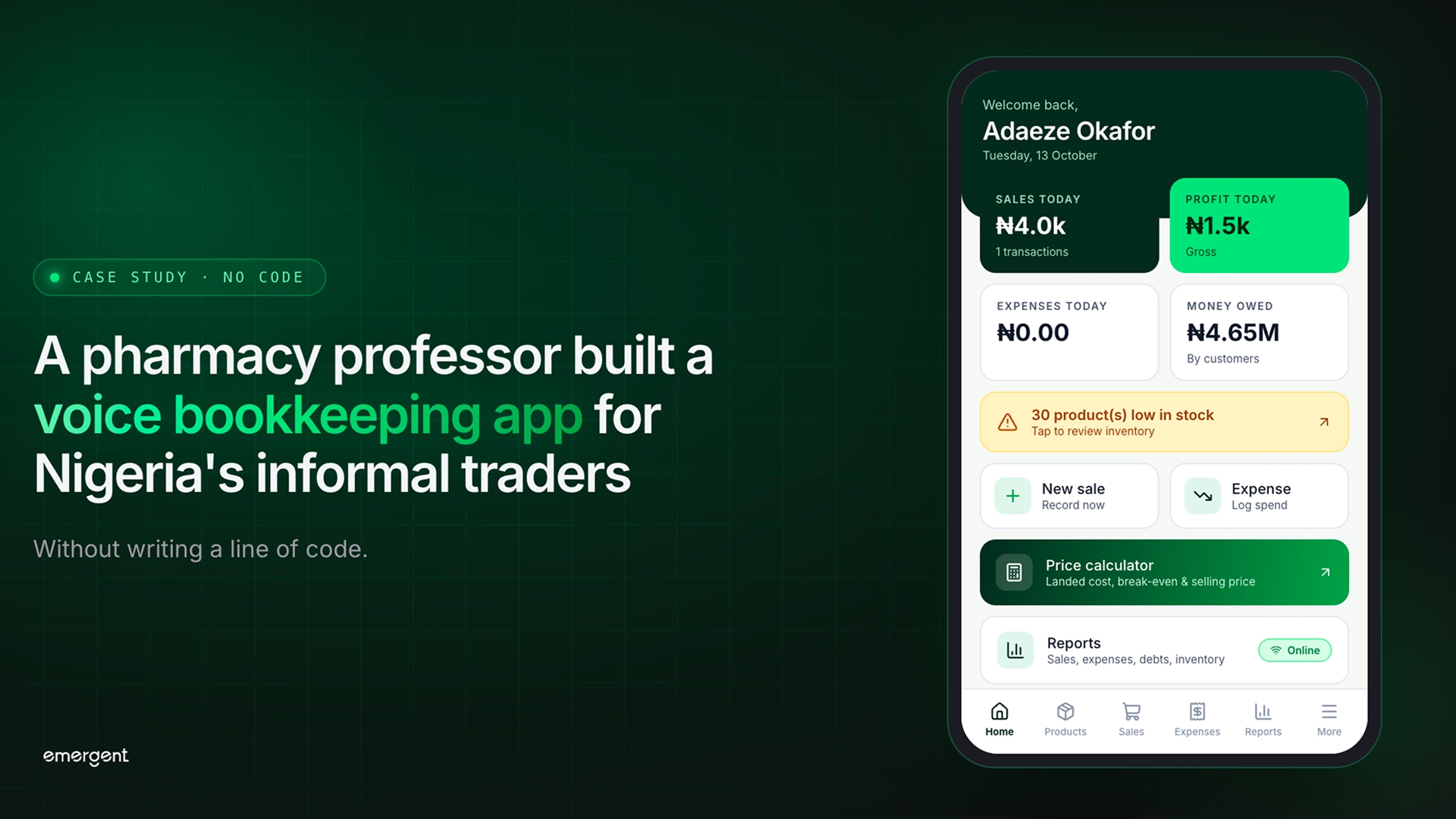
That shop showed Kenneth a problem many small traders in Nigeria share. They sell all day, mostly for cash, and write almost none of it down. Kenneth wanted a way to record each sale in seconds, without making the next customer wait. With Emergent, he built SalesMate NG a voice bookkeeping app to make that possible.
Challenges
Two businesses in one shop, and no way to split the profit
The pharmacy and the provision store share a counter, and money from both went into the same pot. On busy days, Kenneth's partner served many customers at once and couldn't tell which sale belonged to which business. That was a real problem, because the two partners split the profit and needed to know what each side had earned.
Kenneth had already given his partner an online app to type each sale into. But with customers waiting, his partner couldn't stop to type every sale, so he gave up on it. At the end of the business year, the partners had to enter months of sales by hand, three to four months after they happened. Since nothing had been written down at the time, they had to guess. They took the quantities from supplier invoices, added their usual markup, and estimated what they must have sold. Kenneth called it "very messy," and the numbers were never accurate enough to trust.
Pen and paper fail at the counter, and business software was never built for it
Before Kenneth's app, the traders around him kept records in their heads or on paper. Both break down on a busy day. People who write sales down still forget some, and nobody stops serving to take notes. "If there's pressure, you won't leave people who are standing before you to start writing," Kenneth said.
Business software wasn't built for these shops either. Most of it is designed for formal companies that run on computers and barcodes. Someone has to put a barcode on every product before it can be scanned, which adds cost. The person using the system also needs to be comfortable on a computer. Kenneth's partner is only in his 30s, and even he struggled to keep up. "Nobody is caring about this set of traders in the informal sector," Kenneth said.
Strong sales, and nothing to show the bank
Missing records also make it hard for traders to borrow money. Microfinance banks lend to market traders, but they want proof of sales before they approve a loan. Many traders sell millions of naira worth of goods and still have nothing on paper to prove it. Kenneth described the answer they usually get from lenders: "You say you make a lot of money, but there's no evidence to that."
Solution & outcomes
A sales ledger you can talk to
Kenneth built a bookkeeping app for the smartphone most traders already carry. A shopkeeper says the sale out loud, something like "I sold two bottles of Coca-Cola, cash," and the app writes it down, shows the entry, and saves it once they confirm. Then they turn to the next customer. If you want to build an inventory keeping app like Kenneth's, the same approach works for any shop that runs on cash. His version includes:
- Voice entry: Traders log sales by speaking everyday English, and the app handles a wide range of accents.
- Offline typing: With no internet, users type entries by hand and get the same records. Voice entry pauses offline because the app can't yet understand different accents without a connection.
- Stock and profit reports: Every entry updates how much stock is left, what it cost, and the profit made.
- Margin calculation: When a trader adds a new product, the app works out its profit margin.
- Debt tracking: The app lists which customers still owe money.
- Activity log: Owners can see who logged in and what they recorded.
- Lender-ready reports: A trader can pull a report covering three months, four months, or a full year to show a microfinance bank.
Most of these features trace back to what Kenneth watched go wrong at his own shop. He also wanted anyone to be able to use it. "You don't have to be computer literate to do this," he said. "Can you speak a bit of English? That works."
From a hotel website to a voice app, without code
Kenneth's first brush with AI app builders went nowhere. He watched a video about Lovable, created an account, and never got past that. Then Emergent ads started showing up in his feeds, and he gave it a go. "I felt at home with Emergent," he said. "It was easy for me to start using Emergent."
His first project had nothing to do with pharmacy. A new hotel near his apartment had no website or online booking, so Kenneth gathered a few details from the hotel and built a site for it by typing prompts into Emergent. He saved the code to GitHub and got the site working without writing any code himself. A friend who works in tech asked if Kenneth had really built it, then told him to stick to pharmacy and leave tech to the experts. By the time Kenneth showed the hotel, it had already hired a developer. Kenneth still thinks his version looks better.
Around May 2026, he went back to Emergent with the problem from his shop. His first idea was a tool that worked through WhatsApp. After several rounds of plain-English prompts, it grew into a voice app of its own.
$10,000 for an app he wasn't building to win
When Kenneth started building, he had no idea Emergent was running the Fabrizio Romano Builders' Contest, a global contest with a $100,000 prize pool. Partway through, he was told he could enter. When he finished, he found out he was already in, and all he had to do was launch the app. "I was not building the app for the contest," he said. "I was building the app to use."
The contest included a public vote and a pitch interview, so Kenneth campaigned for votes. His business partner, whose messy records had sparked the project, became one of his biggest supporters. He told customers he couldn't keep track of his own sales and asked them to vote because he needed the app. Several people he asked wanted to know when they could start using it too. Kenneth shared third place in the contest and took home $10,000.
Conclusion
Kenneth Ngwoke is a pharmacy professor with no coding background. On Emergent, he built a working bookkeeping app for traders that most business software ignores. The app records a sale in the time it takes to say it and creates reports a lender can check. It won $10,000 before its pilot even began, and his partner keeps asking when they can start using it. Kenneth also plans to feature his win when promoting the university certificate and diploma programs he now leads, as proof that building with AI works.
If your business, or one you know, still keeps its records in someone's head, Kenneth's story shows you can build the fix yourself. He didn't wait for a software company to start caring about cash-based shops, and he didn't hire a developer to turn his idea into an app. He described the problem in plain English, improved it prompt by prompt, and ended up with an app shaped by what he had seen go wrong at his own counter. You know your problem better than anyone, and Emergent turns that knowledge into software.
A build that solves a real problem can pay off in more than one way. Emergent runs AI builder contests throughout the year, often several at once, and Kenneth's $10,000 came from one he entered without even planning to. Build something that matters to you, enter it, and it could win prize money too.
Emergent turns your idea into a full-stack web or mobile app, no coding required.
 No coding required
- Web & mobile apps
- Deploys instantly

on Emergent today




